


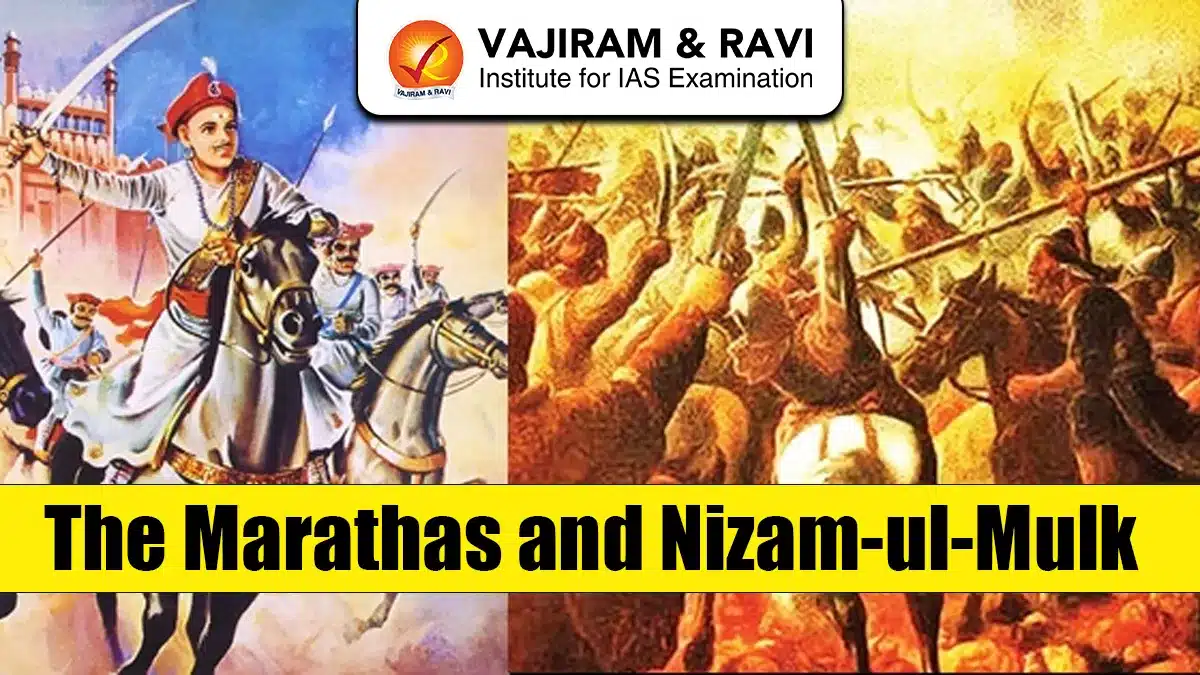
The history of 18th-century India is marked by the rise of regional powers following the decline of the Mughal Empire. Among these powers, the Marathas and Nizam-ul-Mulk played significant roles in shaping the political landscape of the Deccan and northern India. Their interactions, sometimes cooperative and at other times contentious, had long-lasting effects on the subcontinent’s history.
The Marathas
The Marathas were a powerful warrior group that emerged in the western Deccan region under the leadership of Shivaji Maharaj in the 17th century. Initially, they fought against the Mughal Empire to establish their autonomy, but by the 18th century, they had become a dominant force in India.
- Origins and Leadership: The Marathas originated from the western region of Maharashtra. After Shivaji’s death, the Peshwas became the real power behind the Maratha Confederacy.
- Military Prowess: Known for their guerrilla warfare tactics, the Marathas effectively challenged the Mughal forces across the Deccan and northern India.
- Expansion: By the mid-18th century, the Marathas had extended their influence to Malwa, Gujarat, Bundelkhand, and parts of the north, making them one of the most formidable powers of the era.
- Revenue and Administration: The Marathas implemented an efficient revenue system, the Chauth and Sardeshmukhi, which helped finance their military campaigns.
- Cultural Impact: They promoted Marathi language and culture, patronized temples, and strengthened local governance.
Nizam-ul-Mulk
Nizam-ul-Mulk, also known as Asaf Jah I, was the founder of the Hyderabad state in the early 18th century. Originally a Mughal noble, he became the first Nizam of Hyderabad, establishing a semi-independent state in the Deccan.
- Early Life: Born in 1671, he served as a high-ranking officer under the Mughal emperor Aurangzeb before moving to establish his own rule in the Deccan.
- Founding of Hyderabad: In 1724, he declared autonomy over the Deccan, marking the beginning of the Asaf Jahi dynasty.
- Administration: Nizam-ul-Mulk implemented strong administrative structures, efficient tax collection, and maintained a well-organized army.
- Political Strategy: He skillfully balanced relations with the declining Mughal Empire, the Marathas, and other regional powers to maintain his sovereignty.
- Legacy: His governance laid the foundation for Hyderabad’s political and cultural prominence for over two centuries.


Relations between Marathas and Nizam-ul-Mulk
The relationship between the Marathas and Nizam-ul-Mulk was complex, characterized by both conflict and temporary alliances:
- First Encounter: Nizam-ul-Mulk met the young Peshwa Baji Rao for the first time on January 4, 1721. Despite Nizam’s attempts to establish cordial relations, no long-term understanding could be achieved.
- Key Point of Dispute: The most critical dispute between them was over Karnataka. Nizam-ul-Mulk claimed it by right of succession from the Bijapur and Golconda kingdoms, while the Marathas, since Shahji’s time, had considered Karnataka a prime hunting and plunder region under tribute.
- Breakdown of Agreements: Between 1721 and 1724, in Nizam’s absence, his subordinate Mubariz-ul-Mulk violated the Chauth and Sardeshmukhi agreements, igniting hostilities with the Marathas.
- Attempts at Diplomacy: In 1723, on his way to Gujarat, Nizam met Baji Rao in Malwa to maintain peaceful relations. In 1724, when Mubariz-ul-Mulk tried to prevent Nizam from reestablishing authority in the Deccan, Nizam convened a conference with Baji Rao to negotiate.
- Temporary Cooperation: At the Battle of Shakar Khera in 1725, a Maratha contingent actually fought alongside Nizam’s forces, showing that alliances were sometimes pragmatic.
- Rising Tensions: By 1728, Nizam-ul-Mulk was deeply concerned about the expansion of Maratha influence in Malwa and Gujarat. Though he accompanied Shahu on campaigns to Karnataka in 1725 and 1726, he secretly ordered his commander to confront the Marathas.
- Exploiting Maratha Internal Conflicts: Nizam leveraged disputes between the Satara and Kolhapur courts and tensions between Baji Rao and the Pratinidhi. He suspended Chauth and Sardeshmukhi payments, citing a conflict between Shahu and Sambhaji of Kolhapur, and proposed arbitration as the Mughal Emperor’s envoy, attempting to weaken Maratha unity.
- Strategic Maneuvering: Nizam built connections with Kolhapur soldiers and sought to dismiss Baji Rao. Initially, Shahu considered Nizam’s arbitration, but he quickly regained control and recalled Maratha forces, preparing defenses.
- Decisive Conflict – Battle of Palkhed: Baji Rao returned from Karnataka and decisively rejected Nizam’s peace overtures. In a swift and strategic campaign, the Marathas defeated Nizam-ul-Mulk at the Battle of Palkhed on February 7, 1728, showcasing Maratha mobility and military expertise.
- Aftermath – Treaty of Mungi Shevgaon (1728): Following the defeat, Nizam-ul-Mulk acknowledged Shahu’s authority over Deccan Chauth and Sardeshmukhi and pledged not to support Sambhaji of Kolhapur, formalizing Maratha dominance in the region.

 Last updated on Oct, 2026
→ UPSC 2027 Notification will be released on 13 January 2027 at upsconline.nic.in.
→ Check Nobel Prize 2026 Winners List here.
→ Download PIB PRiSM Monthly Magazine 2026 here.
→ Check UPSC Monthly Current Affairs Magazine The Recitals here.
→ Check out the latest UPSC Syllabus here.
→ Download UPSC Model Answers for Mains 2026
→ UPSC Mains Question Paper 2026 is out now for Essay & GS Paper 1, 2, 3 & 4.
→ UPSC Calendar 2027 has been released.
→ Enroll in Vajiram & Ravi’s UPSC Mains Test Series 2027 for structured answer writing practice, expert evaluation, and exam-oriented feedback.
→ Join Vajiram & Ravi’s UPSC Mentorship Program 2027 for personalized guidance, strategy planning, and one-to-one support from experienced mentors.
→ Go through the UPSC Mains Previous Year Papers to enhance your preparation.
→ UPSC has released UPSC Toppers List 2025 with the Civil Services final result on its official website.
→ Also check Best UPSC Coaching in India
The Marathas and Nizam-ul-Mulk FAQs
Q1. Who were the Marathas?+
Q2. Who was Nizam-ul-Mulk?+
Q3. When did the Marathas and Nizam-ul-Mulk first meet?+
Q4. What was the main cause of conflict between them?+
Q5. Did the Marathas and Nizam-ul-Mulk ever fight together?+
Tags: the marathas and nizam-ul-mulk











