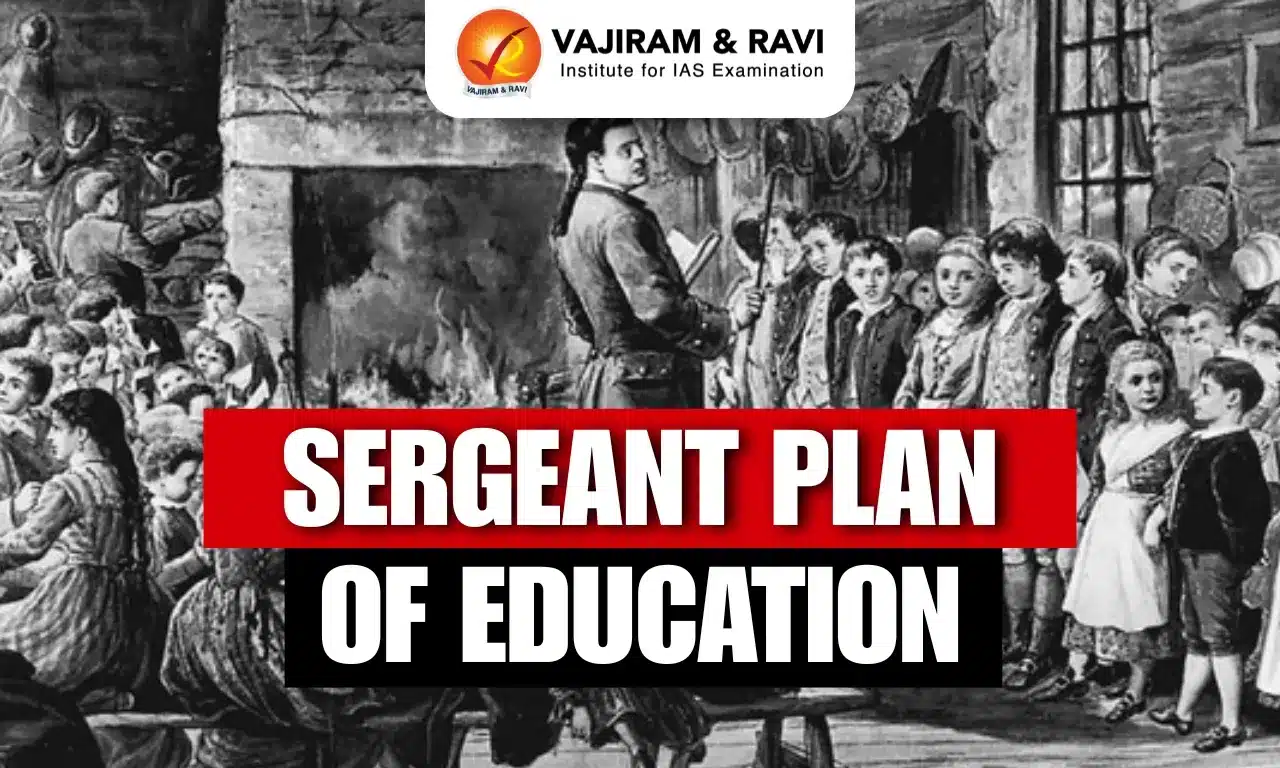
The Sergeant Plan of Education was proposed in 1944 by Sir John Sargent under the British Indian government to comprehensively reform India’s weak education system. It was officially known as Report of the Sargent Commission on Post War Education Development in India. Earlier efforts like the Government of India Resolution 1913, Sadler Commission 1917 and Hartog Committee 1929 failed to ensure universal access and quality.
The Central Advisory Board of Education prepared this plan with a long term national vision. It aimed to systematically develop education from pre-primary to university level, address illiteracy, improve teacher status and create equal opportunities. The plan is also called Sargent’s 40 Year Scheme because it envisioned achieving educational standards comparable to England within four decades.
Sergeant Plan of Education Objectives
The Sergeant Plan of Education aimed to fulfill the below mentioned objectives:
- The plan aimed to reach England’s educational standards in at least forty years through gradual, planned expansion of institutions and trained manpower.
- It sought free and compulsory education for all children to improve literacy, enrollment and retention nationwide.
- It emphasized removing social and regional barriers so that rural, urban and disadvantaged children could access schooling equally.
- It stressed effective teaching, better curriculum relevance and improved learning outcomes rather than mere numerical expansion of schools.
- Education was viewed as essential for producing skilled citizens for administration, industry and post war economic development.
Sergeant Plan of Education Provisions
The major provisions of the Sergeant Plan of Education has been listed below:
- Pre-Primary Education: Recommended organized education for children aged 3 to 6 to build early learning habits before entering formal primary schooling.
- Primary Education: Proposed free and universal education for the 6-11 age group with compulsory attendance to sharply reduce mass illiteracy.
- Secondary Education: Suggested high school education for selected children aged 11-17,
- Divided Secondary Education into Academic and Vocational streams.
- University Education: Recommended a three year university degree after higher secondary education and abolition of the intermediate course for efficiency.
- Vocational and Technical Education: Emphasized skill based training aligned with agriculture, industry and services to support economic needs.
- Teacher Training: Stressed systematic training institutions, better salaries and improved working conditions to raise teacher quality and professional status.
- Adult Education: Aimed to liquidate adult illiteracy within 20 years through organized literacy programs and community based learning initiatives.
- Education for Differently Abled: Included special provisions for physically and mentally handicapped learners to ensure inclusive education.
- Physical Education: Highlighted physical training as essential for healthy development alongside intellectual growth.
- Community Participation: Encouraged local involvement in school management to improve accountability and public ownership of education.


Sergeant Plan of Education Limitations
Despite its comprehensive vision, Sergeant Plan of Education faced several limitations and drawbacks as highlighted below:
- Financial Constraints: The ambitious expansion required massive funding, but wartime pressures and limited colonial resources made adequate financing unrealistic.
- Western Centric Orientation: The plan largely followed English educational models, neglecting indigenous knowledge systems, languages and cultural traditions.
- Teacher Quality Gaps: Rapid expansion emphasized numbers over depth, leading to shortages of well trained teachers and weak professional preparation.
- Limited Social Reach: It failed to fully address deep rural-urban and class disparities, leaving large sections without quality access.
- Implementation Disruptions: Political instability, the end of British rule and Partition severely hindered systematic execution of recommendations.

 Last updated on Sep, 2026
→ UPSC 2027 Notification will be released on 13 January 2027 at upsconline.nic.in.
→ Asian Games 2026 are being held in Aichi-Nagoya, Japan, from 19 September to 4 October.
→ Check out the latest UPSC Syllabus here.
→ Download UPSC Model Answers for Mains 2026
→ UPSC Mains Question Paper 2026 is out now for Essay & GS Paper 1, 2, 3 & 4.
→ UPSC Calendar 2027 has been released.
→ Enroll in Vajiram & Ravi’s UPSC Mains Test Series 2027 for structured answer writing practice, expert evaluation, and exam-oriented feedback.
→ Join Vajiram & Ravi’s UPSC Mentorship Program 2027 for personalized guidance, strategy planning, and one-to-one support from experienced mentors.
→ Go through the UPSC Mains Previous Year Papers to enhance your preparation.
→ UPSC has released UPSC Toppers List 2025 with the Civil Services final result on its official website.
→ Also check Best UPSC Coaching in India
Sergeant Plan of Education FAQs
Q1. Who proposed the Sergeant Plan of Education?+
Q2. Why is the Sergeant Plan of Education called the 40 Year Plan?+
Q3. What age group was targeted for compulsory education in the Sergeant Plan of Education?+
Q4. Which organization developed the Sergeant Plan of Education?+
Q5. What was a major long term goal of the Sergeant Plan of Education?+
Tags: sergeant plan of education