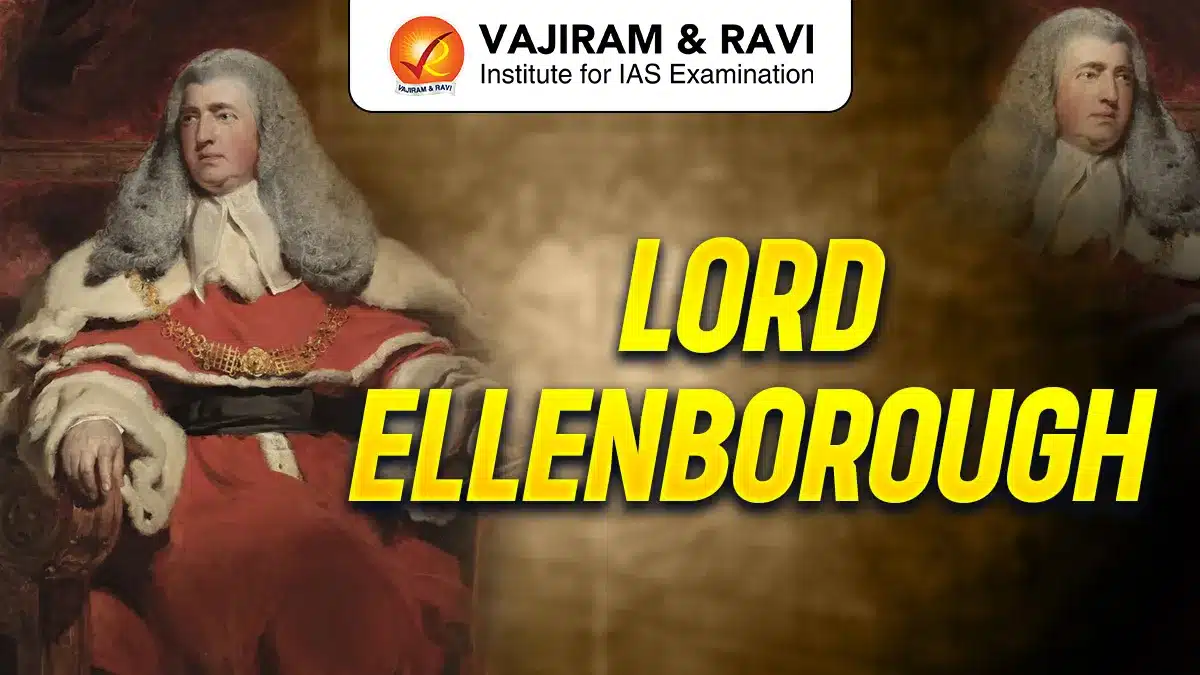
Lord Ellenborough was formally known as Edward Law, 1st Earl of Ellenborough. He was a British Tory politician and administrator who served as Governor General of India from 1842 to 1844. His tenure was unusually short, lasting only two and a half years, yet it was marked by continuous warfare, bold proclamations and controversial decisions. He was sent to India to “restore peace in Asia,” his rule instead became famous for aggressive military actions in Afghanistan, Sind and Gwalior. Ellenborough is famous for decisive but polarising governance.
Lord Ellenborough Biography
Lord Ellenborough was born on 8 September 1790 into a prominent British political family and later became the 1st Earl of Ellenborough. He was a committed Tory politician and served four times as President of the Board of Control, supervising British administration in India. After the failure of Lord Auckland in Afghanistan, Ellenborough was appointed as the Governor General of India in 1842. His tenure ended in 1844 due to conflicts with the Court of Directors, who criticised his authoritarian style and independent decision making.
Read about: Lord Northbrook
Lord Ellenborough Contributions
Lord Ellenborough’s contributions were limited but notable, as most of his tenure was dominated by war and political crises rather than social reform.
- Abolition of Slavery: He formally abolished slavery in British controlled territories, marking a legal step against human exploitation, though practical enforcement remained weak in many regions of India.
- Police Administration Reforms: He improved police efficiency by increasing the pay of darogas and introducing promotion opportunities, aiming to reduce corruption and strengthen local law enforcement.
- Creation of Deputy Magistrates: A new administrative post of Deputy Magistrate was introduced to improve district level governance and reduce administrative overload on senior officials.
- Financial Reforms in Cities: He banned the use of lotteries as a revenue source for urban development in Calcutta, Bombay and Madras, promoting more accountable public finance methods.
- Military Assertion of Authority: Through medals like “Pax Asiae Restituta,” he symbolically asserted British dominance, reflecting his belief that peace could only be achieved through military strength.


Events during Lord Ellenborough Tenure
Lord Ellenborough’s tenure was shaped almost entirely by major political and military events that reshaped British control in the Indian subcontinent.
- Afghan Crisis and Kabul Campaign: When Ellenborough arrived in India, British forces faced disaster after the Kabul massacre and sieges of Ghazni and Jalalabad. He initially ordered a decisive blow against Afghans, leading to the rescue of captives and destruction of central Kabul.
- Release of Dost Mohammad Khan: He released Dost Mohammad Khan from imprisonment in Calcutta and restored him to the Afghan throne at Bala Hissar, reversing earlier British interference in Afghan succession politics.
- Somnath Gates Proclamation: Ellenborough ordered the transport of the Ghazni gates, linked to Mahmud of Ghazni’s 1024 raid, to Agra Fort. This symbolic act, though historically flawed, damaged his credibility and hastened his recall.
- Annexation of Sind in 1843: Despite earlier treaties, conflict with the Amirs of Sind escalated after Ellenborough empowered Sir Charles Napier. Battles of Miani and Hyderabad saw 3,000 British troops defeat around 12,000 Baluchis, leading to full annexation.
- Napier’s Peccavi Message: After Sind’s conquest, Napier famously sent the Latin word “Peccavi,” meaning “I have sinned,” cleverly implying “I have Sind,” symbolising British imperial arrogance during Ellenborough’s rule.
- Control of the Indus River: Following Sind’s annexation, the Indus became a British controlled river from Karachi to Multan, strengthening trade routes and military logistics in north-western India.
- Gwalior Crisis of 1842: Political factionalism and army indiscipline in Gwalior threatened civil war. Ellenborough ordered troop concentration near Sindia’s territory to support the regent installed under British supervision.
- Battles of Maharajpur and Punniar: Fought on the same day, these battles decisively subdued Gwalior’s forces, placing the entire kingdom under British dominance while avoiding direct annexation.
- Recall in June 1844: Exhausted by his aggressive policies and lack of consultation, the Court of Directors exercised its authority to recall him, ending his Governor General tenure abruptly.
- Continued Influence after India: Even after returning to Britain, Ellenborough remained involved in Indian affairs and was later forced to resign in 1858 for authorising publication of a private letter critical of Lord Canning.

 Last updated on Sep, 2026
→ UPSC 2027 Notification will be released on 13 January 2027 at upsconline.nic.in.
→ Asian Games 2026 are being held in Aichi-Nagoya, Japan, from 19 September to 4 October.
→ Check out the latest UPSC Syllabus here.
→ Download UPSC Model Answers for Mains 2026
→ UPSC Mains Question Paper 2026 is out now for Essay & GS Paper 1, 2, 3 & 4.
→ UPSC Calendar 2027 has been released.
→ Enroll in Vajiram & Ravi’s UPSC Mains Test Series 2027 for structured answer writing practice, expert evaluation, and exam-oriented feedback.
→ Join Vajiram & Ravi’s UPSC Mentorship Program 2027 for personalized guidance, strategy planning, and one-to-one support from experienced mentors.
→ Go through the UPSC Mains Previous Year Papers to enhance your preparation.
→ UPSC has released UPSC Toppers List 2025 with the Civil Services final result on its official website.
→ Also check Best UPSC Coaching in India
Lord Ellenborough FAQs
Q1. Who was Lord Ellenborough?+
Q2. What was the economic reform taken under the rule of Lord Ellenborough?+
Q3. How long was Lord Ellenborough’s tenure as Governor General of India?+
Q4. What was the Somnath Gates controversy during Lord Ellenborough?+
Q5. Why was Lord Ellenborough recalled from India?+
Tags: lord ellenborough