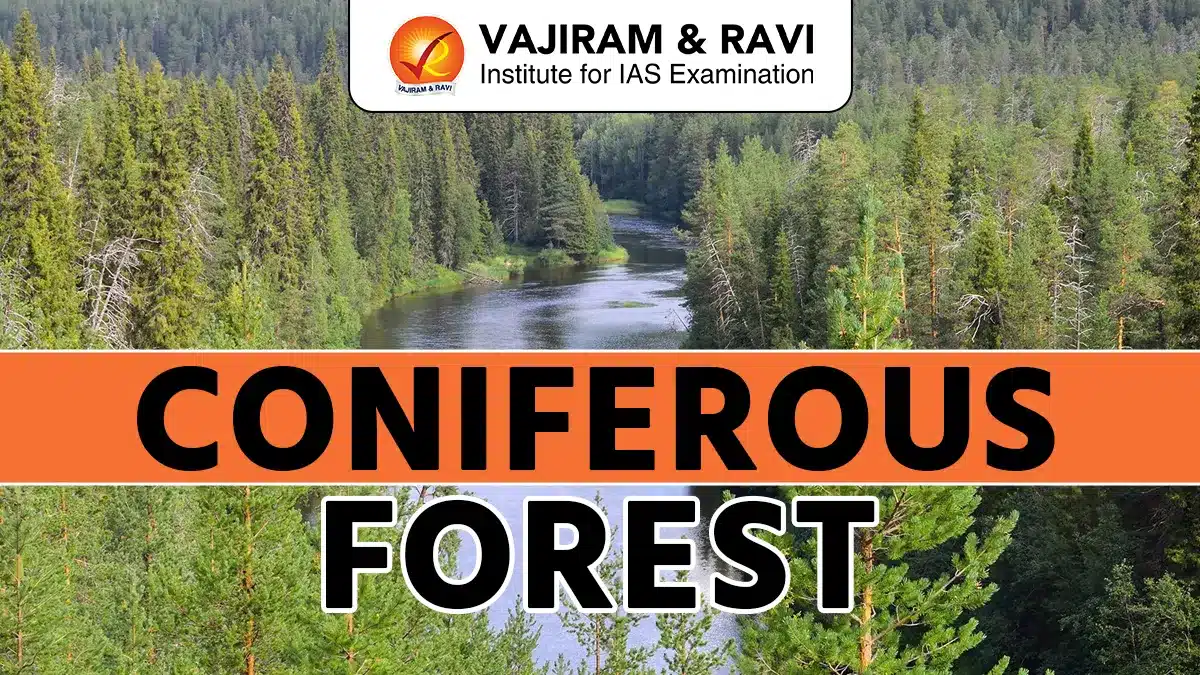
Coniferous forests are one of the most important natural vegetation types of the world. They play a crucial role in maintaining ecological balance, regulating climate, supporting biodiversity, and providing valuable forest products. These forests are mainly found in cold and temperate regions and are dominated by cone-bearing evergreen trees. Due to their wide geographical spread and economic importance, coniferous forests hold special significance in geography and environmental studies.
What are Coniferous Forests?
Coniferous forests are forests dominated by cone-bearing trees such as pine, fir, spruce, cedar, and larch. These trees belong to the group Gymnosperms, meaning their seeds are not enclosed within fruits.
These forests are also known as Taiga forests or Boreal forests, especially in the high-latitude regions of the Northern Hemisphere. They form the largest terrestrial biome in the world and are mainly found in areas with long winters and short summers.
The term Taiga originates from a Russian word that means “land of little sticks” or “primeval forest,” referring to the dense coniferous vegetation of cold regions.
Read about: Types of Forests in India
Coniferous Forest Characteristics
Coniferous forests are dominated by evergreen, cone-bearing trees adapted to cold and temperate climates. Their structure and vegetation are specially suited to survive low temperatures and heavy snowfall. The characteristics of the Coniferous Forest have been shared below.
Tree and Plant Characteristics
- Coniferous forests are dominated by trees such as pine, spruce, fir, and larch.
- These trees have needle-like or scale-like leaves covered with a thick waxy layer to reduce water loss and prevent freezing.
- Most trees are evergreen, allowing them to carry out photosynthesis throughout the year.
- Trees are conical or pyramidal in shape, which helps snow slide off easily and prevents branch breakage.
- The forest floor has sparse undergrowth due to low sunlight penetration and poor soil fertility.
- Mosses, lichens, and small shrubs dominate the lower vegetation layer.
Climate Characteristics
- Coniferous forests experience long, cold, and dry winters and short, cool summers
- Temperature remains low for most of the year, restricting plant growth.
- Precipitation is moderate to high, mostly in the form of snowfall.
- Snow cover protects the soil and plant roots from extreme cold during winter.
Soil Characteristics
- The soil found in coniferous forests is generally acidic and nutrient-poor.
- It is commonly known as podzol soil.
- Decomposition of fallen needles is very slow due to low temperature.
- A thick layer of partially decomposed organic matter called mor humus is formed.
- Due to low fertility, agricultural activity is limited in these regions.


Types of Coniferous Forest
Coniferous forests are classified on the basis of climate, altitude, and geographical location. The major types include Northern (Taiga), Montane, Temperate, Tropical, Sclerophyllous, and Alpine coniferous forests.
- Northern Coniferous Forests (Taiga): Northern coniferous forests, also known as Taiga, are found in the high-latitude regions of the Northern Hemisphere, including Canada, Scandinavia, and Siberia. These forests form the largest terrestrial biome in the world.
- Montane Coniferous Forests: Montane coniferous forests occur in high-altitude mountainous regions across the world. They are characterized by cool temperatures, reduced oxygen levels, and short growing seasons. Common tree species include subalpine fir, Engelmann spruce, and mountain pine.
- Temperate Coniferous Forests: Temperate coniferous forests are found in moderate climatic zones, especially in the Pacific Northwest of North America, parts of Europe, and East Asia. They experience mild temperatures and high rainfall, which supports dense and tall forest growth. Typical species include Douglas fir, western red cedar, and Sitka spruce, often mixed with some broadleaf trees.
- Tropical Coniferous Forests: Tropical coniferous forests occur in high-elevation tropical regions, such as the Sierra Madre Oriental in Mexico. Although located in the tropics, these forests experience cooler temperatures due to altitude.
- Sclerophyllous Coniferous Forests: These forests are found in regions with a Mediterranean-type climate, such as California, central Chile, and parts of Australia. They are characterized by dry summers and wet winters. Vegetation includes Monterey pine, cypress, and other drought-resistant, hard-leaved plants adapted to water scarcity.
- Alpine Coniferous Forests: Alpine coniferous forests occur in high-altitude alpine and subalpine zones above the treeline. They face extreme cold, strong winds, and heavy snowfall. Trees such as whitebark pine and alpine fir grow in stunted, wind-shaped forms to survive harsh conditions.
Read about: Tropical Evergreen Forests
Major Coniferous Forest Regions of the World
Coniferous forests are mainly distributed in the Northern Hemisphere, especially in cold and temperate climatic zones. These forests form the largest forest belt of the world and play a vital role in global climate regulation.
- North American Coniferous Region: This region includes Canada, Alaska, and the northern United States. It forms a major part of the Taiga belt, dominated by pine, spruce, and fir trees. The climate is extremely cold with long winters, and the forests are an important source of softwood timber.
- European Coniferous Region: Found mainly in Scandinavia (Norway, Sweden, Finland) and parts of northern Europe. These forests experience cold winters and short summers and are dominated by spruce and pine. They support timber, paper, and pulp industries.
- Siberian Coniferous Region (Asia): Located in Russia and Siberia, this is the largest continuous coniferous forest belt in the world. The climate is extremely harsh, with long freezing winters. Larch, pine, and spruce are the dominant tree species.
- East Asian Coniferous Region: Found in northern China, Japan, and parts of Korea. These forests grow in temperate climatic conditions and include species such as pine, fir, and cedar. They are often mixed with deciduous forests.
- Mountain Coniferous Regions: These forests occur in high-altitude areas of major mountain ranges such as the Himalayas, Alps, Rockies, and Andes. They are dominated by deodar, chir pine, silver fir, and spruce and play a key role in soil conservation and water regulation.
- Temperate Coastal Coniferous Region: Found along the Pacific coast of North America, especially in the USA and Canada. This region receives high rainfall and supports very tall trees like Douglas fir, redwood, and western hemlock.
Difference Between Coniferous and Deciduous Forests
Coniferous forests consist mainly of evergreen, needle-leaved trees adapted to cold climates, while deciduous forests are dominated by broad-leaved trees that shed their leaves seasonally. The Difference Between Coniferous and Deciduous Forests has been tabulated below.
| Difference Between Coniferous and Deciduous Forests | |
| Coniferous Forests | Deciduous Forests |
|
Location & Climate: Found mainly in cold and temperate regions with long winters and short summers. |
Location & Climate: Found in tropical and temperate regions with moderate to warm climate and distinct seasons. |
|
Leaves & Trees: Dominated by evergreen trees with needle-shaped or scale-like leaves that reduce water loss and resist frost. |
Leaves & Trees: Dominated by broad-leaved trees that shed leaves seasonally to conserve water during dry or cold periods. |
|
Reproduction: Trees bear cones instead of flowers or fruits; seeds develop inside cones. |
Reproduction: Trees bear flowers and fruits, supporting seed dispersal by animals and wind. |
|
Soil & Fertility: Soil is acidic, nutrient-poor, and slow to decompose due to cold climate and needle litter. |
Soil & Fertility: Soil is fertile and rich in humus because of fast decomposition of fallen broad leaves. |
|
Biodiversity & Undergrowth: Low biodiversity with sparse undergrowth; mosses, lichens, and shrubs dominate. |
Biodiversity & Undergrowth: High biodiversity with dense undergrowth; shrubs, herbs, and climbers are abundant. |
|
Economic Importance: Major source of softwood timber, paper, and resin; helps in carbon storage. |
Economic Importance: Provides hardwood timber, medicinal plants, fruits, and fuelwood; supports diverse wildlife. |
Coniferous Forest Importance
Coniferous forests are vital for maintaining ecological balance, supporting biodiversity, and regulating global climate. They also provide valuable resources for human use, including timber, paper, and other forest products.
1. Environmental Importance
- Climate Regulation: Act as major carbon sinks, reducing atmospheric CO₂ and mitigating climate change.
- Soil Conservation: Tree roots prevent soil erosion, especially in mountainous and sloped regions.
- Hydrological Cycle: Forests help maintain water balance by regulating rainfall runoff and groundwater recharge.
- Biodiversity Support: Provide habitat for cold-climate wildlife such as moose, bears, lynx, and various bird species.
2. Economic Importance
- Timber Production: Source of softwood for construction, furniture, and industrial use.
- Paper and Pulp Industry: Conifers are the primary source of raw material for paper manufacturing.
- Resins and Products: Produce resin, turpentine, and other medicinal or industrial products.
- Fuelwood: Provides wood for heating and energy in cold regions.
3. Ecological Importance
- Carbon Storage: Help in long-term carbon sequestration, contributing to global climate stability.
- Air Quality Improvement: Release oxygen and absorb pollutants, improving air quality.
- Buffer Against Climate Extremes: Reduce temperature fluctuations and protect mountain ecosystems from avalanches and landslides.

 Last updated on Oct, 2026
→ UPSC 2027 Notification will be released on 13 January 2027 at upsconline.nic.in.
→ Check Nobel Prize 2026 Winners List here.
→ Download PIB PRiSM Monthly Magazine 2026 here.
→ Check UPSC Monthly Current Affairs Magazine The Recitals here.
→ Check out the latest UPSC Syllabus here.
→ Download UPSC Model Answers for Mains 2026
→ UPSC Mains Question Paper 2026 is out now for Essay & GS Paper 1, 2, 3 & 4.
→ UPSC Calendar 2027 has been released.
→ Enroll in Vajiram & Ravi’s UPSC Mains Test Series 2027 for structured answer writing practice, expert evaluation, and exam-oriented feedback.
→ Join Vajiram & Ravi’s UPSC Mentorship Program 2027 for personalized guidance, strategy planning, and one-to-one support from experienced mentors.
→ Go through the UPSC Mains Previous Year Papers to enhance your preparation.
→ UPSC has released UPSC Toppers List 2025 with the Civil Services final result on its official website.
→ Also check Best UPSC Coaching in India
Coniferous Forest FAQs
Q1. What are coniferous forests?+
Q2. Where are coniferous forests found?+
Q3. Why are they called Taiga?+
Q4. What are the main trees in coniferous forests?+
Q5. What is the economic importance of coniferous forests?+
Tags: coniferous forest geography