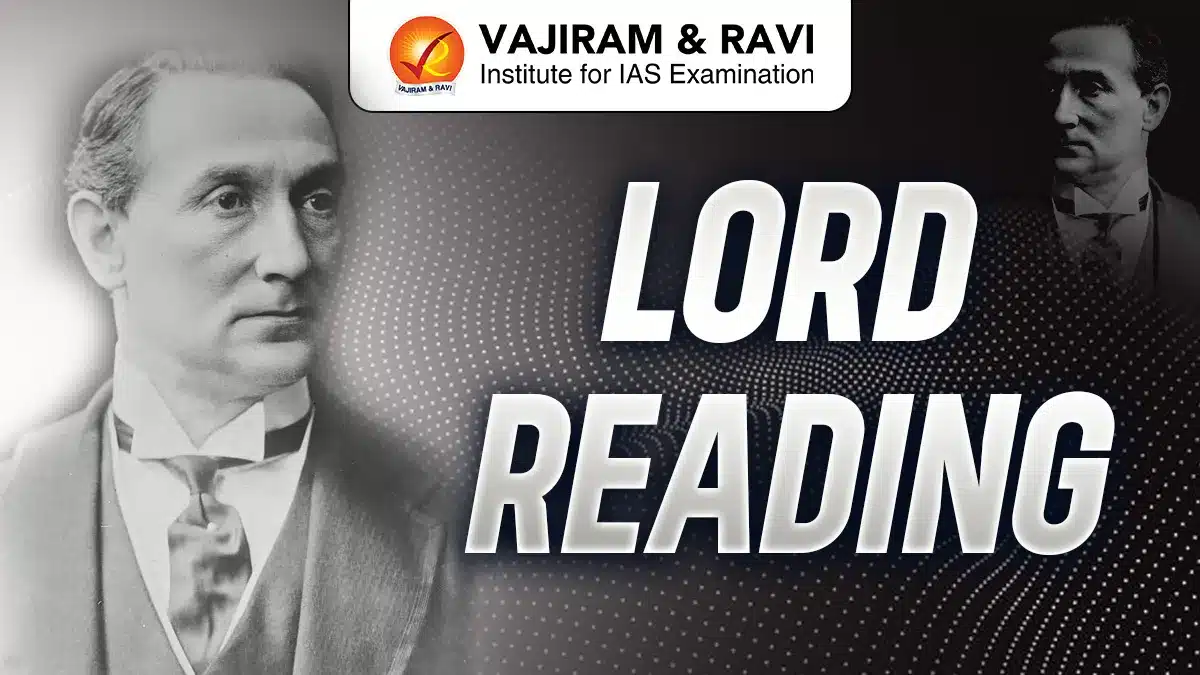
Lord Reading, formally known as Rufus Daniel Isaacs, was one of the most remarkable figures in British imperial and legal history. He rose from a modest Jewish family background to hold some of the highest offices of the British Empire. He served as Lord Chief Justice of England, Viceroy and Governor General of India from 1921 to 1926 and later as Foreign Secretary.
Lord Reading Biography
Lord Reading was born on 10 October 1860 in London, England to a Jewish fruit importer from Spitalfields. After the completion of his education, he entered the family business at 15 and worked as a ship’s boy and stock exchange jobber before studying law. He entered politics as a Liberal, became Attorney General in 1910, Lord Chief Justice in 1913 and in 1921 assumed office as Viceroy of India. He participated in several hunting events organised by Rana Rulers in Nepal. He died at the age of 75 on 30 December 1935 in London, England.
Lord Reading Contributions
Lord Reading’s contributions spanned law, politics, imperial governance and diplomacy, marked by attempts to balance reform, authority and stability during periods of unrest.
- Implementation of Government of India Act 1919: As Viceroy, he actively worked to enforce the Montagu Chelmsford Reforms, introducing dyarchy in provinces and expanding Indian participation in administration while maintaining British control at the centre.
- Conciliatory Approach to Indian Leaders: Reading personally engaged with Indian political figures like Mahatma Gandhi and Muhammad Ali Jinnah, aiming to reduce hostility through dialogue rather than relying only on repression.
- Opposition to Racial Discrimination: He opposed overt racial discrimination in administration and public life, believing that exclusion would deepen resentment and hostility toward British rule.
- Relations with Indian Princes: Reading maintained cooperative ties with princely states, though he compelled two maharajas to abdicate when their conduct was deemed incompatible with British standards of governance.
- Imperial Honours and Recognition: During his viceroyalty, he was appointed GCSI and GCIE in 1921 and elevated to GCVO in 1922, reflecting imperial confidence in his administrative capabilities.
- Elevation to Marquess: In 1926, he became the 1st Marquess of Reading, the first commoner to rise to this rank since the Duke of Wellington, symbolising his extraordinary rise in British public life.
- Participation in Constitutional Reforms: He played a key role in Round Table Conferences from 1930 to 1932 and served on the committee drafting the Government of India Act 1935, shaping future constitutional frameworks.


Events during Lord Reading Tenure
Lord Reading’s tenure as Viceroy coincided with intense political unrest, mass movements and revolutionary activity across India.
- Non-Cooperation and Khilafat Movements: His tenure began when Non-Cooperation and Khilafat movements were at their peak, mobilising millions across India through boycotts, strikes and protests against British rule after World War I.
- Arrest of Ali Brothers 1921: In 1921, his government arrested Muhammad Ali and Shaukat Ali, leading Khilafat leaders, to curb growing Muslim mobilisation and prevent the movement from merging fully with revolutionary nationalism.
- Malabar (Moplah) Rebellion 1921: The Moplah Muslims of Malabar rose against British authority after Congress and Khilafat meetings were banned, which soon turned into a violent communal conflict between tenant Moplahs and Hindu landlords, forcing the government to create the Malabar Special Police to suppress it.
- Prince of Wales Visit 1921: The visit of the Prince of Wales in 1921 faced nationwide hartals and boycotts, reflecting widespread hostility toward British authority during Reading’s early viceroyalty.
- Chauri Chaura Incident 1922: In February 1922, violent protesters in Chauri Chaura burned a police station, killing 22 policemen, which led Mahatma Gandhi to withdraw the Non-Cooperation Movement and prompted the colonial government to impose severe punishments. Following the withdrawal of Non-Cooperation, Lord Reading’s administration arrested Gandhi on charges of sedition, sentencing him to six years’ imprisonment, marking a decisive shift from conciliation to repression
- Suppression of Sikh Unrest in Punjab 1922: The government used force to suppress Sikh agitation in Punjab, reflecting British fears that religious movements could destabilise northern India during a volatile period.
- Visit to Amritsar: Reading visited Amritsar as a symbolic gesture of reconciliation after the 1919 massacre, attempting to rebuild trust between Indians and the colonial government.
- Civil Services Reforms 1923: The Royal Commission on Superior Civil Service in India was established in 1923 which laid several reforms on civil services.
- Formation of Swaraj Party 1923: After the suspension of mass movements, leaders like Motilal Nehru and C R Das formed the Swaraj Party to enter legislative councils under the Government of India Act 1919 and press for reforms from within. Nationalist politics split between Pro-changers (Swarajist) supporting council entry and No-changers emphasizing constructive work under Gandhian leadership philosophy.
- Kakinada Congress Session 1923: At the Kakinada Session, Maulana Mohammad Ali resigned from Congress, highlighting the deepening Hindu-Muslim divide following the withdrawal of mass movements.
- Rise of Communal Organisations: Pandit Madan Mohan Malviya revived the Akhil Bharat Hindu Mahasabha in 1921 and Keshav Baliram Hedgewar founded the Rashtriya Swayamsevak Sangh in 1925, alongside Muslim Tablighi Movements in 1926.
- Peshawar Conspiracy Case 1922-1927: It was the set of 5 legal cases, influenced by the Russian Revolution, several Muslims returning from Moscow were arrested near Peshawar, tried and imprisoned for attempting to spread communist ideology.
- Formation of Communist Party of India 1925: The Communist Party of India was founded in 1925 at Kanpur, Uttar Pradesh.
- Kanpur Bolshevik Conspiracy Case 1924: Leaders like S A Dange, Muzaffar Ahmad, Shaukat Usmani and Nalini Gupta were tried for spreading communist ideology, popularising communism in India through extensive press coverage.
- Communal Violence and Assassinations 1926: Communal riots increased across India, culminating in the assassination of Swami Shraddhanand in Delhi, symbolising entrenched communalism.
- Kakori Train Conspiracy 1925: Members of the Hindustan Republican Association carried out the Kakori train robbery, leading to executions of Ram Prasad Bismil, Ashfaqullah Khan, Rajendra Lahiri and Roshan Singh.

 Last updated on Sep, 2026
→ UPSC 2027 Notification will be released on 13 January 2027 at upsconline.nic.in.
→ Asian Games 2026 are being held in Aichi-Nagoya, Japan, from 19 September to 4 October.
→ Check out the latest UPSC Syllabus here.
→ Download UPSC Model Answers for Mains 2026
→ UPSC Mains Question Paper 2026 is out now for Essay & GS Paper 1, 2, 3 & 4.
→ UPSC Calendar 2027 has been released.
→ Enroll in Vajiram & Ravi’s UPSC Mains Test Series 2027 for structured answer writing practice, expert evaluation, and exam-oriented feedback.
→ Join Vajiram & Ravi’s UPSC Mentorship Program 2027 for personalized guidance, strategy planning, and one-to-one support from experienced mentors.
→ Go through the UPSC Mains Previous Year Papers to enhance your preparation.
→ UPSC has released UPSC Toppers List 2025 with the Civil Services final result on its official website.
→ Also check Best UPSC Coaching in India
Lord Reading FAQs
Q1. Who was Lord Reading?+
Q2. When did Lord Reading serve as Viceroy of India?+
Q3. What major challenges did Lord Reading face in India?+
Q4. How did Lord Reading deal with Mahatma Gandhi in India?+
Q5. What was Lord Reading’s role in Indian administrative reforms?+
Tags: lord reading