Aviation Safety Gaps Latest News
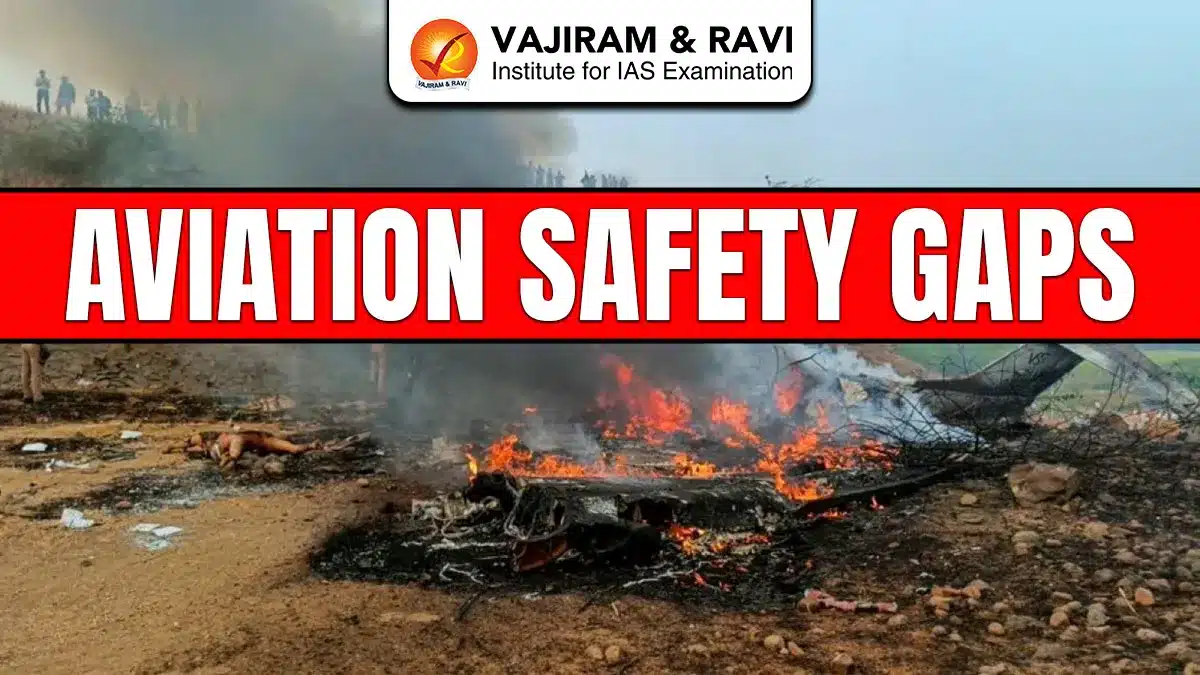
- A plane crash in Baramati that killed Maharashtra Deputy Chief Minister Ajit Pawar has drawn attention to earlier warnings by a Parliamentary Standing Committee about gaps in India’s civil aviation safety framework.
- Months before the accident, a Parliamentary Standing Committee had flagged serious concerns in a report tabled in Parliament in August 2025. The panel cautioned that India’s rapid aviation growth was outpacing regulatory oversight.
- The committee highlighted specific vulnerabilities in the non-scheduled aviation sector, including private jets and charter aircraft. It noted that while this segment has expanded quickly, safety oversight and enforcement mechanisms have not kept pace.
- Drawing a contrast with scheduled commercial airlines, the report observed that airlines operate under highly standardised and tightly regulated systems, whereas private and charter operations show uneven compliance, increasing safety risks.
Private and Charter Aircraft Safety Under Scrutiny
- Concerns Over Maintenance and Safety Practices – The Parliamentary Committee raised concerns about maintenance standards, documentation, and operational controls among non-scheduled operators. It noted that some charter firms operate with small technical and safety teams, which can weaken maintenance planning and oversight.
- Need for Stronger DGCA Oversight – The panel urged the DGCA to step up surveillance of private and charter aircraft through surprise inspections and more frequent, stricter audits to ensure compliance with safety norms.
- Gaps in Operational Support Systems – Unlike scheduled airlines, smaller operators often lack layered operational control centres to support pilots, especially during bad weather or diversions. This absence was flagged as a key safety vulnerability.
- Mandatory Safety Management Systems – The committee called for mandatory and fully functional Safety Management Systems (SMS) across all private operators, stressing that safety processes in the charter segment must be on par with scheduled airlines.
- Flight Planning and Risk Assessment – The report highlighted weaknesses in flight planning, weather assessment, and pre-departure risk evaluation in private operations. It stressed that alternate planning and real-time operational oversight should not be compromised simply because flights are non-scheduled.


Aviation Regulator Under Strain
- The Parliamentary Committee flagged that the DGCA is overburdened, facing manpower shortages and expanding responsibilities that often force it into a reactive approach to safety oversight.
- It recommended strengthening technical staffing, improving training, and adopting data-driven, predictive risk assessment tools.
- The report warned that rapid fleet expansion, new airports, and rising aircraft movements require parallel enhancement of safety surveillance, or else the margin for error in civil aviation will continue to shrink.
ATC Capacity and Fatigue Risks
- Controllers Under Rising Workload – The Parliamentary Committee described Air Traffic Control (ATC) as the backbone of aviation safety and warned that controllers at busy airports are managing dense traffic without matching increases in manpower.
- Fatigue and Human Error Concerns – High workload, especially during peak hours and adverse weather, was flagged as a key risk. The panel noted that fatigue and stress among controllers can significantly raise the chances of human error.
- Need for Staffing and System Upgrades – The committee recommended faster recruitment of ATC personnel, better rostering to limit fatigue, and quicker modernisation of communication, navigation, and surveillance systems.
- Redundancy and Airspace Coordination – It also stressed the importance of system redundancy and smoother civil–defence airspace coordination to ensure safer and more resilient air traffic management.
Learning from Past Aviation Accidents
- Human Factors and Training Gaps – The Parliamentary Committee noted that investigations into past crashes repeatedly highlight human error, training quality, and decision-making under pressure as key factors affecting aviation safety.
- Implementing Safety Recommendations – It stressed that findings and safety advisories from accident probe reports must be systematically tracked and implemented, not merely recorded. A centralised mechanism to monitor compliance with safety recommendations was recommended.
- Upgrading Infrastructure at Smaller Airports – The report also flagged the need to upgrade infrastructure at smaller airports, as operations expand under regional connectivity schemes. Improvements are needed in runway safety areas, navigational aids, and emergency response systems to match rising traffic levels.
Growth Must Not Outpace Aviation Safety
- The Parliamentary panel cautioned that India’s rapid aviation growth must be matched by equal, if not greater, emphasis on safety.
- It warned that expansion without strengthening oversight, ATC capacity, and operator discipline—particularly in private aviation—could heighten systemic risks.

 Last updated on Sep, 2026
→ UPSC 2027 Notification will be released on 13 January 2027 at upsconline.nic.in.
→ Asian Games 2026 are being held in Aichi-Nagoya, Japan, from 19 September to 4 October.
→ Check out the latest UPSC Syllabus here.
→ Download UPSC Model Answers for Mains 2026
→ UPSC Mains Question Paper 2026 is out now for Essay & GS Paper 1, 2, 3 & 4.
→ UPSC Calendar 2027 has been released.
→ Enroll in Vajiram & Ravi’s UPSC Mains Test Series 2027 for structured answer writing practice, expert evaluation, and exam-oriented feedback.
→ Join Vajiram & Ravi’s UPSC Mentorship Program 2027 for personalized guidance, strategy planning, and one-to-one support from experienced mentors.
→ Go through the UPSC Mains Previous Year Papers to enhance your preparation.
→ UPSC has released UPSC Toppers List 2025 with the Civil Services final result on its official website.
→ Also check Best UPSC Coaching in India
Aviation Safety Gaps FAQs
Q1. What aviation safety gaps were flagged after the Ajit Pawar plane crash?+
Q2. Why are aviation safety gaps larger in private and charter aircraft?+
Q3. How does DGCA capacity contribute to aviation safety gaps?+
Q4. What ATC-related aviation safety gaps were identified?+
Q5. Why did the panel warn against growth-driven aviation safety gaps?+
Tags: Aviation safety gaps mains articles upsc current affairs upsc mains current affairs