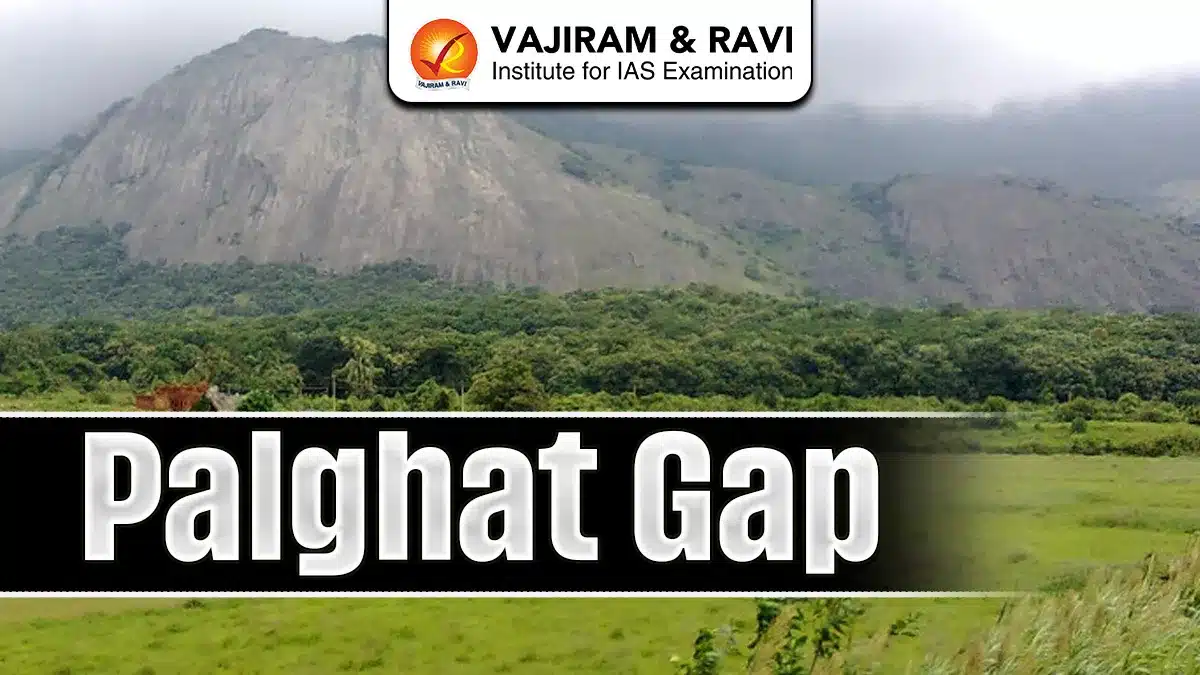
Gaps and passes are natural low lying breaks in mountain ranges that allow movement of winds, rivers, people and wildlife across otherwise high barriers. In the Western Ghats, such gaps play a critical role in shaping climate, ecology and human connectivity.
The Palghat Gap, also called the Palakkad Gap, is the widest and most significant break in this mountain chain. It connects the two states by forming a natural corridor between Tamil Nadu and Kerala. It separates two massive hill systems and influences rainfall, biodiversity distribution, geological stability and historical trade routes across peninsular India.
Palghat Gap Geography
The Palghat Gap is a 40 km wide corridor in the Western Ghats between the Nilgiri Hills and the Anamalai Hills.
- Geographical Location: The Palghat Gap is situated between Coimbatore district of Tamil Nadu and Palakkad district of Kerala, forming the lowest and broadest opening in the Western Ghats mountain system.
- Surrounding Hills: The gap is flanked by the Nilgiri Hills to the north and the Anamalai Hills to the south, both rising above 2,000 meters above mean sea level.
- Width and Elevation: With an approximate width of 40 km, it is the largest discontinuity in the Western Ghats, significantly wider than other mountain passes in peninsular India.
- River System: The Bharathappuzha River, one of Kerala’s longest rivers, flows through this gap, reinforcing its role as a natural east west corridor.
- Vegetation Type: Unlike dense tropical rainforests elsewhere in the Western Ghats, the Palghat Gap supports dry evergreen forest due to lower or seasonally varied moisture availability.
- Transport Corridor: The gap serves as a critical route for National Highway 544 and major railway lines, connecting Kerala’s interior with Tamil Nadu’s industrial regions.
- Historical Trade: Historically, the Palghat Gap hosted Rajakesari Peruvazhi, an ancient highway linking Muziris on the west coast to Arikamedu on the east coast.
- Cultural Exchange: The gap enabled population movement between Chera Nadu and Kongu Nadu, shaping political control, trade networks and cultural exchange in ancient Tamilakam.
- Medieval Migration: Between the 15th and 18th centuries, Tamil Brahmin communities migrated into Palakkad through the gap, influencing regional culture and agrarian systems.
Palghat Gap Origin
The Palghat Gap originated due to ancient continental movements and later shaped human migration and trade routes.
- The formation of the Palghat Gap is linked to continental drift following the separation of Africa and Australia from the Gondwana landmass over 100 million years ago.
- Geological evidence suggests the gap formed when India split from Madagascar, creating a structural weakness similar to Madagascar’s Ranotsara Gap.
- The gap lies along a Precambrian east west shear zone, a deep fracture in the Earth’s crust that prevented the rise of high mountains.
- This shear zone explains why the Western Ghats did not rise continuously here, resulting in a long standing low elevation corridor.


Palghat Gap Features
The Palghat Gap exhibits unique geological, climatic and structural characteristics within the Western Ghats.
- Shear Zone: Geologically, the Palghat Gap is a shear zone, representing a structurally weak segment of the Earth’s crust extending east to west.
- Seismic Sensitivity: The crustal weakness occasionally results in mild tremors felt in the Coimbatore region, indicating ongoing tectonic sensitivity.
- Climatic Channel: The gap allows moist monsoon winds from the Arabian Sea to pass eastward into Tamil Nadu, unlike other parts of the Western Ghats.
- Rainfall: Areas north of the gap receive higher concentrated rainfall, while regions south experience rainfall more evenly distributed throughout the year.
- Wind Corridor: Average wind speeds of 18-22 km per hour make the region suitable for wind energy generation, contributing to renewable power development.
- Thermal Influence: The gap permits hot continental winds from Tamil Nadu to enter Kerala, raising temperatures in eastern Kerala compared to coastal regions.
- Cyclone Pathway: During summer, the gap allows cyclonic systems from the Bay of Bengal to influence Kerala’s interior climate.
Palghat Gap Significance
The Palghat Gap holds immense geographical, ecological, climatic and historical significance for southern India.
- Gateway to Kerala: It has long served as the principal land gateway into Kerala, enabling road, rail and trade connectivity with Tamil Nadu.
- Transport Backbone: Major highways and railway lines pass through the gap, making it one of the most important transport corridors in peninsular India.
- Climatic Moderator: By channeling monsoon winds, the gap moderates temperature extremes and rainfall distribution across Tamil Nadu and Kerala.
- Geological Marker: The gap marks a clear geological boundary within the Western Ghats, separating distinct rock formations and crustal histories.
- Biogeographic Divider: It acts as a natural barrier influencing species distribution, evolution and genetic divergence across the Western Ghats.
- Economic Importance: The corridor supports agriculture, trade, industry and renewable energy development, especially wind power installations.
- Strategic Location: Historically and presently, control over the Palghat Gap has been crucial for political administration and regional integration.
Palghat Gap Biodiversity
The Palghat Gap strongly influences biodiversity patterns, creating distinct floral and faunal assemblages on either side.
Flora
- Vegetation Type: The gap is dominated by dry evergreen forests, differing sharply from the moist evergreen and shola forests of surrounding highlands.
- Species Richness South: South of the gap, the Western Ghats host over 450 tree species, reflecting exceptional species richness and evolutionary depth.
- Ancient Tree Lineages: Species such as Magnolia champaca, known locally as Champa or Sambagan, have existed for over 130 million years.
- Climatic Support: Warm temperatures, proximity to the equator and evenly distributed rainfall sustain long term plant survival and diversification.
- Evolutionary Refuge: During ice ages and drought cycles, southern Western Ghats acted as a refuge for ancient plant species.
Fauna
- Elephant Genetic Divide: Studies show mitochondrial DNA differences between elephant populations north of the gap in Nilgiris and those south in Anamalai and Periyar.
- Bird Species Divergence: IISc Bangalore research found genetic divergence in the White bellied Shortwing across the gap.
- Robin Variations: Nilgiri blue robin and White bellied blue robin populations show visible differences between Ooty and Anamalai hill regions.
- Barrier Effect: The gap limits gene flow for several species, leading to distinct evolutionary paths on either side.
- High Endemism: Southern Western Ghats south of the Palghat Gap exhibit higher phylogenetic diversity and endemism compared to northern sections.

 Last updated on Sep, 2026
→ UPSC 2027 Notification will be released on 13 January 2027 at upsconline.nic.in.
→ Asian Games 2026 are being held in Aichi-Nagoya, Japan, from 19 September to 4 October.
→ Check out the latest UPSC Syllabus here.
→ Download UPSC Model Answers for Mains 2026
→ UPSC Mains Question Paper 2026 is out now for Essay & GS Paper 1, 2, 3 & 4.
→ UPSC Calendar 2027 has been released.
→ Enroll in Vajiram & Ravi’s UPSC Mains Test Series 2027 for structured answer writing practice, expert evaluation, and exam-oriented feedback.
→ Join Vajiram & Ravi’s UPSC Mentorship Program 2027 for personalized guidance, strategy planning, and one-to-one support from experienced mentors.
→ Go through the UPSC Mains Previous Year Papers to enhance your preparation.
→ UPSC has released UPSC Toppers List 2025 with the Civil Services final result on its official website.
→ Also check Best UPSC Coaching in India
Palghat Gap FAQs
Q1. What is the Palghat Gap?+
Q2. Which hills are separated by the Palghat Gap?+
Q3. Why is the Palghat Gap important for climate?+
Q4. Which river flows through the Palghat Gap?+
Q5. Why is the Palghat Gap important for biodiversity?+
Tags: palghat gap