Why in the news?
As part of the continuous Structural reforms in the mining sector undertaken by Government of India to align with the vision of Aatmanirbhar Bharat and Viksit Bharat 2047, the Government has recently notified Coking Coal as Critical and Strategic mineral under the Mines and Minerals (Development and Regulation) Act, 1975 (MMDR Act).
About Critical Minerals
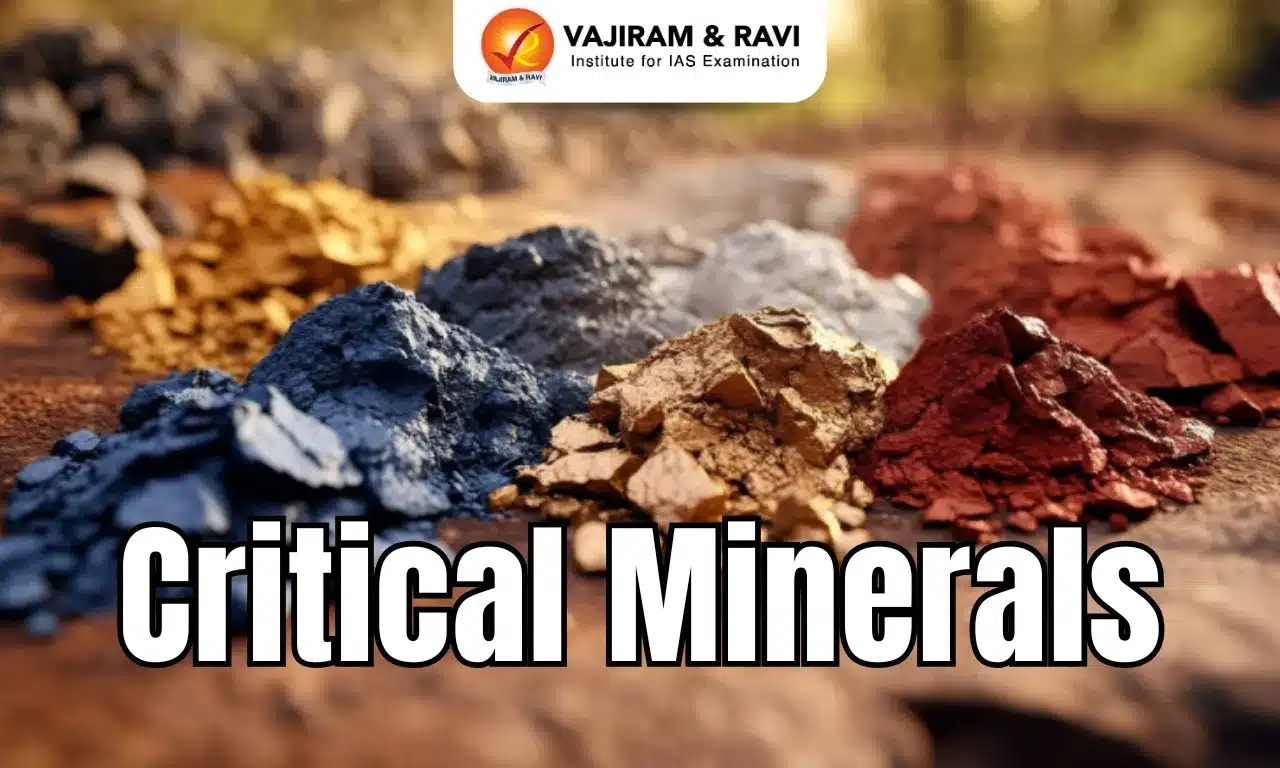
Critical Minerals are the set of minerals which are crucial for national security and latest modern technologies and economic development but due to their lack of availability, geographical concentration, extraction or processing difficulties leads to supply chain disruptions.


Why are they called Critical Minerals?
- The criticality level of minerals are determined by their economic importance and their risk of supply chain disruptions.
- The economic importance depends on the factor of how relevant it is to produce new advanced technologies, while the supply chain vulnerabilities refer to likelihood of shortage due to their geographical scarcity and extraction difficulties.
- The major reason for the mineral supply chain disruptions is that they are present in minimum concentration as by-products of the ‘major’ minerals.
- The other reason for their criticality is the market concentration in the downward processing stage.
- For instance about 40% of global smelting and refining of Cobalt, Lithium, REE and Copper is concentrated in China.
Coking Coal Inclusion Significance
- India accounts for about 37.37 billion tonnes of coking coal, majorly found in Jharkhand, with minor reserves in Madhya Pradesh, West Bengal, and Chhattisgarh.
- However, despite this India saw coking coal imports rising from 51.20 million tonnes in 2020–21 to 57.58 million tonnes in 2024–25.
- At present, around 95% of the steel industry’s coking coal requirement is fulfilled through imports, creating a heavy drain on foreign exchange.
- Now, classifying coking coal as a critical mineral is expected to increase approvals, upgrade ease of doing business, and boost up exploration and mining, including deep-seated deposits.
- Exemptions from public consultation and the use of degraded forest land for compensatory afforestation are also likely to attract greater private sector participation.
Use of Coking Coal
- Essential for steel making: Coking coal is a crucial raw material which is used to produce coke, which is essential for steel production.
- Supports infrastructure growth: Steel which is made using coking coal is crucial for buildings, railways, roads, and defence equipment.
- Economic importance: Reducing dependence on imports can save foreign exchange and strengthen India’s economy.
- Strategic significance: A steady supply of coking coal is crucial for industrial security and self-reliance.
- Employment and investment: Increase in domestic mining can create jobs and can also attract private investment.
Critical Minerals Application
- Energy: They are indispensable for clean energy technologies like solar panels, wind turbines, advanced batteries for energy storage and transportation.
Example: Lithium and Cobalt are used in Lithium ion batteries which are the backbone of Electric vehicles (Evs)
- Modern technologies: Critical minerals are the foundation on which modern technologies are built. Most of the modern digital devices depend on critical minerals for their manufacturing.
Example: the manufacturing of semiconductors, LEDs and modern micro high speed chips.
- Defence and strategic technologies: They are used in advanced military equipment to increase precision, to support R&D and other aerospace weaponry.
Example: the use of Titanium in submarines and fighter jets.
- Medical devices: Critical minerals play a vital role in the diagnostics, advanced medical equipment and implants.
Example: Use in MRI and medical imaging systems.
- Space Technologies: Critical minerals are essential for space missions and nuclear energy infrastructure.
Example: Use of Beryllium in the satellites and space exploration telescope.
Critical Minerals List
The Government of India in 2023 has notified a list of 30 Critical Minerals, which are crucial for India’s economic development, which is as follows:
| Critical Minerals List | ||
| S.No. | Critical Minerals | Application |
|
|
Antimony |
Flame retardants, Lead-acid batteries, Lead alloys, Plastics (catalysts and stabilisers), Glass and ceramics |
|
2. |
Beryllium |
Automotive components: Transport and Defence Manufacturing of Machinery., Electronic and telecommunications equipments |
|
3. |
Bismuth |
Chemicals, Pharmaceuticals, Casting of Iron |
|
4. |
Cadmium |
Batteries, Pigments, Coatings |
|
5. |
Cobalt |
Electric Vehicle, Batteries, corrosion resistant alloys, aerospace applications, Pigments and Dyes |
|
6. |
Copper |
Electrical and electronics products, Electrical Wiring, Solar Panel, Automotive industry |
|
7. |
Gallium |
Semiconductors, Integrated Circuits, LEDs |
|
8. |
Germanium |
Optical fibres, satellites, solar cells |
|
9. |
Batteries, Lubricants, fuel cells for EVs, Electric Vehicle |
|
|
10. |
Hafnium |
Superalloy, Catalyst precursor, Semiconductors, Oxide for Optical, Nuclear reactors |
|
11. |
Indium |
Electronics (Laptops, LED Monitors/TVs, Smartphones), and semiconductors |
|
12. |
Electric Vehicle, Batteries, glassware, ceramics, fuel manufacturing, Lubricant |
|
|
13. |
Molybdenum |
Steel alloys, Pigment and Dyes, Catalyst, Electrical and Electronic |
|
14. |
Niobium |
Construction, transportation |
|
15. |
Nickel |
Stainless steel, solar panels, batteries, aerospace, defence applications and Electric Vehicle |
|
16. |
PGE |
Auto catalyst, Jewellery, medicine, electronic equipment used by military |
|
17. |
Phosphorus |
Mineral fertilizer |
|
18. |
Potash |
Chemical Fertilizers, Water softener |
|
19. |
Rare earth element (REE) |
Permanent magnets for electricity generators and motors, catalyst, polishing, Batteries, Electronics, Defence technologies, wind energy sector, aviation, and Space |
|
20. |
Rhenium |
Super-alloys, aerospace and machinery uses, Catalysts in petroleum industry |
|
21. |
Selenium |
Electrolytic, Manganese, Glass, pigments |
|
22. |
Silicon |
Semiconductors, electronics, and transport equipment, Paints, Aluminum alloys |
|
23. |
Strontium |
Alloys of aluminium, Pigments and Fillers, Glass, Magnets, Pyrotechnic applications |
|
24. |
Tantalum |
Capacitors, Superalloys, Carbides, Medical technology |
|
25. |
Tellurium |
Solar power, thermoelectric devices, Rubber vulcanising |
|
26. |
Tin |
Aerospace, construction, home decor, electronics, jewellery and telecommunications |
|
27. |
Titanium |
Aerospace and defence applications, chemicals and petrochemicals, Pigments, Polymers |
|
28. |
Mill and cutting tools, Mining and construction tools, Catalysts and pigments, Aeronautics and energy uses, tungsten carbide |
|
|
29. |
Vanadium |
Alloys, batteries |
|
30. |
Zircon |
High value chemical manufacturing and electronics sector |
Critical Minerals Vs. Rare Earth Elements (REE)
Critical Minerals are a broad class of minerals, which are crucial for the economy and clean energy of a country with a high supply chain vulnerability. Their classification is determined by their strategic importance, economic availability and supply chain risks.
Rare Earth Elements (REE) are a subset of specific 17 chemically similar elements in the periodic table. They are a part of Critical minerals if deemed strategic importance. They are primarily used in high-performance magnets, electronics and defence, EVs and wind turbines.
Critical Mineral Global Overview
The report by the International Energy Agency provides an outlook for the key energy minerals and rare earth elements.
| Critical Mineral Global Overview | |||
| S.No. | Critical Mineral | Top 3 (Mining Countries) | Top 3 (Refining Countries) |
|
|
|
|
|
|
|
Lithium |
|
|
|
3. |
Nickel |
|
|
|
4. |
Cobalt |
|
|
|
5. |
Graphite |
|
|
|
6. |
REE |
|
|
Critical Mineral Five Pillars Value Chain
For the success of the Critical Minerals in India, there is a need to develop capacity at each stage starting from exploration to recycling.
For the success of the Critical Minerals in India, there is a need to develop capacity at each stage starting from exploration to recycling.
1. Geoscience and Upstream Exploration
- Diverse geological regions of India have been thoroughly mapped by the Geological Survey of India (GSI) to recognize mineral-rich areas known as Obvious Geological Potential (OGP) zones.
- These respective zones hold important minerals such as gold, rare earth elements, nickel, and cobalt. Exploration of minerals is mainly undertaken by MECL and State mining departments.
- Earlier, exploration was mainly focused on bulk minerals like coal and iron ore.
- However, with rising demand for critical minerals the focus has shifted towards deep-seated resources. Reforms such as the MMDR Amendment Act, 2021 and further support from NMET have enabled accelerated participation by the private sector in mineral exploration.
2. Upstream Mining and Extraction
- Mining is the process of separating minerals from the earth through both surface or underground methods, depending on the characteristics of the deposit. These operations often use heavy machinery for drilling, blasting, excavation, and transporting minerals for further processing.
3. Midstream – Processing, Refining and Metallurgy
- Although India has strengthened mineral exploration and manufacturing, intermediate processing and refining still need much attention.
- Developing advanced, environmentally friendly refining technologies is crucial for building a strong critical minerals ecosystem.
- Even though India has capable research institutions, most of the work remains at the laboratory level.
- Increase in funding and pilot-scale support are essential to commercialize innovations and process minerals efficiently from primary sources as well as waste such as used batteries and mine tailings.
4. Downstream – Component Manufacturing & Advanced Technology Production
- Processed critical minerals are used in EV motors, wind turbines, and other advanced products.
- Permanent magnets from rare earth metals are key for electric vehicles and renewable energy.
- India’s Aatmanirbhar Bharat and Make in India programs promote domestic manufacturing and exports.
- The PLI (Production-Linked Incentive) scheme boosts global competitiveness in 13 sectors; 7 key sectors using critical minerals:
- Large-scale electronics (MeitY)
- Electronic/technology products (MeitY)
- Telecom & networking products (DoT)
- White goods like ACs & LEDs (DPIIT)
- High-efficiency solar PV modules (MNRE)
- Automobiles & auto components (DHI)
- Advanced Chemistry Cell batteries (DHI)
5. Material Recovery & Recycling
- Recycling majorly reduces dependence on the primary minerals and assists sustainable development.
- Lithium-ion batteries and other such tech products can be recycled to recover valuable minerals.
- Currently, only steel, lead, copper, and aluminium have significant recycling rates; others have minimal.
- By 2040, recycling is expected to play a major role globally.
- Strong recycling policies and infrastructure are needed to recover minerals from end-of-life products, industrial waste, and post-consumer goods.
Critical Minerals Initiatives taken by the Government
The Government of India has launched several initiatives, such as the National Critical Minerals Mission, overseas mineral asset acquisition, exploration reforms, and recycling policies to ensure secure, sustainable, and diversified access to critical minerals essential for economic growth and energy transition.
Early Policy Recognition (2011)
- The Planning Commission (now NITI Aayog) highlighted the need for assured mineral availability for India’s industrial growth.
- Focus was placed on systematic exploration, efficient management, recycling, overseas acquisition, and R&D for substitutes.
- A list of 12 strategic minerals was identified, including lithium, cobalt, tin, tungsten, rare earths, and others.
Ministry of Mines Initiative
- In 2011, the Ministry of Mines formed a Steering Committee to assess Rare Earth Elements (REEs) and energy-critical minerals.
- The 2012 roadmap emphasized strengthening the entire mineral supply chain from exploration to manufacturing.
Research on Mineral Criticality
- A CEEW study (2016), supported by DST, highlighted weak research on mineral security in India.
- It developed a criticality index for 49 non-fuel minerals and identified 13 minerals as highly critical by 2030, including rare earths, graphite, germanium, and niobium.
Focus on Rare Earth Elements (2017–2020)
- GSI and AMD submitted reports on India’s potential REE deposits and strategies to enhance REE exploration.
- India Exim Bank also stressed the importance of securing REEs for economic and strategic needs.
CSEP Studies on Critical Minerals
- CSEP adopted the EU methodology to identify critical minerals for India.
- Studies (2021–2023) assessed the criticality of 11, 23, and 43 non-fuel minerals based on economic importance and supply risk.
- These studies also projected mineral demand for manufacturing and green technologies.
Critical Minerals in India: Conclusions & Recommendations
- India adopted a three-stage assessment involving global benchmarking, inter-ministerial consultations, and empirical analysis to identify critical minerals. The study reviewed strategies of major economies and shortlisted 69 globally critical minerals, incorporating domestic research inputs. Sectoral consultations ensured alignment with national priorities.
- An EU-style framework based on economic importance and supply risk was proposed, highlighting the need for robust indicators such as import reliance and substitutability. Based on this process, 30 minerals, including two fertilizer minerals, were identified as most critical for India.
- To address supply vulnerabilities, the report recommends establishing a Centre of Excellence for Critical Minerals under the Ministry of Mines. The Centre should focus on advanced exploration, R&D, policy coordination, international collaboration (including KABIL), and periodic updating of the critical minerals list. This would help build a domestic value chain and reduce import dependence in strategic sectors.
UPSC CSE Prelims PYQs
Consider the following statements: [2025]
I. India has joined the Minerals Security Partnership as a member.
II. India is a resource-rich country in all the 30 critical minerals that it has identified.
III. The Parliament in 2023 has amended the Mines and Minerals (Development and Regulation) Act, 1957 empowering the Central Government to exclusively auction mining lease and composite licenses for certain critical minerals.
Which of the statements given above are correct?
- I and II only
- II and III only
- I and III only
- I, II and III

 Last updated on August, 2026
→ UPSC Mains Question Paper 2026 is out now for Essay & GS Paper 1, 2, 3 & 4.
→ UPSC Mains GS Paper 1 2026 is out now.
→ UPSC Mains GS Paper 2 2026 is out now.
→ UPSC Mains GS Paper 3 2026 is out now.
→ UPSC Mains GS Paper 4 2026 is out now.
→ UPSC Mains Indian Language Paper & English Compulsory Paper are out now.
→ Check out the latest UPSC Syllabus 2026 here.
→ UPSC Mains Admit Card 2026 is now out.
→ Enroll in Vajiram & Ravi’s UPSC Mains Test Series 2027 for structured answer writing practice, expert evaluation, and exam-oriented feedback.
→ Join Vajiram & Ravi’s UPSC Mentorship Program 2027 for personalized guidance, strategy planning, and one-to-one support from experienced mentors.
→ Go through the UPSC Mains Previous Year Papers to enhance your preparation.
→ Download UPSC Mains Essay Paper 2025, UPSC Mains GS Paper-I 2025, UPSC Mains GS Paper-II 2025, UPSC Mains GS Paper-III 2025, UPSC Mains GS Paper-IV 2025, UPSC Mains English (Compulsory) Paper 2025, UPSC Mains Hindi (Qualifying) Paper 2025 here.
→ UPSC has released UPSC Toppers List 2025 with the Civil Services final result on its official website.
→ UPSC Calendar 2027 has been released.
→ Also check Best UPSC Coaching in India
Critical Minerals FAQs
Q1. What are critical minerals?+
Q2. Why was Coking Coal declared as Critical Mineral?+
Q3. What are the major applications of critical minerals?+
Q4. How are critical minerals different from Rare Earth Elements (REEs)?+
Q5. Why are critical minerals called “critical”?+
Tags: critical minerals