India-US Trade Reset Latest News
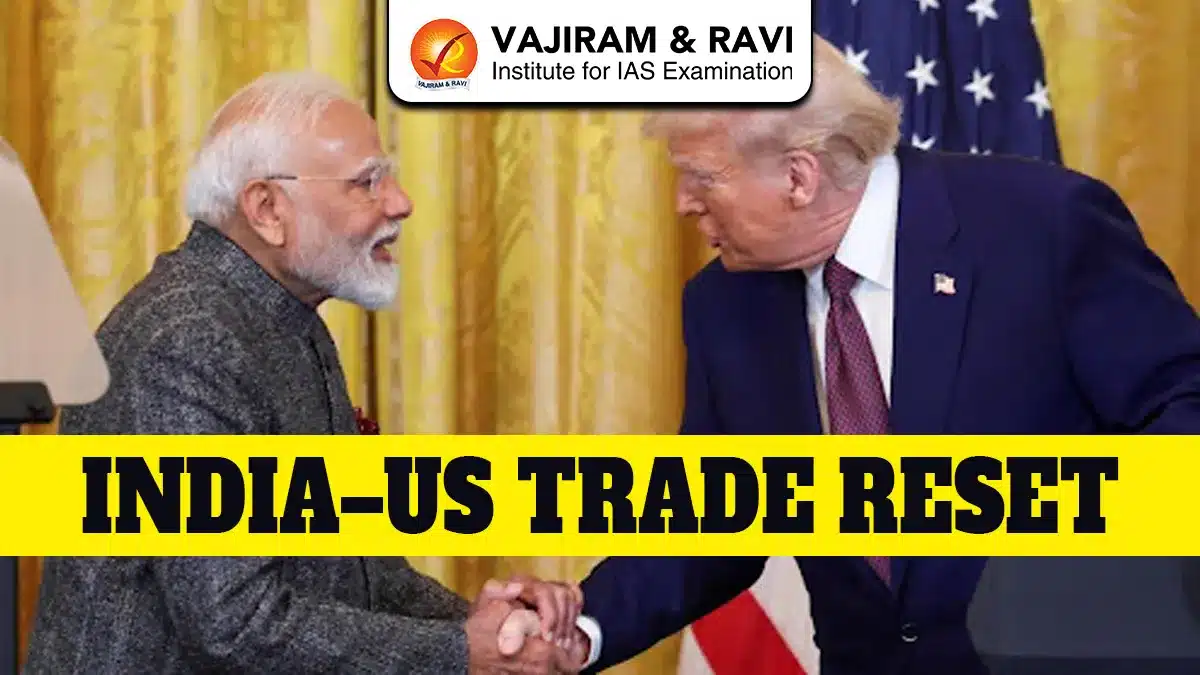
- After months of tariff-driven tensions, India–US economic relations have witnessed a significant thaw following a telephonic conversation between the Indian Prime Minister and the U.S. President.
- The U.S. has agreed to reduce its reciprocal tariff on “Made in India” products to 18%, down sharply from an effective 50% imposed in 2025.
- The announcement signals a possible reconfiguration of India–US trade ties amid global supply chain realignments and geopolitical churn.
Key Developments
- Reduction in U.S. tariffs on Indian goods:
- The U.S. will reduce reciprocal tariffs on Indian exports from 50% to 18%.
- This includes rollback of 25% Liberation Day tariffs, and an additional 25% penalty imposed due to India’s import of Russian oil.
- The Indian PM termed this a boost to Make in India, improving market access for Indian exports.
- Claim of a broader trade deal:
- President Trump announced that India and the U.S. have “agreed” to a trade deal.
- According to Trump, India has committed to reducing tariff and non-tariff barriers on U.S. goods (claimed to be moving towards “zero”), purchasing over $500 billion worth of U.S. products, including –
- Energy (natural gas, coal),
- Technology,
- Agricultural goods, and
- Nuclear equipment.
- For perspective, India’s total goods imports in FY25 were $720.24 billion.
- Energy and geopolitics:
- Trump claimed that India has agreed to stop buying Russian oil, increase imports from the U.S. and potentially Venezuela.
- These assertions have not yet been officially confirmed by India’s Ministry of External Affairs (MEA).
- The claims link trade concessions to broader U.S. strategic objectives, including ending the Russia–Ukraine war.
- Strategic timing and diplomatic context:
- The announcement coincided with External Affairs Minister S. Jaishankar’s visit to the U.S. (Feb 2–4).
- He is participating in the Critical Minerals Ministerial, focused on supply chain resilience, clean energy transition, and reducing dependence on China in critical minerals.
- India, the U.S., and other mineral-rich countries are expected to sign a non-binding framework covering mining, processing, recycling, and pricing mechanisms.


Strategic Significance
- India as a counterweight to China:
- The tariff cut reinforces the U.S. view of India as a strategic ally and counterweight to China.
- With Western economies imposing anti-dumping duties and trade restrictions on Chinese products, India gains a relative advantage in accessing U.S. and EU markets.
- Macroeconomic and market implications:
- The deal was seen as critical amid concerns over capital outflows, pressure on the rupee.
- Expectations include improved investor sentiment, potential strengthening of the rupee, and a positive market response.
- India’s expanding trade footprint:
- With trade arrangements now in place with the U.S., UK, and EU, India is better positioned than many East Asian economies that rely heavily on Chinese investment.
- A tentative thaw in India–China trade relations adds another layer of complexity.
Challenges and Concerns
- Ambiguity in the fine print:
-
- The actual benefits depend on the detailed terms of the agreement, which remain unclear.
- Past experience suggests that U.S. negotiations under President Trump tend to be extractive.
- Energy and strategic autonomy: Any formal commitment to halt Russian oil imports could constrain India’s strategic autonomy and energy security.
- Dependence on China: India’s imports from China exceeded $112 billion last year. China’s dominance in rare earth elements has already impacted Indian sectors such as automobiles.
- Risk of Chinese retaliation: China has warned of consequences if trade agreements are concluded at its expense, raising concerns of indirect economic or supply-chain retaliation.
- Domestic political reactions: The opposition criticised the move, alleging India had “capitulated” under U.S. pressure.
Way Forward
- Clarity and transparency: India must ensure that commitments—especially on tariffs, energy imports, and non-tariff barriers—are clearly defined and mutually balanced.
- Leverage export: Leverage improved access to the U.S. market to boost manufacturing, value-added exports, and employment.
- Supply chain diversification: Use platforms like the Critical Minerals Ministerial to reduce dependence on China.
- Strategic balancing: Maintain autonomy in energy sourcing and foreign policy while deepening ties with the West.
- Domestic capacity building: Align trade gains with Make in India, PLI schemes, and MSME competitiveness.
Conclusion
- The reduction of U.S. tariffs on Indian goods to 18% marks a decisive reset in India–US trade relations and underscores India’s rising strategic relevance in a fragmented global trade order.
- While the move opens significant economic and geopolitical opportunities, its long-term value for India will hinge on the fine print, preservation of strategic autonomy, and the ability to convert improved market access into sustained export-led growth.

 Last updated on Sep, 2026
→ UPSC 2027 Notification will be released on 13 January 2027 at upsconline.nic.in.
→ Asian Games 2026 are being held in Aichi-Nagoya, Japan, from 19 September to 4 October.
→ Check out the latest UPSC Syllabus here.
→ Download UPSC Model Answers for Mains 2026
→ UPSC Mains Question Paper 2026 is out now for Essay & GS Paper 1, 2, 3 & 4.
→ UPSC Calendar 2027 has been released.
→ Enroll in Vajiram & Ravi’s UPSC Mains Test Series 2027 for structured answer writing practice, expert evaluation, and exam-oriented feedback.
→ Join Vajiram & Ravi’s UPSC Mentorship Program 2027 for personalized guidance, strategy planning, and one-to-one support from experienced mentors.
→ Go through the UPSC Mains Previous Year Papers to enhance your preparation.
→ UPSC has released UPSC Toppers List 2025 with the Civil Services final result on its official website.
→ Also check Best UPSC Coaching in India
India–US Trade Reset FAQs
Q1. How does the reduction of U.S. reciprocal tariffs on Indian goods reflect the evolving India-US strategic partnership?+
Q2. What are the economic implications of the India–US trade reset for India?+
Q3. What are the concerns associated with India–US relations?+
Q4. Why is the fine print of the India–US trade deal more important than the headline tariff reduction for India?+
Q5. How does the India–US trade agreement reshape India’s position in global supply chains?+
Tags: india-us trade reset mains articles upsc current affairs upsc mains current affairs