


Death Penalty in India Latest News
- A decade-long study (2016–2025) by the Square Circle Clinic, a criminal laws advocacy group with the NALSAR University of Law (Hyderabad), highlights systemic flaws in death penalty sentencing in India.
- Despite a high number of death sentences awarded by trial courts, appellate courts—High Courts and the Supreme Court—have overturned, commuted, or acquitted the overwhelming majority, pointing to erroneous and unjustified convictions at the trial stage.
- The report is significant for debates on criminal justice reform, due process, Article 21 of the Indian constitution, and capital punishment jurisprudence.
Death Penalty in India
- Meaning: It is a legal punishment for heinous crimes (such as murder, gang rape of minors under 18, terrorism-related offenses), restricted to the “rarest of rare” cases under the IPC and CrPC.
- Confirmation and appellate review: A death sentence passed by a Sessions Court must be confirmed by the High Court. Convicts have a right to appeal to the Supreme Court.
- Exceptions: Death penalties cannot be imposed on individuals who were under 18 at the time of the offense. Executions are generally avoided for pregnant women.
- The Bharatiya Nyaya Sanhita (BNS), 2023: It retains the death penalty for heinous crimes, and is restricted to the “rarest of rare” cases.
- Constitutional aspects:
- Article 21: The death penalty is not inherently unconstitutional, provided the procedure is fair, just, and reasonable (the Supreme Court interpretation).
- Articles 14 and 19: While challenged under these articles, the courts have upheld the constitutionality of capital punishment.
- Clemency powers: Article 72 empowers the President to grant pardons or commute sentences, including death sentences.
- Judicial aspects (Key cases):
- Jagmohan Singh v. State of UP (1973): Upheld constitutionality.
- Bachan Singh v. State of Punjab (1980): Established the “rarest of rare” doctrine.
- Machhi Singh v. State of Punjab (1983): Further refined the guidelines for applying the “rarest of rare” rule.
- Mandatory penalty struck down: The Supreme Court in Mithu v. State of Punjab (1983) declared mandatory death penalties (like Section 303 of the IPC) unconstitutional.
- Judicial discretion: Courts must consider mitigating factors (e.g., age, mental state, potential for rehabilitation) against aggravating factors (e.g., brutality, premeditation).


Key Findings of the Report
- Stark disparity between trial courts and appellate courts:
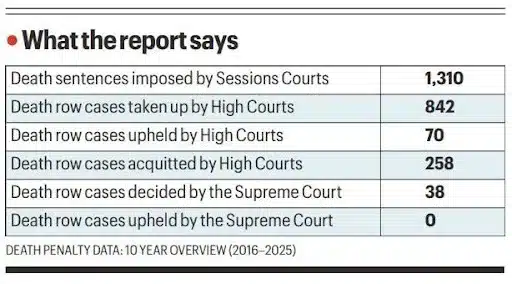
- In 2025 alone: Sessions courts awarded 128 death sentences in 94 cases. High Courts overturned death sentences in almost 90% of cases. Supreme Court acquitted the accused in over 50% of cases (10 out of 19).
- This indicates a pattern, not an aberration, of wrongful or unjustified convictions.
- Growing death row population despite fewer confirmations:
- For example: 574 persons on death row as of December 31, 2025 — the highest since 2016.
- Paradox: Appellate courts increasingly cautious, yet trial courts continue to impose death sentences at scale.
- Supreme Court’s evolving jurisprudence on due process:
- 2022 guidelines: Before imposing a death sentence, trial courts must consider psychological evaluation report, probation officer’s report, and prison conduct records.
- Vasanta Sampat Dupare v. Union of India (2025):
- Death penalty sentencing hearings recognised as an essential component of a fair trial.
- Non-compliance with 2022 guidelines amounts to violation of Articles 14 and 21.
- Enabled reopening of sentencing hearings even after exhaustion of appeals.
- This reflects a constitutional shift towards procedural fairness and mitigation-centric sentencing.
- Persistent non-compliance at Sessions Court level:
- In 2025, trial courts failed to comply with Supreme Court guidelines in 79 of 83 cases (95.18% non-compliance).
- For example, sentencing is often conducted on the same day as conviction (18 cases). Within five days in over two-thirds of cases.
- Such haste prevents collection of mental health and prison records, and effective presentation of mitigating circumstances by the defence.
- Legislative expansion vs judicial retrenchment:
- While the higher judiciary shows restraint, Parliament and state legislatures have expanded the scope of capital punishment over the past decade.
- Reflects a disconnect between legislative intent and judicial application.
- Rise of life imprisonment without remission:
- Appellate courts increasingly commute death sentences to fixed-term or whole-life imprisonment without remission.
- The report flags this as a poorly regulated and arbitrary sentencing category.
- Such sentences remove the possibility of remission, and deprive prisoners of hope, an essential element of human dignity under Article 21.
- Geographical and offence-wise trends:
- States with highest death row population: Uttar Pradesh (highest), followed by Gujarat, Haryana, Maharashtra, Kerala, Karnataka.
- Women: Constituted 4.18% of death row inmates in 2025.
- Major offences: Murder simpliciter, and murder involving sexual offences.
Challenges Highlighted and Way Forward
- Systemic failure of trial courts: To follow constitutional safeguards. Mandatory enforcement of Supreme Court’s 2022 sentencing guidelines.
- High risk of wrongful convictions: Capacity-building and sensitisation of trial court judges on mitigation and sentencing hearings.
- Arbitrary use: Of life imprisonment without remission. Development of a clear statutory framework governing life imprisonment without remission.
- Gap: Between evolving constitutional jurisprudence and ground-level judicial practice. Strengthening legal aid and defence representation in capital cases.
- Legislative push: Towards harsher punishment amid judicial caution. Aligning legislative policy with constitutional values of fair trial, proportionality, and human dignity.
Conclusion
- The report underscores that wrongful convictions in death penalty cases are systemic, not incidental, revealing deep structural flaws in India’s criminal justice system.
- While higher courts have emerged as corrective institutions safeguarding Articles 14 and 21, the persistence of procedural lapses at the trial level and the unregulated rise of harsh alternative sentences demand urgent reform.
- For a constitutional democracy, the legitimacy of capital punishment hinges not merely on legality, but on scrupulous adherence to due process and fairness.
Source: IE

 Last updated on Oct, 2026
→ UPSC 2027 Notification will be released on 13 January 2027 at upsconline.nic.in.
→ Check Nobel Prize 2026 Winners List here.
→ Download PIB PRiSM Monthly Magazine 2026 here.
→ Check UPSC Monthly Current Affairs Magazine The Recitals here.
→ Check out the latest UPSC Syllabus here.
→ Download UPSC Model Answers for Mains 2026
→ UPSC Mains Question Paper 2026 is out now for Essay & GS Paper 1, 2, 3 & 4.
→ UPSC Calendar 2027 has been released.
→ Enroll in Vajiram & Ravi’s UPSC Mains Test Series 2027 for structured answer writing practice, expert evaluation, and exam-oriented feedback.
→ Join Vajiram & Ravi’s UPSC Mentorship Program 2027 for personalized guidance, strategy planning, and one-to-one support from experienced mentors.
→ Go through the UPSC Mains Previous Year Papers to enhance your preparation.
→ UPSC has released UPSC Toppers List 2025 with the Civil Services final result on its official website.
→ Also check Best UPSC Coaching in India
Death Penalty in India FAQs
Q1. What does the high acquittal rate of death row prisoners by appellate courts indicate?+
Q2. How has the SC strengthened due process in death penalty sentencing in recent years?+
Q3. Why is the judgment in Vasanta Sampat Dupare v. Union of India (2025) considered a landmark?+
Q4. What are the key concerns associated with the increasing use of life imprisonment without remission?+
Q5. What institutional contradiction does the report highlight regarding capital punishment in India?+
Tags: death penalty in india








