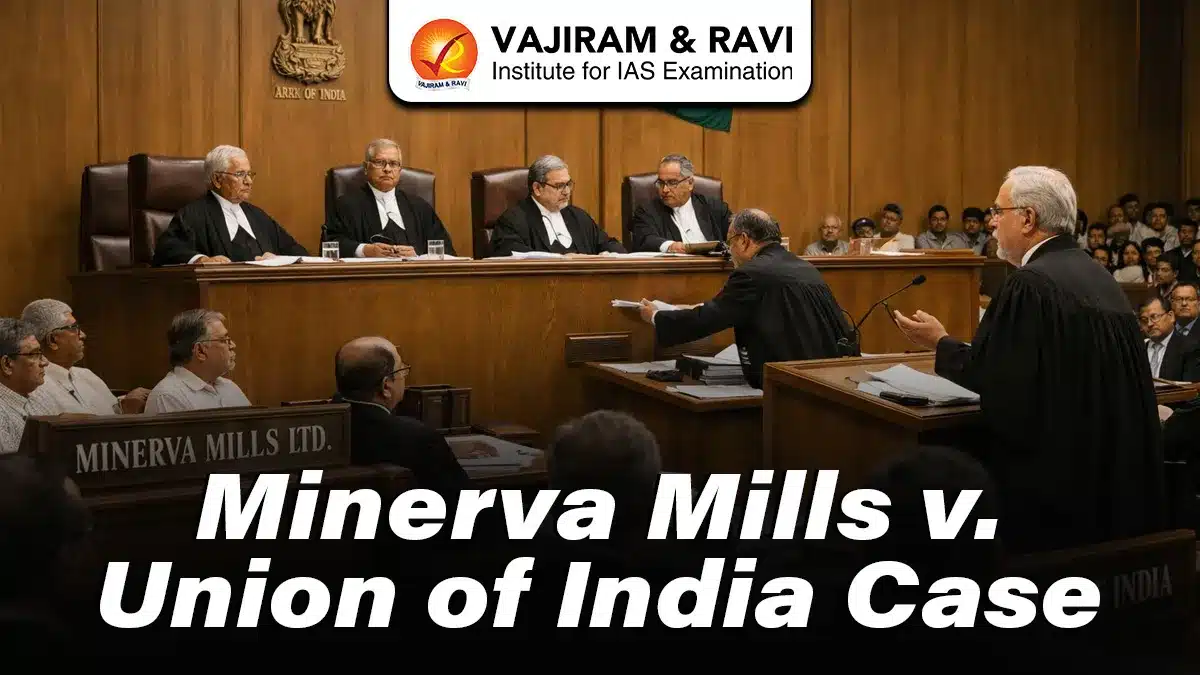
The Minerva Mills v. Union of India Case is one of the most decisive constitutional judgments in India’s legal history. Delivered on 31 July 1980 by a Constitution Bench headed by Chief Justice Y.V. Chandrachud, the case clarified the limits of Parliament’s power to amend the Constitution under Article 368. The Supreme Court firmly ruled that Parliament’s amending power is not absolute and is constrained by the Constitution itself. By striking down key provisions of the 42nd Constitutional Amendment Act 1976, the judgment reinforced constitutional supremacy, judicial review and the balance between Fundamental Rights and Directive Principles of State Policy, forming a lasting safeguard against concentration of power.
Minerva Mills v. Union of India Case Background
The Minerva Mills v. Union of India Case arose from the nationalisation of a private textile company and a constitutional challenge to expansive amendment powers.
- In 1971, Minerva Mills Ltd., a textile undertaking in Karnataka, was taken over by the Central Government.
- Nationalisation occurred under laws addressing sick textile undertakings.
- The company and its shareholders filed a writ petition challenging the takeover.
- The petition questioned the constitutional validity of Articles 31B and 31C.
- Sections 4 and 55 of the Constitution (42nd Amendment) Act, 1976 were specifically challenged.
- These provisions aimed to give Parliament unlimited power to amend the Constitution.
- The case questioned the removal of judicial review over constitutional amendments.
Minerva Mills v. Union of India Case Issues Involved
The Minerva Mills v. Union of India Case focused on whether constitutional amendments could override foundational constitutional principles. Major issues highlighted in this case were:
- Whether Parliament has unlimited power to amend the Constitution under Article 368.
- Whether the 42nd Amendment violated the basic structure doctrine.
- Whether judicial review of constitutional amendments could be excluded.
- Whether amended Article 31C disturbed the balance between Fundamental Rights and Directive Principles.
- Whether nationalisation laws were protected from challenge under Article 31B.


Minerva Mills v. Union of India Case Judgment
The Supreme Court decisively limited Parliament’s amending power and restored constitutional balance in the Minerva Mills v. Union of India Case.
- Limited Amending Power Affirmed: The Court ruled that Parliament’s power under Article 368 is limited and cannot be exercised to destroy or alter the Constitution’s basic framework.
- Invalidation of Article 368(4) and 368(5): Clauses excluding judicial review and declaring unlimited amending power were struck down as unconstitutional and violative of basic structure principles.
- Judicial Review as Basic Feature: The judgment held that judicial review is an essential constitutional mechanism to prevent excesses by constitutional authorities and cannot be removed through amendments.
- Basic Structure Doctrine Reaffirmed: The Court reaffirmed the doctrine evolved earlier, stating that Parliament cannot abrogate or repeal the Constitution under the guise of constitutional amendments.
- Balance Between Parts III and IV: The Court emphasized that Fundamental Rights and Directive Principles are complementary and giving absolute primacy to either would destroy constitutional harmony.
- Section 4 of 42nd Amendment Struck Down: The amendment extending Article 31C to all Directive Principles was invalidated for abrogating Articles 14 and 19 completely.
- Original Article 31C Upheld: The Court upheld Article 31C in its original form, limiting protection only to laws implementing Articles 39(b) and 39(c).
- Constitutional Supremacy Established: The judgment reinforced that the Constitution is supreme and Parliament’s constituent power remains subject to constitutional limitations.
- Protection of Democratic Framework: The ruling ensured preservation of democracy by preventing concentration of unchecked power in Parliament through unlimited amendment authority
Minerva Mills v. Union of India Case Legal Aspects Involved
The judgment for the Minerva Mills v. Union of India Case clarified core constitutional principles governing amendments and governance.
- Article 368 (Amending Power of Parliament)
- Doctrine of Basic Structure
- Judicial Review
- Article 31C (Directive Principles Protection)
- Article 31B (Ninth Schedule Protection)
- Articles 14, 19 and 21 (Golden Triangle)
- Harmony Between Parts III and IV (Fundamental Rights and Directive Principles)
- Article 13 (Limitation on State Action)
- Constitutional Supremacy
- 42nd Constitutional Amendment Act 1976 (Mini Constitution)
What is the Doctrine of Basic Structure?
The Doctrine of Basic Structure is a judicial principle developed by the Supreme Court to limit Parliament’s power to amend the Constitution. It was formally shaped in the Kesavananda Bharati case (1973) to prevent amendments that damage core constitutional features. The doctrine holds that while Article 368 allows amendments, it does not permit destruction of essentials like constitutional supremacy, separation of powers, judicial review, federalism and the balance between Fundamental Rights and Directive Principles. This doctrine preserves democratic governance and prevents concentration of unchecked power.
42nd Constitutional Amendment Act 1976
The 42nd Amendment attempted to expand Parliament’s amending power by removing judicial review and giving Directive Principles absolute primacy over Fundamental Rights. It inserted clauses (4) and (5) in Article 368 and expanded Article 31C, actions later invalidated for violating the Constitution’s basic structure.
Minerva Mills v. Union of India Case Dissent
Justice P.N. Bhagwati partly dissented while agreeing on limits to amending power.
- Partial Agreement on Article 368: Justice P.N. Bhagwati agreed that clauses (4) and (5) of Article 368 were unconstitutional as they destroyed the basic structure.
- Validity of Amended Article 31C: He dissented on Section 4, holding that giving primacy to Directive Principles over Fundamental Rights did not violate the Constitution’s basic structure.
- Emphasis on Social Justice: The dissent viewed Directive Principles as instruments to achieve socio-economic justice and believed their expansion aligned with constitutional goals.
- Flexible Interpretation of Balance: Justice Bhagwati argued that the balance between Parts III and IV need not be rigid and could evolve through constitutional amendments.
- Limited Impact on Fundamental Rights: He maintained that not every infringement of Articles 14 or 19 necessarily damages the Constitution’s basic structure.
- Deference to Legislative Wisdom: The dissent stressed judicial restraint, arguing that Parliament should be allowed wider discretion in pursuing socio-economic reforms.

 Last updated on Sep, 2026
→ UPSC 2027 Notification will be released on 13 January 2027 at upsconline.nic.in.
→ Check out the latest UPSC Syllabus here.
→ Download UPSC Model Answers for Mains 2026
→ UPSC Mains Question Paper 2026 is out now for Essay & GS Paper 1, 2, 3 & 4.
→ UPSC Calendar 2027 has been released.
→ Enroll in Vajiram & Ravi’s UPSC Mains Test Series 2027 for structured answer writing practice, expert evaluation, and exam-oriented feedback.
→ Join Vajiram & Ravi’s UPSC Mentorship Program 2027 for personalized guidance, strategy planning, and one-to-one support from experienced mentors.
→ Go through the UPSC Mains Previous Year Papers to enhance your preparation.
→ UPSC has released UPSC Toppers List 2025 with the Civil Services final result on its official website.
→ Also check Best UPSC Coaching in India
Minerva Mills v. Union of India Case FAQs
Q1. What was the Minerva Mills v. Union of India Case?+
Q2. When was the judgment for Minerva Mills v. Union of India Case delivered?+
Q3. Which provisions of the 42nd Amendment were struck down in the Minerva Mills v. Union of India Case?+
Q4. Who were the judges on the Constitution Bench in the Minerva Mills v. Union of India Case?+
Q5. What impact did the judgment of Minerva Mills v. Union of India Case have on constitutional amendments?+
Tags: indian poility minerva mills v. union of india case