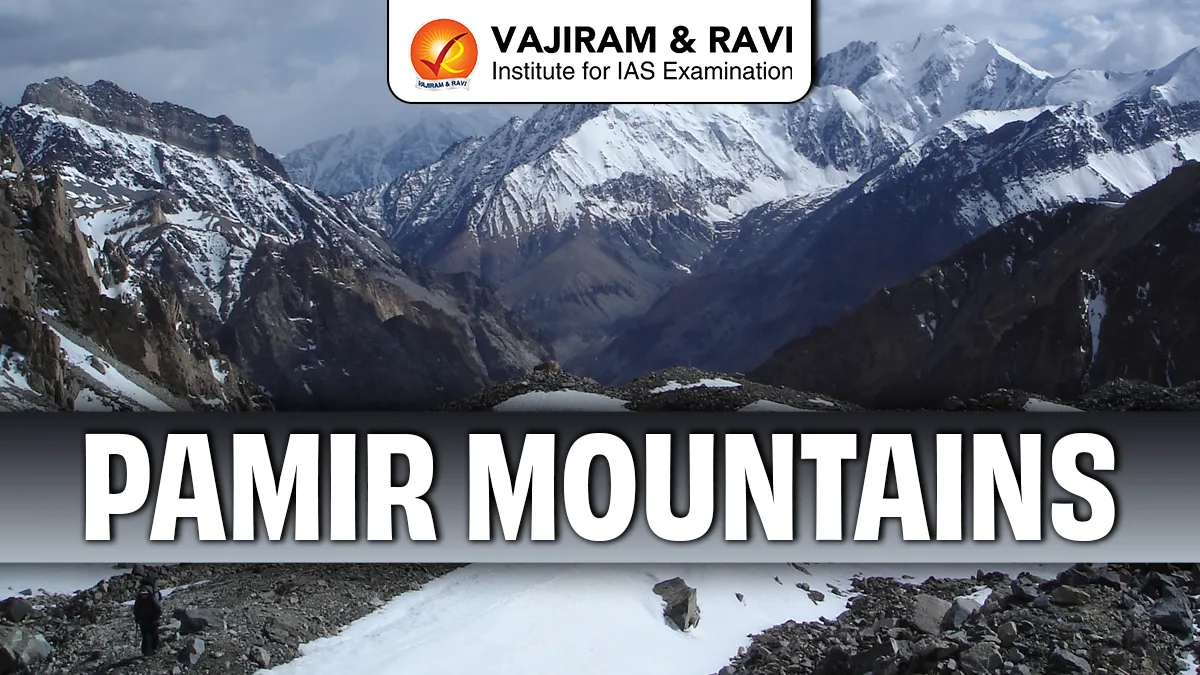
The Pamir Mountains are a range of mountains between Central Asia and South Asia. They are often called the “Roof of the World” due to their very high average elevation, ranging between 4,000-5,000 metres.
Pamir Mountains Location
- The Pamir Mountains are located in Central Asia, primarily in eastern Tajikistan (Gorno-Badakhshan Autonomous Region).
- They extend into northeastern Afghanistan, western China (Xinjiang), and southern Kyrgyzstan.
- Geographically, the Pamirs lie at the junction of South Asia, Central Asia, and East Asia, making them a key trans-continental region.
- Because of their strategic location, they became an important junction of the ancient Silk Road.
Pamir Mountains Geology
- The region is part of the Alpine-Himalayan orogenic belt.
- The Pamirs were formed due to the collision of the Indian Plate with the Eurasian Plate.
- Continuous tectonic activity has resulted in uplift of high plateaus, frequent earthquakes, intense folding and faulting.
- Rich in minerals such as gold, silver, and rare metals.
- Potential for hydropower generation due to steep gradients and river systems. However, exploitation is limited due to terrain, climate, and ecological concerns.
- The Pamir Mountains form a mountain knot, a region where multiple major mountain ranges converge. Major ranges meeting here include Himalayas (south), Karakoram (south-east), Hindu Kush (south-west), Tien Shan (north-east), Kunlun Mountains (east). This makes the Pamirs one of the most complex tectonic regions in the world.


Pamir Mountains Major Peaks and Ranges
Pamir Mountains peaks are characterized by permanent snow cover and steep glacial valleys.
- Ismoil Somoni Peak (7,495 m) is the highest peak of the Pamirs and Tajikistan.
- Peak Korzhenevskaya (7,105 m) is the second highest peak.
- Muztagh Ata (7,509 m), located in China, is famous for extensive glaciers.
Pamir Mountain Climate
- The climate is predominantly cold desert or alpine.
- Winters are long, extremely cold, with temperatures often below –30°C.
- Summers are short and cool due to high altitude.
- The region receives very little rainfall because it lies far from oceans and in the rain shadow part of surrounding mountains.
- Pamirs contain thousands of glaciers, including Fedchenko Glacier, one of the longest glaciers outside the polar regions. These glaciers act as a perennial freshwater source for Central Asian countries and therefore they are often called the “Water Tower of Central Asia.”
Also Read: Arakan Yoma Mountain
Pamir Mountains Drainage
The Pamir Mountains are one of the most important sources of rivers in Asia. Important rivers originating here include
- Amu Darya: it flows into the Aral Sea basin. The Panj River rises in the Pamirs and flows along the border of Tajikistan and Afghanistan. It joins the Vakhsh River, which also starts in the Pamir region. Together, they form the Amu Darya River
- Yarkand River: it flows into the Tarim Basin in China.
- Other rivers like Bartang, Gunt, and Murghab also flow from the Pamirs and add water to this system.
- Contain several high-altitude lakes formed by glacial, tectonic, and landslide processes. Major lakes in the region include Karakul Lake, Sarez Lake, Yashilkul Lake in Tajikistan and Zorkul Lake on the Tajikistan-Afghanistan border. Zorkul lake is considered a source of the Amu Darya river system.
Pamir Mountains Ecology
Pamir Mountains are one of the most sensitive mountain ecosystems in the world due to high altitude and extreme climatic conditions.
- Vegetation is sparse and primarily consists of alpine grasslands, cold desert shrubs, and hardy mosses and lichens.
- Forest cover is almost absent, and biological productivity remains limited.
- Despite harsh conditions, the Pamirs support unique fauna such as the snow leopard, Marco Polo sheep, Siberian ibex, yak, and high-altitude birds, many of which are specially adapted to low oxygen levels and extreme cold.
- Tajik National Park, also known as the Mountains of the Pamirs, is a vast protected area located in eastern Tajikistan. It is a UNESCO World Heritage Site, recognised for its unique high-mountain landscapes, glaciers, and rich biodiversity.

 Last updated on Oct, 2026
→ UPSC 2027 Notification will be released on 13 January 2027 at upsconline.nic.in.
→ Check Nobel Prize 2026 Winners List here.
→ Download PIB PRiSM Monthly Magazine 2026 here.
→ Check UPSC Monthly Current Affairs Magazine The Recitals here.
→ Check out the latest UPSC Syllabus here.
→ Download UPSC Model Answers for Mains 2026
→ UPSC Mains Question Paper 2026 is out now for Essay & GS Paper 1, 2, 3 & 4.
→ UPSC Calendar 2027 has been released.
→ Enroll in Vajiram & Ravi’s UPSC Mains Test Series 2027 for structured answer writing practice, expert evaluation, and exam-oriented feedback.
→ Join Vajiram & Ravi’s UPSC Mentorship Program 2027 for personalized guidance, strategy planning, and one-to-one support from experienced mentors.
→ Go through the UPSC Mains Previous Year Papers to enhance your preparation.
→ UPSC has released UPSC Toppers List 2025 with the Civil Services final result on its official website.
→ Also check Best UPSC Coaching in India
Pamir Mountains FAQs
Q1. Where are the Pamir Mountains located?+
Q2. Why are the Pamir Mountains called the “Roof of the World”?+
Q3. How were the Pamir Mountains formed?+
Q4. Which major rivers originate from the Pamir region?+
Q5. Why are the Pamir Mountains called the “Water Tower of Central Asia”?+
Tags: pamir mountains