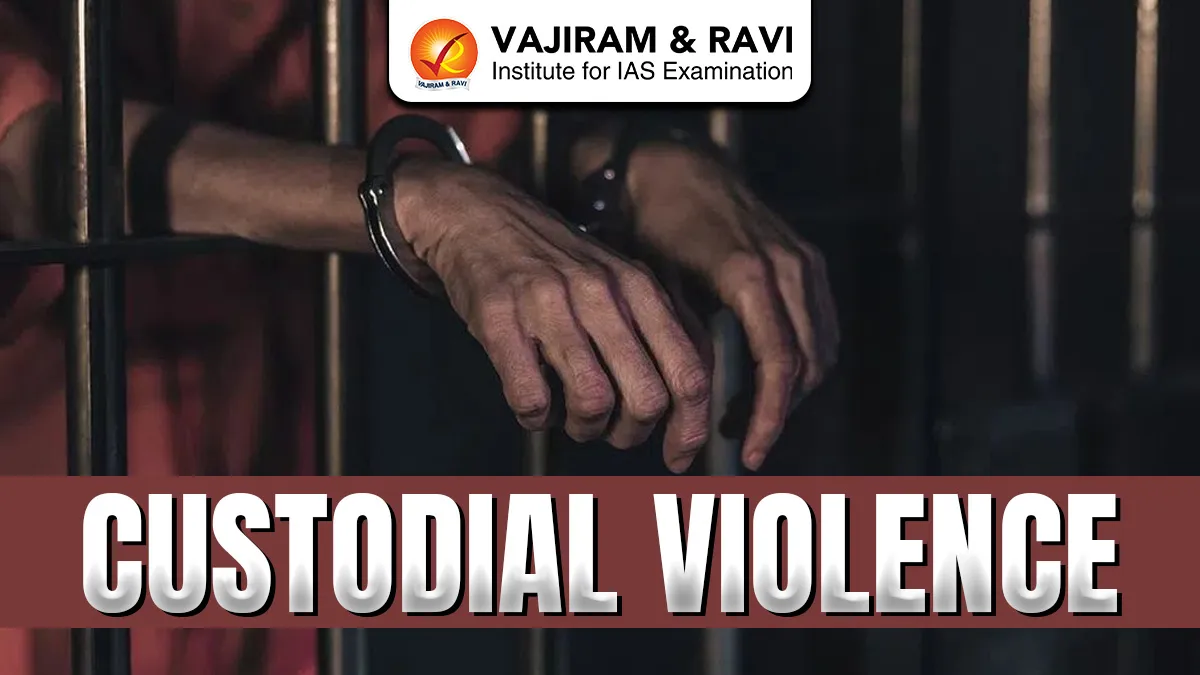
Custodial violence refers to physical, psychological, or sexual abuse inflicted on a person in police custody or judicial custody. It is done to extract some information or forcefully make a person confess an offence or simply to punish the person.
Custodial Violence in India
The NHRC reported 2,739 custodial deaths in 2024, an increase from 2,400 in 2023, with over 155 attributed to police custody. Uttar Pradesh recorded the highest number of custodial deaths, followed by Tamil Nadu, West Bengal, and Maharashtra. The Global Torture Index 2025 classified India as a “high-risk” country for systemic torture.
Custodial Violence Forms
- Physical violence: Beatings, torture, electric shocks, stress positions, denial of food or sleep
- Psychological violence: Threats, humiliation, verbal abuse, prolonged interrogation
- Sexual violence: Rape, molestation, forced nudity
- Negligence leading to death: Denial of medical care, inhuman living conditions


Legal Safeguards Against Custodial Violence
India follows a multi-layered framework to prevent custodial abuse, consisting of constitutional guarantees, judicial interventions, statutory provisions, and international commitments.
Constitutional Provisions
- Article 14: Equality Before Law. Under this article the accused shall be treated as equal as other persons before law. The State is constitutionally bound to treat detainees at par with any other citizen.
- Article 19: Protection of right regarding speech and expression etc.
- Article 20: Protection in Respect of Conviction for Offences
- Article 20(1): Protection against ex-post facto criminal laws.
- Article 20(2): Protection against double jeopardy.
- Article 20(3): Protection against self-incrimination – no person can be compelled to be a witness against himself. Custodial torture to extract confessions directly violates Article 20(3).
- Article 21: Right to Life and Personal Liberty. The Supreme Court in the case of D.K. Basu v. State of West Bengal (1997) held that the expression “life or personal liberty” in Article 21 of the Constitution of India includes a guarantee against torture and assault even by the State and its functionaries to a person who is taken into custody.
- Article 22: Protection against arbitrary arrest and detention. The person must be informed of the grounds of arrest as soon as possible and has the right to consult and be defended by a legal practitioner of his choice.
Judicial Safeguards
- In D.K. Basu v. State of West Bengal (1997): Supreme Court laid down mandatory guidelines to prevent custodial torture, including Preparation of arrest memos, Medical examination of the accused, Informing a friend or relative of the arrest, Production before a magistrate within 24 hours.
- In Joginder Singh v. State of U.P: The Court underscored the importance of reasonable justification for arrests, cautioning against arbitrary detention.
- In Hussainara Khatoon v. State of Bihar (1979): Supreme Court recognised speedy trial as part of Article 21.
- In Paramvir Singh Saini v. Baljit Singh (2020): The Supreme Court directed the Centre to install CCTV cameras and recording systems in all police stations to deter custodial torture.
Statutory Safeguards
- Bharatiya Nyaya Sanhita, 2023 criminalizes intentional infliction of hurt or grievous hurt by public servants to extract confessions or information. Recognizes custodial violence as a punishable offence.
- Bharatiya Nagarik Suraksha Sanhita (BNSS), 2023 mandates arrests only for valid, recorded reasons, Proper documentation and procedural safeguards during detention.
- Bharatiya Sakshya Adhiniyam, 2023 declares confessions obtained through coercion, inducement, threat, or promise as inadmissible in evidence.
International Legal Safeguards
- United Nations Charter (1945) emphasizes respect for human rights and dignity of all individuals, including prisoners.
- Universal Declaration of Human Rights (1948) protects individuals from torture, cruel treatment, and enforced disappearances, ensuring the right to dignity and security.
Custodial violence remains a pervasive and deeply troubling issue in India’s criminal justice system. Despite constitutional guarantees and international human rights obligations, instances of torture, ill-treatment, and custodial deaths continue to occur with impunity.
Custodial Violence Causes
- Absence of a Dedicated Law Against Torture: India has signed but not ratified the United Nations Convention Against Torture, and lacks a stand-alone domestic law criminalising torture.
- Culture of Coercive Interrogation: India’s policing model is rooted in control, coercion, and suspicion. Third-degree torture is often disproportionately inflicted on petty offenders.
- Low conviction rate: Convictions for custodial deaths are extremely low. Between 2018 and 2022, there were reportedly zero convictions for custodial deaths despite hundreds of cases registered. A “brotherhood” mentality often prevails, where police protect each other, making it difficult for witnesses to testify.
- Poor Compliance with Guidelines: Supreme Court directives, such as the D.K. Basu guidelines on arrest and the mandatory installation of CCTV cameras in all police stations, are not fully implemented.
- Inadequate Oversight: Internal inquiries are often biased. NHRC and SHRC recommendations are advisory and lack binding enforcement powers.
- Overburdened System: Indian prisons operate at over 130% capacity, with more than 75% of inmates being undertrials. This overcrowding, along with the pressure to solve cases quickly, often leads police to resort to violence.
- Social Acceptance: For example in 2019 alleged encounter killing of four men accused of raping and murdering a veterinarian near Hyderabad was met with public celebration.
Way Forward
To address the systemic issues surrounding custodial torture and impunity in India, a multi-pronged approach is essential. The following recommendations are aimed at creating a more accountable, transparent, and rights-based law enforcement system
- Enact a Comprehensive Anti-Torture Law in line with UNCAT.
- Enact Robust Anti-Torture Law which defines custodial violence and set out clear punishments, aligning with the UN Convention Against Torture.
- Police Reforms and training: Modernize police training to shift focus from “third-degree” methods to scientific and evidence-based investigation. Sensitize police personnel on human rights.
- Install CCTV and Digital Monitoring Systems in Lockups and Prisons. All lockups and custodial facilities should have real-time audio-visual surveillance, backed by a centralized monitoring unit.
- In Prakash Singh v. Union of India (2006), the Supreme Court mandated the creation of police complaints authorities, led by retired judges, at the State and district levels to address complaints against police misconduct.
- Strengthen Independent Oversight Bodies: National Human Rights Commission (NHRC) and State Human Rights Commissions (SHRCs) must be given statutory authority to enforce their decisions. These institutions should have autonomous investigative wings with powers to summon witnesses, collect evidence, and initiate prosecution.
- Fast-track trials for cases of custodial violence.
- Public Awareness: Raising public awareness to hold the state accountable and protect the rights of detainees.
Conclusion
Custodial violence violates the basic values of a democratic republic, especially the right to life, dignity, and rule of law. When institutions that are meant to protect citizens become perpetrators of harm, the credibility of the justice system is fundamentally undermined and it weakens public trust in the police and the justice system, and affects the poor and marginalized the most. Tackling this problem requires strong laws against torture, independent oversight, strict enforcement of guidelines, and police training based on human rights and constitutional values.

 Last updated on Oct, 2026
→ UPSC 2027 Notification will be released on 13 January 2027 at upsconline.nic.in.
→ Check Nobel Prize 2026 Winners List here.
→ Download PIB PRiSM Monthly Magazine 2026 here.
→ Check UPSC Monthly Current Affairs Magazine The Recitals here.
→ Check out the latest UPSC Syllabus here.
→ Download UPSC Model Answers for Mains 2026
→ UPSC Mains Question Paper 2026 is out now for Essay & GS Paper 1, 2, 3 & 4.
→ UPSC Calendar 2027 has been released.
→ Enroll in Vajiram & Ravi’s UPSC Mains Test Series 2027 for structured answer writing practice, expert evaluation, and exam-oriented feedback.
→ Join Vajiram & Ravi’s UPSC Mentorship Program 2027 for personalized guidance, strategy planning, and one-to-one support from experienced mentors.
→ Go through the UPSC Mains Previous Year Papers to enhance your preparation.
→ UPSC has released UPSC Toppers List 2025 with the Civil Services final result on its official website.
→ Also check Best UPSC Coaching in India
Custodial Violence FAQs
Q1. What is custodial violence?+
Q2. Which constitutional provisions protect against custodial violence?+
Q3. What were the key guidelines in the D.K. Basu case (1997)?+
Q4. Why does custodial violence continue in India?+
Q5. What are the main reforms suggested to curb custodial violence?+
Tags: custodial violence