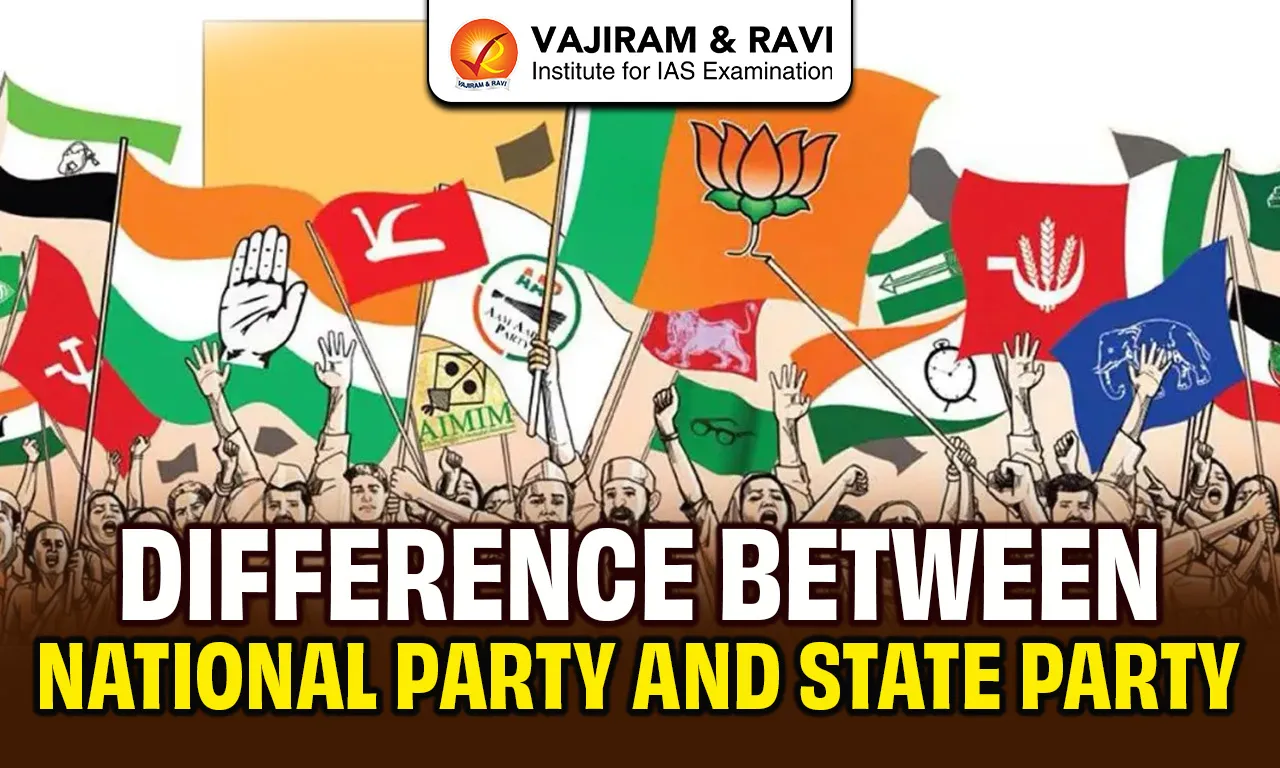
Election Commission of India (ECI) grants recognition to national-level and state-level political parties based on objective criteria. The recognition of national and state parties is done by the Election Commission of India under the Election Symbols (Reservation and Allotment) Order, 1968, which was issued in exercise of its powers under Article 324 of the Constitution and the Representation of the People Act, 1951. The Difference between National and State Party are discussed in detail in the article.
National Party Criteria
National parties have a pan-India presence and exclusive symbols nationwide, while state parties operate within specific states, focusing on regional issues.
Currently six parties enjoy the status of National Party: Bharatiya Janata Party (BJP), Indian National Congress (INC), Communist Party of India (Marxist) – CPI(M), Bahujan Samaj Party (BSP), Aam Aadmi Party (AAP), National People’s Party (NPP).
A registered party is recognised as a national party only if it fulfills any one of the three conditions listed below:
- If its candidates polled at least 6% of total valid votes in any four or more states in the last Lok Sabha or Assembly elections and had at least four MPs in the last Lok Sabha polls; or
- If it has won at least 2% of the total seats in the Lok Sabha from not less than three states; or
- If it is ‘recognised’ in four or more states.
State Party Criteria
A registered party is recognised as a state party only if it fulfils any one of the five conditions listed below:
- At least 6% vote-share in the last Assembly election and have at least 2 MLAs; or have 6% vote-share in the last Lok Sabha elections from that state and at least one MP from that state; or
- At least 3% of the total number of seats or three seats, whichever is more, in the last Assembly elections; or
- At least one MP for every 25 members or any fraction allotted to the state in the Lok Sabha; or
- Have at least 8% of the total valid votes in the last Assembly election or Lok Sabha election from the state.
Major examples of State Parties are: All India Trinamool Congress (West Bengal), Dravida Munnetra Kazhagam – DMK (Tamil Nadu), Samajwadi Party – SP (Uttar Pradesh), Rashtriya Janata Dal – RJD (Bihar), Janata Dal (United) – JD(U) (Bihar), Telugu Desam Party – TDP (Andhra Pradesh) etc


Difference between National and State Party
Difference between National and State Party is discussed below:
| Difference Between National and State Party | |
| Nation Party | State Party |
|
Recognised across India |
Recognised in one particular state |
|
Must fulfill prescribed criteria in multiple states |
Must fulfill prescribed criteria within a single state |
|
They have pan-India presence and influence |
They have regional or state specific influence |
|
Get a permanent reserved symbol valid throughout India |
Gets a reserved symbol symbol only within the concerned state |
|
Generally has a national ideology and agenda |
Focuses on regional issues, state interests, and local identity |
|
Examples – Indian National Congress (INC), Bhartiya Janta Party (BJP) etc |
Examples – Trinamool Congress in West Bengal, Shiv Sena in Maharashtra etc |
Advantages of Being Recognised as a National or State Party
- Exclusive Election Symbol:
- If a party is recognised as a State Party’, it is entitled for exclusive allotment of its reserved symbol to the candidates set up by it in the State in which it is so recognised, and
- If a party is recognised as a `National Party’ it is entitled for exclusive allotment of its reserved symbol to the candidates set up by it throughout India.
- Simpler Nomination Process:Recognised `State’ and `National’ parties need only one proposer for filing the nomination.
- Free Electoral Rolls: Recognised `State’ and `National’ parties are entitled for two sets of electoral rolls free of cost at the time of revision of rolls and their candidates get one copy of electoral roll free of cost during General Elections.
- Free Airtime: Recognised `State’ and `National’ parties get broadcast/telecast facilities over Akashvani/Doordarshan during general elections.
- Star Campaigner Facility: Political parties are entitled to nominate “Star Campaigners” during General Elections.
- A recognized National or State party can have a maximum of 40 “Star campaigners”
- A registered un-recognised party can nominate a maximum of 20 ‘Star Campaigners”.
The travel expenses of star campaigners are not to be accounted for in the election expense accounts of candidates of their party.
Is Registration Necessary to Contest Elections?
Any Indian citizen who is more than 25 years old and is registered as a voter can contest elections even without forming a party. Similarly, associations can also contest elections without getting registered by the Election Commission. They, however, will not be identified as political parties and hence will not be eligible for availing of benefits under the provisions of the Representation of the People Act, 1951 (RPA).
Benefits of Registration
There are many benefits of registering a party:
- Firstly, the RPA allows political parties to accept contributions voluntarily offered to it by any person or company other than a government company.
- Apart from this, candidates of registered parties get preference in allotment of election symbols. Other Candidates are identified as independents and do not get preference in symbol allocation.

 Last updated on Sep, 2026
→ UPSC 2027 Notification will be released on 13 January 2027 at upsconline.nic.in.
→ Asian Games 2026 are being held in Aichi-Nagoya, Japan, from 19 September to 4 October.
→ Check out the latest UPSC Syllabus here.
→ Download UPSC Model Answers for Mains 2026
→ UPSC Mains Question Paper 2026 is out now for Essay & GS Paper 1, 2, 3 & 4.
→ UPSC Calendar 2027 has been released.
→ Enroll in Vajiram & Ravi’s UPSC Mains Test Series 2027 for structured answer writing practice, expert evaluation, and exam-oriented feedback.
→ Join Vajiram & Ravi’s UPSC Mentorship Program 2027 for personalized guidance, strategy planning, and one-to-one support from experienced mentors.
→ Go through the UPSC Mains Previous Year Papers to enhance your preparation.
→ UPSC has released UPSC Toppers List 2025 with the Civil Services final result on its official website.
→ Also check Best UPSC Coaching in India
Difference Between National Party and State Party FAQs
Q1. Who grants recognition to national and state parties in India?+
Q2. What is the main difference between a national party and a state party?+
Q3. How many national parties are there in India as of 2026?+
Q4. What are the key benefits of being a recognised national or state party?+
Q5. Is party registration necessary to contest elections in India?+
Tags: difference between national party and state party indian polity indian polity notes