US Dilutes Trade Deal Language Latest News
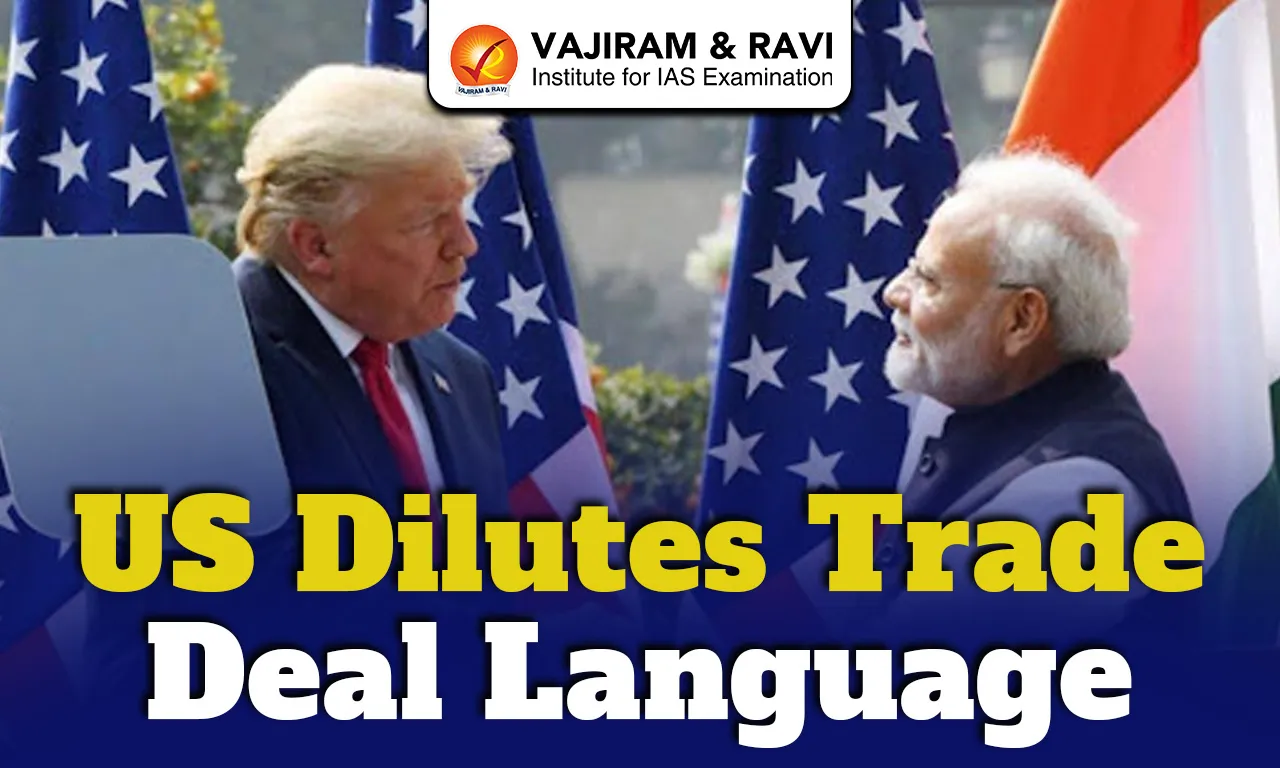
- The United States has revised its factsheet on the India–US trade deal, softening language on India’s commitments and removing references to digital services taxes and tariff cuts on pulses.
- It also modified the joint statement to reflect non-binding intent.
Softening of Language
- The earlier factsheet stated that India had “committed to” purchasing over $500 billion worth of US energy, ICT, coal, and other products.
- The updated version replaces this with “intends”, aligning it with the joint statement and clarifying the non-binding nature of the provision.
Dropping Digital Services Tax Clause
- The original factsheet claimed that India would:
- Remove its digital services taxes
- Negotiate bilateral digital trade rules
- Prohibit customs duties on electronic transmissions
- This section, which was not part of the joint statement, has now been removed entirely.
Changes on Agricultural Tariffs
- The earlier factsheet mentioned tariff reductions on “certain pulses”, a politically sensitive issue in India.
- The updated version drops pulses and instead lists products such as:
- Dried distillers’ grains (DDGs)
- Red sorghum
- Tree nuts
- Fresh and processed fruit
- Soybean oil
- Wine and spirits
- The earlier language had triggered criticism from Opposition parties and farmers, who viewed the claims as excessive concessions.


Farmers’ Concerns Over Agricultural Market Access in Trade Deal
- The US revised its trade factsheet by dropping the reference to “certain pulses” among products India had allegedly committed to import.
- Although pulses were not mentioned in the joint statement, Commerce Ministry sources indicate that market access for pulses may still be part of the agreement, though details remain unclear.
India’s Pulses Import Landscape
- India imports nearly 20% of its annual pulses consumption to meet domestic demand.
- Key suppliers include:
- Canada, Russia, Brazil, Myanmar
- African nations such as Mozambique and Malawi
- In 2024–25, India’s total pulses imports rose 46% to $5.48 billion, though the US accounted for only $90 million, making it a minor supplier.
Push for Self-Reliance in Pulses
- The revision comes as the government promotes self-reliance in pulses production.
- The Agriculture Minister recently termed pulses imports a “matter of shame”, emphasising increased acreage, productivity, and profitability to transform India into an exporter.
- Market access in agriculture has historically been contentious in trade negotiations.
- Indian farmers argue that heavy subsidies in Western countries create unfair competition, and have demanded agriculture remain protected in bilateral and multilateral agreements.
Farmers’ Protests and Fears
- Farmer groups announced a nationwide strike, alleging lack of transparency in negotiations. Concerns include:
- Possible backdoor entry of GM products via dried distillers’ grains (DDGs)
- Fear of US dominance in India’s animal feed market
$500 Billion Purchase Target: What It Means for India
- Trade Snapshot: India–US Commerce – In FY 2024–25, India imported $45.62 billion worth of American goods and exported $86.51 billion to the United States. The US remains one of India’s largest trading partners.
- From ‘Committed’ to ‘Intends’ – The original US factsheet claimed India had “committed” to purchasing $500 billion worth of American goods over five years (about $100 billion annually). The revised version softens the wording to “intends”, reflecting the non-binding nature of the provision.
- Farmers’ Concerns Over Import Surge – The $500-billion figure raised concerns among farmers about a sharp increase in agricultural imports, potentially affecting domestic prices and market stability. Fears centre on increased competition and pressure on farm incomes.
- Government Clarification: Not Legally Binding – Indian officials have clarified that the target is not a sovereign commitment, as purchases would be made by private companies, not governments.
- Similar phrasing has appeared in past trade agreements, such as the India–EFTA deal, where investment targets were indicative rather than mandatory.
Pushback on Digital Services Taxes in Trade Talks
- The revised US factsheet dropped a section suggesting India would remove digital services taxes and refrain from reintroducing equalisation levy–style measures.
- The equalisation levy, often dubbed the “Google tax,” was designed to ensure tax parity between domestic and foreign e-commerce companies.
- India had already scrapped this levy in the previous Budget, but debates remain over whether it should permanently forgo such tools.
- This change follows concerns that India may have limited its future taxation powers over American tech firms.
Concerns Over Policy Sovereignty
- Legal advisers reportedly cautioned against accepting US proposals that would prevent India from reintroducing digital taxes.
- Experts argue that binding commitments in trade deals could constrain India’s regulatory flexibility.
Data Localisation and Digital Sovereignty
- The broader concern extends to data localisation, which requires storing and processing data within national borders.
- Critics warn that trade conditions may restrict India’s ability to enforce localisation policies or safeguard digital sovereignty.
- A 2018 UN Trade and Development report highlighted that data localisation can:
- Promote domestic digital infrastructure investment
- Strengthen enforcement of national laws
- Protect privacy and cyber sovereignty
- With its vast user base and growing digital economy, India holds significant leverage. Experts believe retaining regulatory space could enable India to build globally competitive digital platforms.

 Last updated on Sep, 2026
→ UPSC 2027 Notification will be released on 13 January 2027 at upsconline.nic.in.
→ Asian Games 2026 are being held in Aichi-Nagoya, Japan, from 19 September to 4 October.
→ Check out the latest UPSC Syllabus here.
→ Download UPSC Model Answers for Mains 2026
→ UPSC Mains Question Paper 2026 is out now for Essay & GS Paper 1, 2, 3 & 4.
→ UPSC Calendar 2027 has been released.
→ Enroll in Vajiram & Ravi’s UPSC Mains Test Series 2027 for structured answer writing practice, expert evaluation, and exam-oriented feedback.
→ Join Vajiram & Ravi’s UPSC Mentorship Program 2027 for personalized guidance, strategy planning, and one-to-one support from experienced mentors.
→ Go through the UPSC Mains Previous Year Papers to enhance your preparation.
→ UPSC has released UPSC Toppers List 2025 with the Civil Services final result on its official website.
→ Also check Best UPSC Coaching in India
US Dilutes Trade Deal Language FAQs
Q1. Why did US Dilutes Trade Deal Language become significant?+
Q2. How does US Dilutes Trade Deal Language affect agriculture?+
Q3. What is the $500 billion purchase issue in US Dilutes Trade Deal Language?+
Q4. Why is digital tax removal debated in US Dilutes Trade Deal Language?+
Q5. What sovereignty concerns arise from US Dilutes Trade Deal Language?+
Tags: mains articles upsc current affairs upsc mains current affairs US dilutes trade deal language