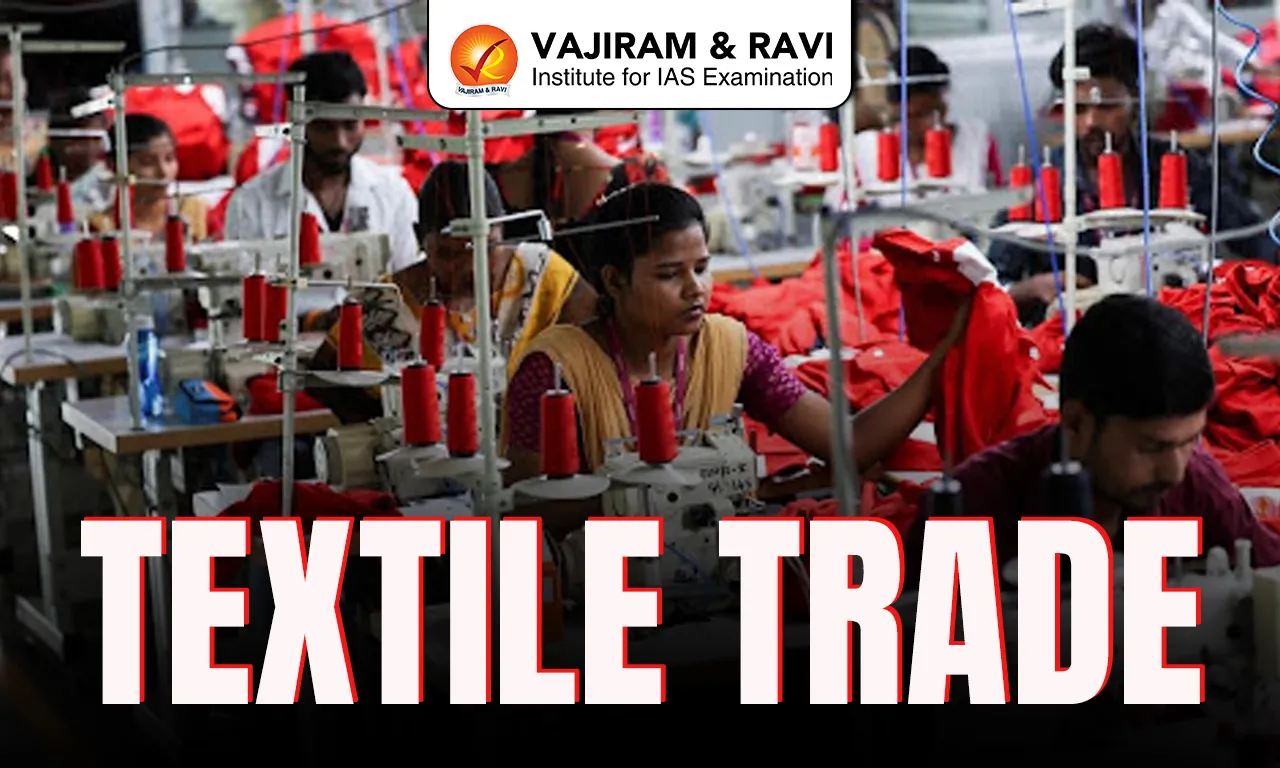
Textile Trade Latest News
- The U.S.-Bangladesh reciprocal trade agreement, granting zero reciprocal tariffs on select apparel, has triggered concerns for Indian textile exporters.
Background of the U.S.-Bangladesh Textile Deal
- The United States has agreed to establish a mechanism under which certain textile and apparel goods from Bangladesh will receive a zero reciprocal tariff rate.
- However, this benefit is conditional. The zero reciprocal tariff will apply only to a specified volume of imports and will be linked to the use of U.S.-produced cotton and man-made fibre (MMF) textile inputs.
- This development is significant because Bangladesh is one of the largest exporters of garments to the U.S., competing directly with India, China, and Vietnam.


Structure of Bangladesh’s Textile Industry
- Bangladesh exported garments worth $50.9 billion globally in 2024, with $7.4 billion going to the U.S.
- Its industry model is heavily dependent on imported textile inputs. In 2024, Bangladesh imported textile inputs worth $16.1 billion, of which $3.1 billion came from India.
- Bangladesh imports around 85 lakh bales of cotton annually from Brazil, India, and African countries. India alone exported 12-14 lakh bales of cotton and $1.47 billion worth of cotton yarn to Bangladesh in 2024-25.
- This indicates that Bangladesh’s garment exports are deeply integrated with Indian raw material supply chains.
India’s Exposure to the U.S. Market
- India exports approximately $16 billion worth of garments annually, with nearly one-third going to the U.S.
- Both India and Bangladesh primarily produce cotton-based apparel. Therefore, any preferential access granted to Bangladesh directly affects Indian exporters competing in the same market segment.
- Currently, Indian goods face an 18% reciprocal tariff in the U.S., while Bangladeshi goods will face 19%, reduced from 20%.
- Thus, the tariff differential between India and Bangladesh has narrowed significantly.
India-U.S. Cotton Trade
- India imports around five lakh bales of U.S. cotton annually, including 2.5 lakh bales of extra-long staple (ELS) cotton such as American PIMA.
- India levies an 11% import duty on cotton, except for ELS cotton. Indian mills are already nominated by American brands to supply yarn made from U.S. cotton.
- The Union Commerce Ministry has stated that Indian garment exporters will receive similar access benefits to the U.S. market as Bangladesh.
- However, operational clarity on this promise is still awaited.
Possible Shift in Trade Dynamics
- Bangladesh may replace Indian cotton with U.S.-produced cotton to qualify for zero reciprocal tariffs.
- If this happens, the immediate impact will be on Indian cotton and yarn exporters supplying Bangladesh.
- However, analysts note that over 63% of Bangladesh’s garment exports go to the European Union duty-free.
- Since its supply chains are oriented toward European buyers, restructuring production to use U.S. cotton may require significant investment in spinning and fabric processing capacity.
Key Concerns for Indian Exporters
- Several practical concerns remain:
- Whether India will waive the 11% import duty on U.S. cotton to ensure competitiveness.
- How the U.S. will determine the quantity of U.S. cotton content in garments.
- Whether increased demand will push up U.S. cotton prices, reducing cost competitiveness.
- Whether benefits apply only to reciprocal tariffs or also to basic duties.
- Both India and Bangladesh exporters will get relief only from the reciprocal tariff if they use U.S. cotton, not from the basic duty.
- If U.S. cotton becomes expensive due to higher demand, garments made from it may not remain competitive compared to those made from cheaper global cotton.
Broader Strategic Implications
- The development highlights three structural issues:
- Growing importance of rules-of-origin conditions in trade agreements.
- Increasing integration of trade with supply-chain geopolitics.
- Need for India to align domestic tariff policy with export competitiveness.
- India’s textile industry is the largest employment generator after agriculture.
- Hence, any shift in global trade patterns has serious economic and employment implications.
Source : TH

 Last updated on Oct, 2026
→ UPSC 2027 Notification will be released on 13 January 2027 at upsconline.nic.in.
→ Asian Games 2026 are being held in Aichi-Nagoya, Japan, from 19 September to 4 October.
→ Check Nobel Prize 2026 Winners List here.
→ Download PIB PRiSM Monthly Magazine 2026 here.
→ Check UPSC Monthly Current Affairs Magazine The Recitals here.
→ Check out the latest UPSC Syllabus here.
→ Download UPSC Model Answers for Mains 2026
→ UPSC Mains Question Paper 2026 is out now for Essay & GS Paper 1, 2, 3 & 4.
→ UPSC Calendar 2027 has been released.
→ Enroll in Vajiram & Ravi’s UPSC Mains Test Series 2027 for structured answer writing practice, expert evaluation, and exam-oriented feedback.
→ Join Vajiram & Ravi’s UPSC Mentorship Program 2027 for personalized guidance, strategy planning, and one-to-one support from experienced mentors.
→ Go through the UPSC Mains Previous Year Papers to enhance your preparation.
→ UPSC has released UPSC Toppers List 2025 with the Civil Services final result on its official website.
→ Also check Best UPSC Coaching in India
Textile Trade FAQs
Q1. What did the U.S. promise Bangladesh under the new trade agreement?+
Q2. How much of Bangladesh’s garment exports go to the U.S.?+
Q3. What is India’s share in Bangladesh’s textile input imports?+
Q4. What is the current tariff difference between India and Bangladesh in the U.S.?+
Q5. What is the key concern for Indian exporters?+
Tags: mains articles textile trade upsc current affairs upsc mains current affairs