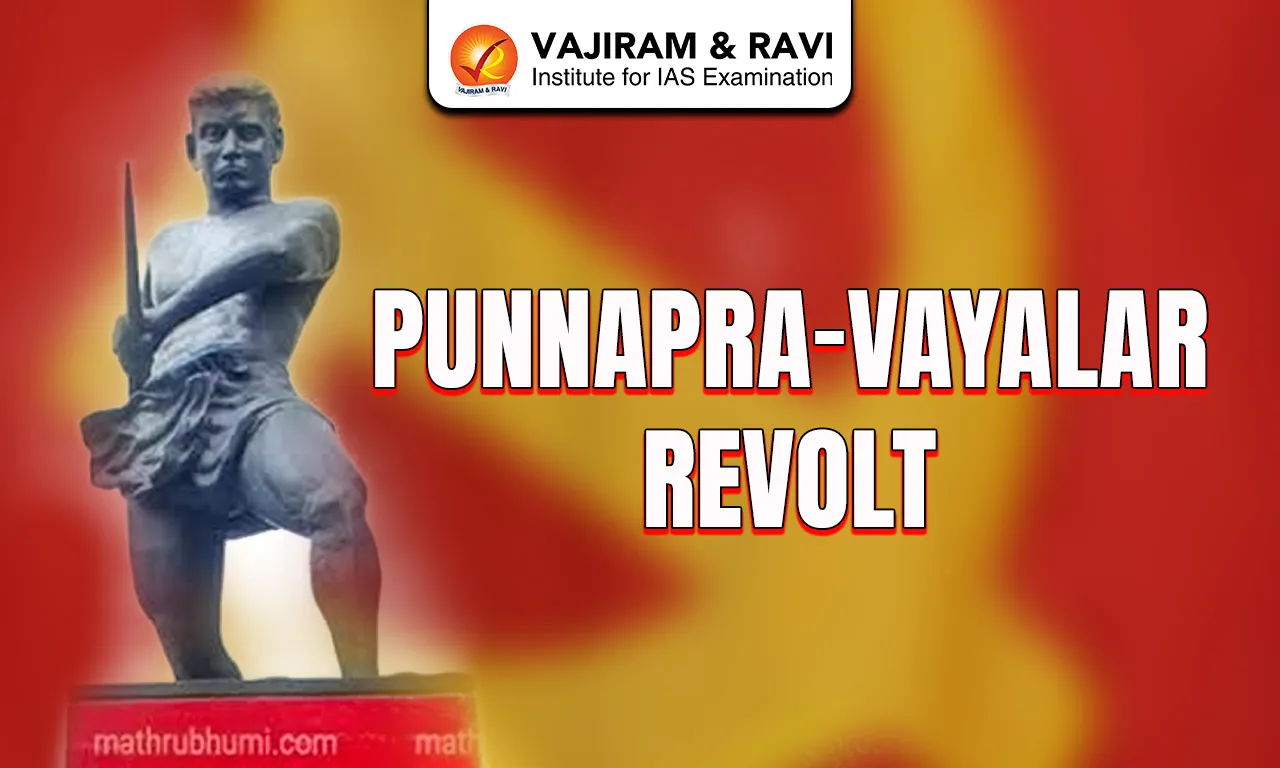
The Punnapra-Vayalar Revolt was a significant peasant and workers’ uprising that took place in October 1946 in the princely state of Travancore (present-day Kerala). The revolt is named after the two places in which it took place; beginning in Punnapra and ending in Vayalar. The revolt was mainly led by the Communist Party and directed against the autocratic rule of the Diwan of Travancore, C. P. Ramaswami Iyer.
Punnapra-Vayalar Revolt Background
- Travancore was a princely state ruled by a Maharaja, but real power was exercised by the Diwan.
- In the 1940s, C. P. Ramaswami Iyer was the Diwan and followed an authoritarian style of governance where civil liberties were restricted, and political dissent was suppressed.
- In June 1947, the Diwan declared that Travancore would become an independent sovereign state after the British left India, instead of joining the Indian Union. This decision created widespread anger among political groups, especially the Congress and the Communists.
- This decision was also opposed by the people, especially workers and peasants, who were already suffering due to low wages and poor working conditions, high prices and economic hardships, political repression and lack of civil liberties after World War II.
- The Communist Party had strong influence among coir workers and peasants in the Alappuzha (Alleppy) region. They organized protests demanding responsible government and better rights.
Course of the Punnapra-Vayalar Revolt
- The All Travancore Trade Union Congress had called for a general strike starting October 22.
- Thousands of workers took to the streets, marching toward the reserve police camp at Punnapra, demanding freedom.
- Armed clashes took place between protesters and state forces.
- In response, the Travancore government declared martial law in the affected areas and deployed armed police and military units to suppress the agitation. Violent clashes followed, and state forces opened fire on protesters. Hundreds of people were killed and the revolt was militarily suppressed.


Punnapra-Vayalar Revolt Consequences
Although the Punnapra-Vayalar Revolt was suppressed militarily, its consequences were significant.
- Though the revolt was brutally suppressed by the state, it weakened the authority of the Diwan.
- In 1947, after an assassination attempt on the Diwan he resigned from office.
- Travancore agreed to join the Indian Union.
- The event strengthened the Communist movement in Kerala and it later contributed to the rise of the first elected Communist government in Kerala in 1957.

 Last updated on Oct, 2026
→ UPSC 2027 Notification will be released on 13 January 2027 at upsconline.nic.in.
→ Check Nobel Prize 2026 Winners List here.
→ Download PIB PRiSM Monthly Magazine 2026 here.
→ Check UPSC Monthly Current Affairs Magazine The Recitals here.
→ Check out the latest UPSC Syllabus here.
→ Download UPSC Model Answers for Mains 2026
→ UPSC Mains Question Paper 2026 is out now for Essay & GS Paper 1, 2, 3 & 4.
→ UPSC Calendar 2027 has been released.
→ Enroll in Vajiram & Ravi’s UPSC Mains Test Series 2027 for structured answer writing practice, expert evaluation, and exam-oriented feedback.
→ Join Vajiram & Ravi’s UPSC Mentorship Program 2027 for personalized guidance, strategy planning, and one-to-one support from experienced mentors.
→ Go through the UPSC Mains Previous Year Papers to enhance your preparation.
→ UPSC has released UPSC Toppers List 2025 with the Civil Services final result on its official website.
→ Also check Best UPSC Coaching in India
Punnapra-Vayalar Revolt FAQs
Q1. What was the Punnapra-Vayalar Revolt?+
Q2. Why did the Punnapra-Vayalar Revolt occur?+
Q3. Where did the Punnapra-Vayalar Revolt take place?+
Q4. How did the Travancore government respond to the revolt?+
Q5. What were the consequences of the revolt?+
Tags: modern indian history modern indian history notes punnapra vayalar revolt