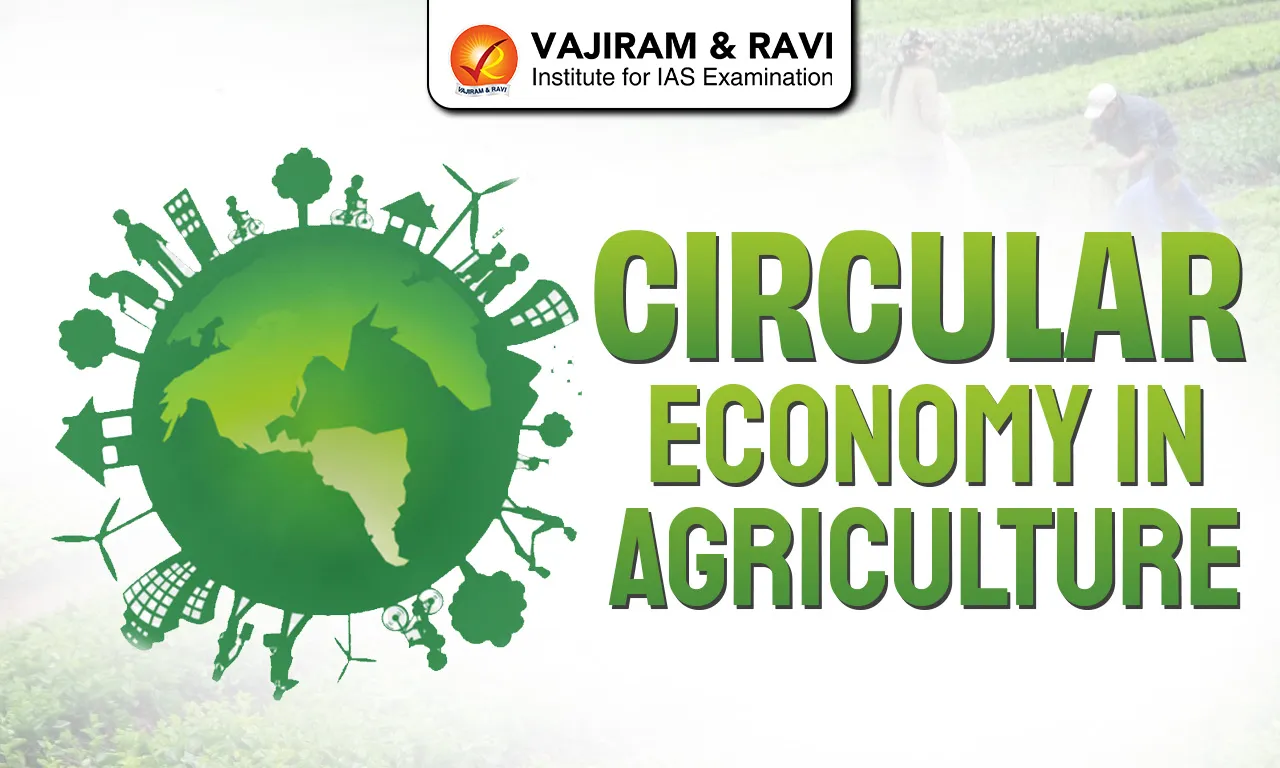
Agriculture is vital for India’s food security and rural livelihoods, but it also generates huge amounts of waste at every stage, from cultivation to consumption. Poor management of crop and food waste not only harms the environment but also adds to greenhouse gas emissions and degrades soil health. India produces around 350 million tonnes of agricultural waste every year, including crop residues, straw, husk, and livestock by-products. The idea of a Circular Economy in Agriculture provides a practical solution by treating this waste as a resource rather than a burden. It focuses on recovering, reusing, and reintegrating materials into productive cycles, enabling economic growth while maintaining ecological balance. By adopting circular practices, India can turn these challenges into opportunities for generating energy, producing organic inputs, and creating livelihoods.
Circular Economy in Agriculture
The Circular Economy in Agriculture is a systemic approach that moves away from the linear “take-make-dispose” model. Its core principles include:
- Reduce: Minimizing waste generation at the source by improving efficiency in farming practices.
- Reuse: Repurposing crop residues, animal manure, and food waste into compost, feed, or biofertilizers.
- Recycle: Converting waste into energy, organic fertilizers, and biochar without losing value.
- Recover, Repair, Refurbish: Maintaining equipment and extracting nutrients or energy from waste.
A key feature of this approach is true recycling, where waste is converted back without losing its original value, rather than being downcycled. Following these principles, the Circular Economy in Agriculture helps maintain soil health, improves energy efficiency, and boosts economic returns over the long term.
Sources of Agricultural Waste
Agricultural waste is generated across the entire value chain:
- Crop Residues and Stubble: Post-harvest residues such as stalks, straw, and stubble are partially used for cattle feed, compost, or mulch. However, a large share is burned, especially in Punjab, Haryana, and Uttar Pradesh, degrading soil fertility and releasing greenhouse gases. Circular approaches encourage in-situ incorporation into soil or ex-situ processing for bioenergy and organic fertilizers.
- Animal Manure & By-products: Large livestock populations produce dung and bedding waste. Converting this into biogas or compost reduces pollution and adds value.
- Post-Harvest Losses: Poor storage and transport lead to loss of quantity and quality. Cold storage, sorting, and processing help reduce waste and increase farmer incomes.
- Food Waste: Edible food is wasted at markets, retail outlets, and households. Innovative solutions like engineered biochar transform waste into carbon-rich amendments, supporting soil fertility, carbon sequestration, and circularity in agriculture.


Circular Economy in Agriculture Government Initiatives
India has launched multiple policies and schemes to operationalize the Circular Economy in Agriculture:
- GOBARdhan (Galvanising Organic Bio-Agro Resources Dhan)
- The scheme brings together multiple ministries to convert cattle dung, crop residues, and food waste into compressed biogas (CBG) and organic manure.
- In 2023, the government launched the Unified GOBARdhan Portal to enhance transparency and functionality.
- By January 2026, 51.4% of districts are covered with 979 operational biogas plants.
- Incentives include carbon credit trading, tax benefits on CBG, and easier norms for organic manure.
- Crop Residue Management (CRM)
- CRM initiative aims to reduce the open burning of crop residues by promoting in-situ management, where residues are directly incorporated into the soil or used as mulch, and ex-situ management, where residues are collected for composting, biogas production, or bioenergy. These practices help improve soil health, enhance farm productivity, and promote effective waste management.
- Since 2018-19, over 42,000 Custom Hiring Centres (CHCs) and 3.24 lakh machines have been deployed in states like Punjab, Haryana, UP, and Delhi.
- Agriculture Infrastructure Fund (AIF)
- Agriculture Infrastructure Fund (AIF) was launched in 2020-21.
- AIF provides medium to long-term institutional credit for the development of post-harvest infrastructure and farm-level assets.
- Supports organic input production, cold storage, sorting and grading units, and processing centers.
- As of 2025, 1,13,419 projects have been sanctioned, mobilizing investments of ₹1,07,502 crore.
- Animal Husbandry Infrastructure Development Fund (AHIDF)
- Launched in 2020-21.
- The Government has introduced the AHIDF under the Atmanirbhar Bharat Abhiyan, with a corpus of ₹ 15,000 crore to strengthen infrastructure across the livestock value chain.
- The fund is designed to catalyse private and cooperative investments in meat and dairy processing, animal feed manufacturing, and waste-to-wealth management, thereby enhancing value addition, efficiency, and resilience in the animal husbandry sector.
- Jal Shakti Mission
- The Ministry of Jal Shakti promotes the treatment and reuse of domestic and wastewater for non-drinking purposes, such as agriculture, landscaping, and horticulture, through schemes such as the National Mission for Clean Ganga, PMKSY-Watershed Development, and Jal Shakti Abhiyan.
- The Ministry also focuses on water conservation and source sustainability by supporting watershed development, rainwater harvesting, revival of traditional water bodies, and groundwater recharge. These efforts improve water availability for irrigation, reduce pressure on groundwater, and encourage a resource-efficient and sustainable approach to water management in agriculture and allied sectors.
- Complementing wastewater reuse initiatives, the Jal Jeevan Mission-Har Ghar Jal (launched in August 2019), focuses on ensuring universal access to safe and adequate drinking water in rural areas. The mission provides functional household tap water connections supplying 55 litres per capita per day of potable water.
Circular Economy in Agriculture and SDG
The Circular Economy in Agriculture contributes directly to:
- SDG 2 (Zero Hunger): By reducing food loss, improving soil fertility, and supporting resilient farming systems.
- SDG 12 (Responsible Consumption and Production): Promotes efficient use of resources and waste valorization.
- Practices like composting, biochar utilization, and biomass recycling enhance productivity while protecting the environment.
Conclusion
The Circular Economy in Agriculture shows that economic growth and environmental sustainability can go together. Schemes like GOBARdhan, CRM, AIF, and AHIDF convert agricultural waste into energy, fertilizers, and livelihoods, improving resilience and productivity. Scaling these initiatives and aligning incentives with ecological outcomes can make agricultural waste a key resource for sustainable development, climate resilience, and food security.

 Last updated on Oct, 2026
→ UPSC 2027 Notification will be released on 13 January 2027 at upsconline.nic.in.
→ Check Nobel Prize 2026 Winners List here.
→ Download PIB PRiSM Monthly Magazine 2026 here.
→ Check UPSC Monthly Current Affairs Magazine The Recitals here.
→ Check out the latest UPSC Syllabus here.
→ Download UPSC Model Answers for Mains 2026
→ UPSC Mains Question Paper 2026 is out now for Essay & GS Paper 1, 2, 3 & 4.
→ UPSC Calendar 2027 has been released.
→ Enroll in Vajiram & Ravi’s UPSC Mains Test Series 2027 for structured answer writing practice, expert evaluation, and exam-oriented feedback.
→ Join Vajiram & Ravi’s UPSC Mentorship Program 2027 for personalized guidance, strategy planning, and one-to-one support from experienced mentors.
→ Go through the UPSC Mains Previous Year Papers to enhance your preparation.
→ UPSC has released UPSC Toppers List 2025 with the Civil Services final result on its official website.
→ Also check Best UPSC Coaching in India
Circular Economy in Agriculture FAQs
Q1. What is the Circular Economy in Agriculture?+
Q2. How does the Circular Economy in Agriculture help farmers?+
Q3. Which government schemes support the Circular Economy in Agriculture?+
Q4. How does the Circular Economy in Agriculture reduce environmental damage?+
Q5. How does the Circular Economy in Agriculture contribute to SDGs?+
Tags: circular economy in agriculture