Trump’s Emergency Tariff Powers Latest News
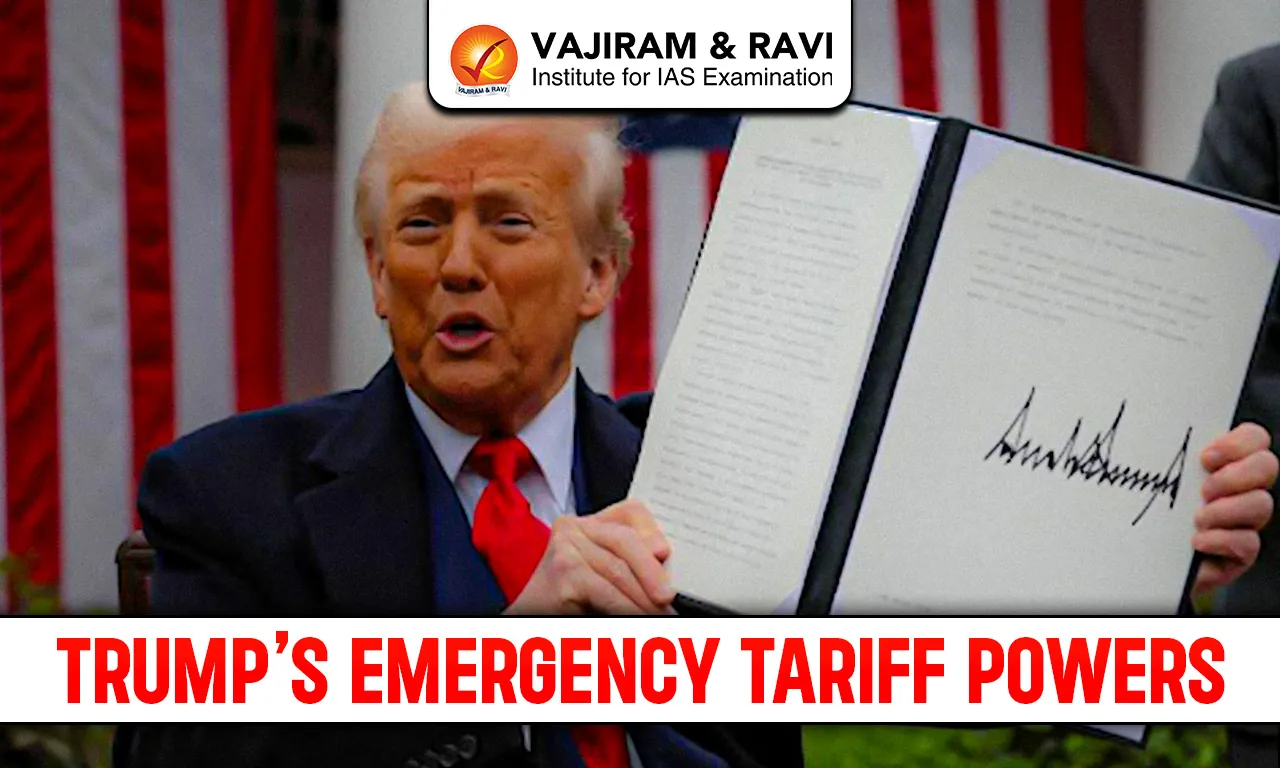
- The U.S. Supreme Court, in a 6–3 ruling, struck down President Donald Trump’s sweeping tariffs imposed under the International Emergency Economic Powers Act (IEEPA), 1977.
- The judgment marks a critical moment in the debate over separation of powers, executive overreach, and the future of U.S. trade policy.
- The ruling has significant implications for the global economy, including countries like India, which have been directly affected by U.S. tariff measures.
Constitutional Issue – Executive vs Legislative Authority
- Core constitutional principle:
- The U.S. Constitution grants Congress the authority to levy taxes and tariffs, not the President.
- Trump invoked IEEPA, a law meant for national emergencies, to impose tariffs without Congressional approval.
- The Court upheld a lower court ruling stating that this action exceeded presidential authority.
- Nature of IEEPA:
- Enacted in 1977 under President Jimmy Carter, it was historically used to freeze assets, impose sanctions. It does not explicitly mention tariffs.
- Trump became the first President to use IEEPA to impose tariffs.


Trump’s Tariff Strategy – Economic and Foreign Policy Tool
- Trade war and economic leverage:
- Trump used tariffs as a revenue-generating instrument (estimated $300 billion annually if fully retained).
- It is used as a foreign policy tool, a means to renegotiate trade deals, and a pressure mechanism against China, Canada, Mexico, India, and Brazil.
- “Liberation Day” tariffs (April 2, 2025):
- Announced “reciprocal tariffs” on most trading partners.
- Justified under a “national emergency” related to trade deficits.
- Also invoked IEEPA citing fentanyl trafficking and migration concerns.
- Economic impact:
- Over $175 billion collected under IEEPA-based tariffs (Penn-Wharton estimate).
- $195 billion net customs duty receipts in FY 2025 (record high).
- Refund liability likely after the Supreme Court ruling.
- Created global market uncertainty and financial volatility.
Legal Challenges and Federal Pushback
- Three lawsuits challenged the tariffs –
- Small importing businesses.
- 12 U.S. states (including Arizona, Colorado, New York).
- Federal rulings against the administration.
- The Court reaffirmed national emergency powers cannot become a substitute for legislative trade authority.
Alternative Tariff Mechanisms – Sections 122, 301, and 232
- After the ruling, Trump indicated he would explore other statutory options. For example,
- Section 122 (Trade Act, 1974):
- It allows up to 15% tariff to address serious balance-of-payments deficits. Never used before, it is valid for 150 days, unless extended by Congress.
- Trump signaled a 10% global tariff under this provision.
- Section 301 (Trade Act, 1974):
- It is a targeted and investigation-based (not sweeping) provision, triggered when the U.S. Trade Representative (USTR) finds “unfair trade practices”.
- Previously used against India over the Digital Services Tax (2020). Later resolved under OECD global minimum tax framework.
- Section 232 (Trade Expansion Act, 1962):
- It allows tariffs on national security grounds, and it is sector-specific (steel, aluminium, automobiles, etc.).
- India currently faces 232 tariffs on steel, aluminium, automobiles, and copper derivatives.
- Some relief possible under the recent U.S.-India trade understanding, including:
- Tariff removal on certain aircraft parts.
- Preferential TRQ (Tariff Rate Quota) for automotive parts.
- Negotiations in generic pharmaceuticals.
Broader Implications
- For the U.S. political system: Reassertion of judicial review. Curtailment of expansive executive authority. Reinforcement of Congressional primacy in taxation.
- For Global trade: Potential rollback or restructuring of tariff regimes. Increased uncertainty in the short term. Possible shift toward more rules-based trade measures. Affects WTO dynamics and global trade governance.
- For India: Relief potential in select sectors (aircraft parts, auto components). Continued exposure to 232 tariffs. Trade diplomacy becomes critical. Strategic balancing amid U.S.–China competition.
Challenges and Way Forward
- Conflict: Between Executive-Legislative branches over trade authority. Strengthening Congressional oversight in trade policy.
- Risk: Of renewed protectionism under alternative provisions. Greater adherence to multilateral trade norms (WTO-consistent measures). Targeted, transparent use of national security provisions.
- Instability: Of the global supply chain. Diplomatic engagement to prevent tariff escalation. For India, proactive trade negotiations and diversification of export markets is the way ahead.
Conclusion
- The Supreme Court’s ruling marks a pivotal constitutional correction in the United States, reinforcing the doctrine that emergency powers cannot be stretched into instruments of broad economic policy.
- For the global economy — and countries like India — the decision may reduce tariff unpredictability, but the era of strategic trade weaponisation is far from over.
- The episode underscores a larger global trend: trade policy is increasingly intertwined with national security, domestic politics, and geopolitical rivalry.

 Last updated on Oct, 2026
→ UPSC 2027 Notification will be released on 13 January 2027 at upsconline.nic.in.
→ Check Nobel Prize 2026 Winners List here.
→ Download PIB PRiSM Monthly Magazine 2026 here.
→ Check UPSC Monthly Current Affairs Magazine The Recitals here.
→ Check out the latest UPSC Syllabus here.
→ Download UPSC Model Answers for Mains 2026
→ UPSC Mains Question Paper 2026 is out now for Essay & GS Paper 1, 2, 3 & 4.
→ UPSC Calendar 2027 has been released.
→ Enroll in Vajiram & Ravi’s UPSC Mains Test Series 2027 for structured answer writing practice, expert evaluation, and exam-oriented feedback.
→ Join Vajiram & Ravi’s UPSC Mentorship Program 2027 for personalized guidance, strategy planning, and one-to-one support from experienced mentors.
→ Go through the UPSC Mains Previous Year Papers to enhance your preparation.
→ UPSC has released UPSC Toppers List 2025 with the Civil Services final result on its official website.
→ Also check Best UPSC Coaching in India
Trump’s Emergency Tariff Powers FAQs
Q1. What are the constitutional issues involved in the U.S. Supreme Court’s ruling against Trump’s tariffs?+
Q2. How did the use of tariffs under IEEPA reflect the growing trend of trade weaponisation?+
Q3. What are Section 301 and Section 232 of U.S. trade law?+
Q4. What are the implications of the U.S. Supreme Court judgment on global trade governance?+
Q5. What is the impact of U.S. tariff policies on India’s trade interests?+
Tags: mains articles trump’s emergency tariff powers upsc current affairs upsc mains current affairs