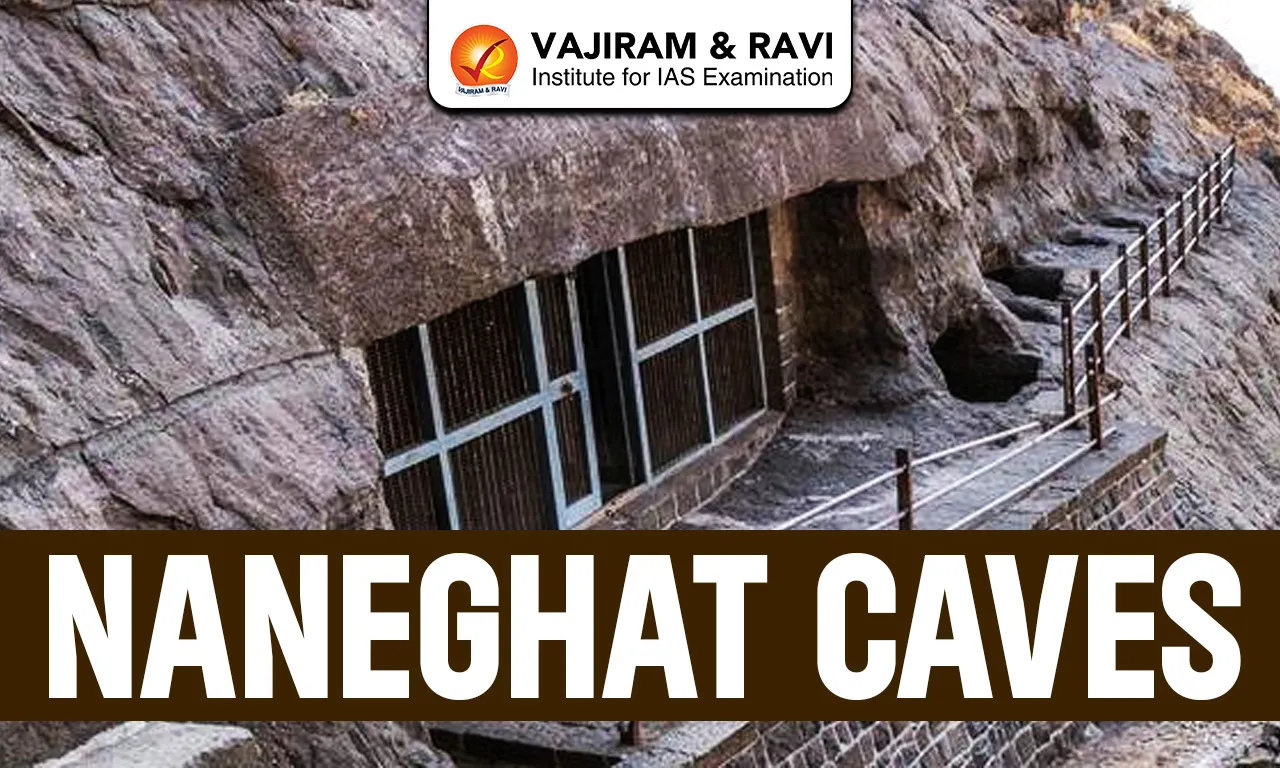
The Naneghat Caves were in the news due to concerns over illegal constructions, infrastructure activities, and environmental damage. The Archaeological Survey of India (ASI) took steps to safeguard the site from encroachments and damage.
Naneghat cave is an example of Rock-cut cave architecture in India. Rock-cut cave architecture is one of the most remarkable achievements of ancient Indian civilization. Rock-cut cave architecture is a style of building in which structures are carved directly into natural rock surfaces such as hills or mountains instead of being built with bricks or stones.
The tradition of carving caves into hills and mountains developed mainly with the spread of Buddhism and Jainism from around the 5th- 4th century BCE. These caves were used as monasteries, meditation spaces, and religious centres. Western India, especially Maharashtra, Karnataka, and parts of Madhya Pradesh, contains some of the finest examples of this architectural tradition.
About Nanaghat Caves
- Naneghat Caves are ancient caves located in the Western Ghats of Maharashtra near Junnar in Pune district.
- These caves are believed to be built around the Satavahana period (about 2nd century BCE to 1st century CE).
- In Marathi, “nane” means coin and “ghat” means mountain pass. Therefore, the Naneghat Caves were likely a place where traders had to pay tolls while crossing the mountain pass. In ancient times, this pass was very important for trade between the Konkan coastal region and the Deccan plateau.
- The site is historically important because of its Brahmi inscriptions, which provide information about the Satavahana dynasty and ancient trade networks between the Deccan plateau and the western coastal region.
- There is also a rock-cut water cistern inside the cave, which shows how people managed water storage in ancient times.
- Today, Naneghat Caves are protected as an archaeological site. Archeological Survey of India (ASI) prevents illegal construction, mining, or damage around the caves.
Junnar Region
- The Junnar taluka of Maharashtra is an important archaeological cluster.
- Three major heritage sites in this region are protected – Naneghat rock-cut caves, Shivneri fort and Lenyadri cave complex.
- The Shivneri Fort is historically significant as the birthplace of Chhatrapati Shivaji, and it also demonstrates advanced military and water management architecture.
- The Lenyadri Caves are part of a Buddhist cave complex containing chaitya halls and viharas carved into rocky hillsides.


Major Cave Complexes of Western India
The major cave complexes of Western India are important examples of ancient rock-cut architecture. Sites like the Naneghat Caves and other cave complexes reflect India’s rich historical, religious, and artistic heritage.
Ajanta Caves
- The Ajanta Caves are among the most famous Buddhist cave complexes in the world.
- Located in Maharashtra’s Aurangabad district, these caves were developed as a monastic centre for Buddhist monks.
- The complex contains 29 rock-cut caves, which include chaitya halls (prayer halls) and vihara caves (residential and learning spaces for monks).
- Ajanta is especially renowned for its wall paintings and sculptures depicting Buddhist mythology, Jataka tales, and scenes from the life of the Buddha.
- Famous artworks include the Bodhisattva paintings such as Padmapani and Vajrapani.
- Because of their outstanding artistic and historical importance, Ajanta was declared a UNESCO World Heritage Site in 1983.
Ellora Caves
- The Ellora Caves are unique because they represent the coexistence of three major religions of ancient India – Buddhism, Hinduism, and Jainism.
- The complex consists of 34 rock-cut caves extending over nearly two kilometres.
- The most remarkable structure is the Kailashnath Temple, Ellora, a massive monolithic temple carved from a single rock during the 8th century. This structure is considered one of the largest rock-cut monolithic temples in the world.
- Ellora is also listed as a UNESCO World Heritage Site.
Elephanta Caves
- The Elephanta Caves are located on Elephanta Island, which was originally known as Gharapuri.
- These caves mainly belong to the 5th century CE.
- They are famous for rock-cut Hindu temples dedicated to Lord Shiva.
- The most famous sculpture here is the gigantic three-faced Shiva sculpture, known as the Trimurti, symbolising the cosmic functions of creation, preservation, and destruction.
- The caves were later named Elephanta by Portuguese explorers because they installed a large stone elephant statue on the island.
- Elephanta caves are also recognised as a UNESCO World Heritage monument.
Badami Cave Temples
- The Badami caves are considered important examples of early Hindu rock-cut architecture.
- The Badami Cave Temples are carved into red sandstone hills in Karnataka.
- They were developed during the rule of the early Chalukya dynasty.
- The complex contains mainly three important caves dedicated to Hindu and Jain traditions. These caves are famous for mythological carvings, especially the depiction of Vishnu’s avatars such as Varaha, Narasimha, and Vamana.
- Another important artistic feature is the representation of Hari-Hara, a combined form of Shiva and Vishnu.
Bagh Caves
- The Bagh Caves are a Buddhist cave complex located in Madhya Pradesh.
- The caves are generally dated to the 5th–6th century CE.
- These caves are often compared with Ajanta because of their mural paintings, although Bagh caves are structurally simpler.
- The caves were used mainly as meditation and residential spaces for Buddhist monks.

 Last updated on Oct, 2026
→ UPSC 2027 Notification will be released on 13 January 2027 at upsconline.nic.in.
→ Check Nobel Prize 2026 Winners List here.
→ Download PIB PRiSM Monthly Magazine 2026 here.
→ Check UPSC Monthly Current Affairs Magazine The Recitals here.
→ Check out the latest UPSC Syllabus here.
→ Download UPSC Model Answers for Mains 2026
→ UPSC Mains Question Paper 2026 is out now for Essay & GS Paper 1, 2, 3 & 4.
→ UPSC Calendar 2027 has been released.
→ Enroll in Vajiram & Ravi’s UPSC Mains Test Series 2027 for structured answer writing practice, expert evaluation, and exam-oriented feedback.
→ Join Vajiram & Ravi’s UPSC Mentorship Program 2027 for personalized guidance, strategy planning, and one-to-one support from experienced mentors.
→ Go through the UPSC Mains Previous Year Papers to enhance your preparation.
→ UPSC has released UPSC Toppers List 2025 with the Civil Services final result on its official website.
→ Also check Best UPSC Coaching in India
Naneghat Caves FAQs
Q1. Where are the Naneghat Caves located?+
Q2. During which period were the Naneghat Caves built?+
Q3. Why is the name “Naneghat” significant?+
Q4. Why are the Naneghat Caves historically important?+
Q5. Which authority protects the Naneghat Caves today?+
Tags: naneghat caves