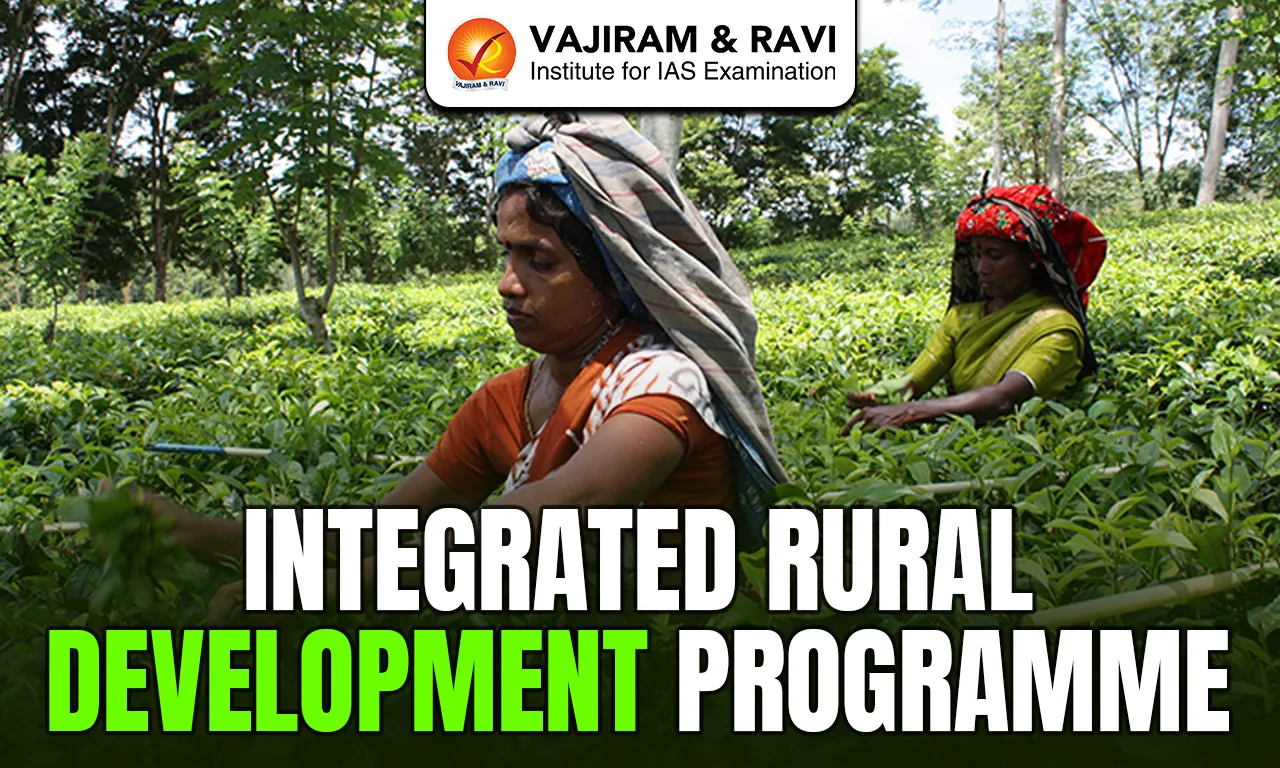
The Integrated Rural Development Programme was launched in 1978, is a government scheme to reduce rural poverty by providing assets, skills and financial support to poor families, helping them become self-reliant and improve their livelihoods.
About Integrated Rural Development Programme
- The Integrated Rural Development Programme (IRDP) was started by the Government of India in 1978 and put into action in 1980. It ran until 1999, after which it was merged with five other schemes and re-launched as the Swarnjayanti Gram Swarozgar Yojana (SGSY). The main aim of IRDP was to help the rural poor become self-reliant through self-employment.
- IRDP was created by combining earlier rural schemes like the Community Area Development Programme (CADP), Drought Prone Area Programme (DPAP), Small Farmer Development Agency (SFDA), and Marginal Farmers and Agricultural Labourers Agency (MFALA). This merger allowed the government to provide a more coordinated effort to fight poverty and support rural development.
- The scheme focused on reducing poverty, hunger and unemployment in villages. At the beginning, it was implemented in 2,000 out of the 5,004 development blocks in India. The National Common Minimum Programme (NCMP) of the central government also highlights that villages are essential for the country’s overall development and emphasizes the need to improve rural communities
Read about: United Nations Development Programme
Integrated Rural Development Programme Objectives
- Main Goal: Help poor rural families earn extra income so they can rise above the poverty line.
- Coverage: Around 55 million poor people benefited under the scheme at a cost of ₹13,700 per person to the government.
- Target Groups: Sharecroppers, marginal and small farmers, laborers, artisans, Scheduled Castes (SCs), Scheduled Tribes (STs) and other rural poor.
- Support Provided: Financial assistance, subsidies, loans, or credit to buy productive assets like tools, livestock or equipment.
- Self-Employment: Focuses on creating opportunities for rural people to earn their own livelihood.
- Partner Programs: Some associated schemes include:
- Development of Women and Children in Rural Areas (DWCRA)
- Ganga Kalyan Yojana (GKY)
- Million Wells Scheme (MWS)
- Supply of Improved Toolkits to Rural Artisans (SITRA)
- Training of Rural Youth for Self-Employment (TRYSEM)
- Sectoral Support: Promotes fisheries, livestock, poultry, social forestry and cottage industries in villages.
- Income and Living Standards: Aims to increase income and improve the overall living conditions of poor rural families.
- Empowerment: Helps disadvantaged people become self-reliant by giving them assets, skills and financial support.


Integrated Rural Development Programme (IRDP) Key Aspects
- Cumulative Sectoral Development
- Focuses on imp
- sectors grow together for balanced rural progress.
- Spatial Integration
- Look at the connection between resources (like raw materials) and where production or activities happen.
- Identifies areas that need extra attention to make development more effective.
- Individual and Group Development
- Ensures that development benefits reach not just a few, but the majority of rural people.
- Promotes fair distribution of funds and opportunities so everyone can improve their living standards.
- Socio-Economic and Environmental Balance
- Focuses on providing essentials like food, shelter, education and health to reduce poverty.
- Ensures that while using resources for development, the environment is protected for future generations.
Integrated Rural Development Programme (IRDP) Sixth Five-Year Plan Period
- The Integrated Rural Development Programme (IRDP) was mainly launched to fight poverty in villages.
- It aimed to help the poorest families get productive assets, skills, and knowledge so they could earn a stable income.
- These families also needed basic social services like housing, healthcare, and education to improve their living standards.
- Other important programs under this initiative included the National Rural Development Programme (NRDP) and the Minimum Needs Programme (MNP).
- The Panchayat Samitis were responsible for implementing these programs at the local level.
Integrated Rural Development Programme (IRDP) Beneficiaries
The IRDP is meant to help people in rural areas who are poor or struggling. The main beneficiaries are:
- Rural artisans – people in villages who make handicrafts or do traditional work.
- Laborers – those who work as daily wage workers or farm helpers.
- Small and marginal farmers – farmers who have very little land and income.
- Scheduled Castes (SCs) and Scheduled Tribes (STs) – groups officially recognized by the government for special support.
- Economically weaker people – anyone earning less than Rs. 11,000 per year.
Subsidies Provided Under Integrated Rural Development Programme (IRDP)
- Small farmers get 25% subsidy.
- Agricultural laborers and marginal farmers get 33.33% subsidy.
- SC/ST families, children and persons with disabilities get 50% subsidy.
- Maximum subsidy for SC/ST households and differently-abled persons: Rs 6,000 in general areas, Rs 5,000 in DPAP/DDP areas, Rs 4,000 in non-DPAP/non-DDP areas.
- Women and differently-abled individuals among SC/ST candidates are given extra preference.
- First preference is given to those with ceiling surplus land and green card holders under bonded labor or family welfare schemes.
- The program helps rural poor, marginalized farmers and disadvantaged groups improve their income and livelihood.
Integrated Rural Development Programme (IRDP) Implementation
The Integrated Rural Development Program (IRDP) is carried out by different organizations at different levels:
- Block-level staff: Work at the village and local level to implement the program on the ground.
- District Rural Development Agencies (DRDAs): Coordinate and manage the program at the district level.
- State Level Coordination Committee (SLCC): Oversees the program in each state.
- Ministry of Rural Areas and Employment: Provides funds, makes policies, monitors progress, evaluates the program and gives guidance.
Integrated Rural Development Programme (IRDP) Funding
- The Integrated Rural Development Program (IRDP) is a centrally sponsored scheme. The cost is shared equally between the Union Government and the States (50:50).
- The program has been running in all blocks across the country since 1980.
- Central funds are given to states based on how many rural poor they have compared to the total rural poor in India.
- Financial help is also provided by banks, cooperatives and regional rural banks in the form of subsidies and loans.
Integrated Rural Development Programme (IRDP) Targeted Areas
- Tribal areas: Madhya Pradesh and Odisha
- Agriculturally developed areas: Punjab, Haryana, Andhra Pradesh
- Agriculturally underdeveloped areas: Eastern Uttar Pradesh and Maharashtra
- Hilly regions: Jammu & Kashmir, West Bengal, Tamil Nadu
- Desert areas: Rajasthan
- Other states: Gujarat, Kerala, Karnataka have well-managed administration, while Bihar, Himachal Pradesh, and Madhya Pradesh have weaker administration
Integrated Rural Development Programme (IRDP) Significance
The Integrated Rural Development Program (IRDP) has been helping rural India for over 44 years, benefiting more than 6 lakh families, with 60% of them from Scheduled Castes (SCs) and Scheduled Tribes (STs). Its main aim is to reduce poverty and promote equality by giving disadvantaged groups a chance to improve their income and living standards. The government has implemented the program in different stages to reach more people and make it more effective. While there have been challenges in proper execution at the local level, the program has still been largely successful in providing support to the rural poor. Overall, IRDP has played an important role in helping marginalized communities become self-reliant and in promoting social and economic inclusion across rural India.

 Last updated on Oct, 2026
→ UPSC 2027 Notification will be released on 13 January 2027 at upsconline.nic.in.
→ Check Nobel Prize 2026 Winners List here.
→ Download PIB PRiSM Monthly Magazine 2026 here.
→ Check UPSC Monthly Current Affairs Magazine The Recitals here.
→ Check out the latest UPSC Syllabus here.
→ Download UPSC Model Answers for Mains 2026
→ UPSC Mains Question Paper 2026 is out now for Essay & GS Paper 1, 2, 3 & 4.
→ UPSC Calendar 2027 has been released.
→ Enroll in Vajiram & Ravi’s UPSC Mains Test Series 2027 for structured answer writing practice, expert evaluation, and exam-oriented feedback.
→ Join Vajiram & Ravi’s UPSC Mentorship Program 2027 for personalized guidance, strategy planning, and one-to-one support from experienced mentors.
→ Go through the UPSC Mains Previous Year Papers to enhance your preparation.
→ UPSC has released UPSC Toppers List 2025 with the Civil Services final result on its official website.
→ Also check Best UPSC Coaching in India
Integrated Rural Development Programme (IRDP) FAQs
Q1. What is the Integrated Rural Development Programme (IRDP)?+
Q2. Who were the main beneficiaries of the Integrated Rural Development Programme (IRDP)?+
Q3. What kind of support does the Integrated Rural Development Programme (IRDP) provide?+
Q4. How were subsidies under the Integrated Rural Development Programme (IRDP) provided?+
Q5. How was the Integrated Rural Development Programme (IRDP) implemented?+
Tags: governance governance notes Integrated Rural Development Programme