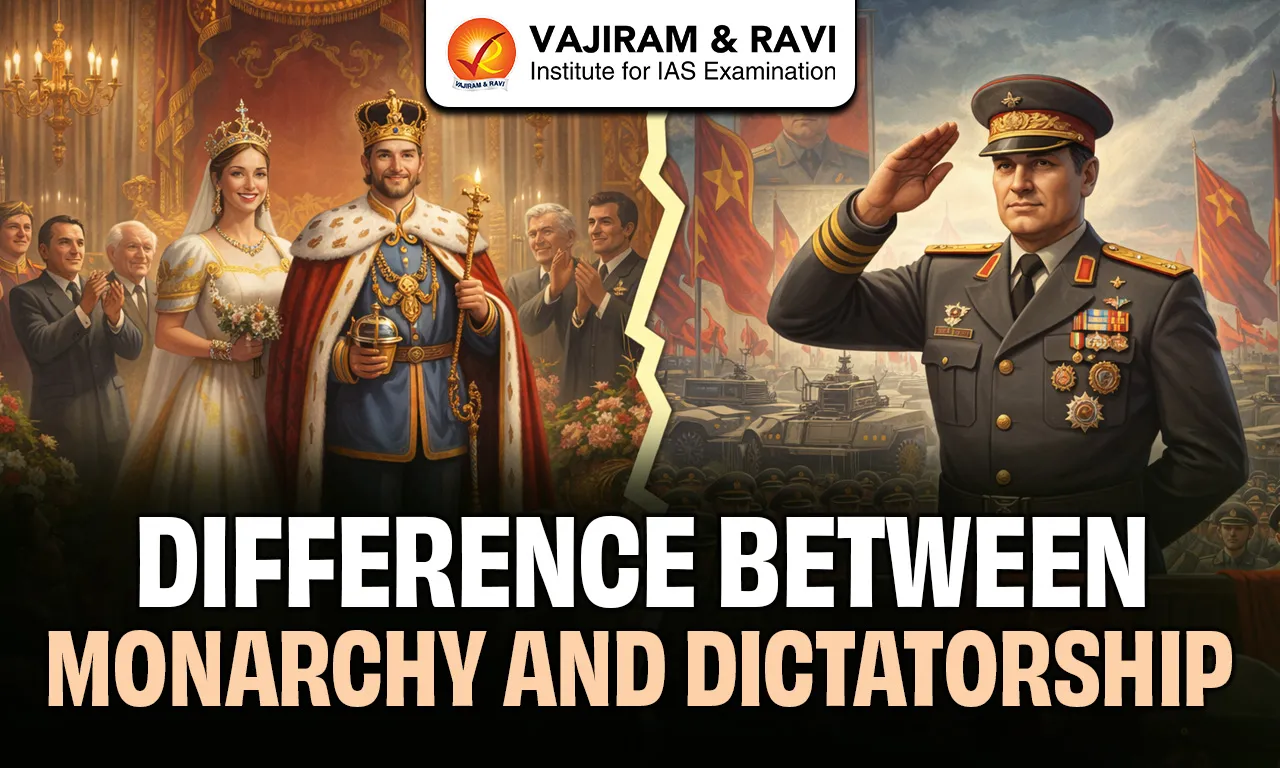
Monarchy and dictatorship are both forms of government where a single person holds supreme power, but the Difference Between Monarchy and Dictatorship lies in how that power is obtained and exercised. In a monarchy, power is usually inherited within a royal family, and the ruler, called a king, queen, or emperor may either have absolute authority or share power under a constitution. In contrast, a dictatorship is a system where one individual, known as a dictator, takes control by force, political manipulation, or other means, often ruling without the consent of the people. While monarchs inherit their position, dictators seize or maintain power through control, yet both systems involve centralized authority in the hands of one person.
Difference between Monarchy and Dictatorship
The table below discusses Difference between Monarchy and Dictatorship, highlighting how they differ in gaining power, governing, succession, civil liberties, and stability. It shows the key ways these two systems of rule operate and affect people’s lives.
| Difference between Monarchy and Dictatorship | ||
| Aspect | Dictatorship | Monarchy |
|
Source of Power |
Dictators usually take power by force, such as military coups or revolutions. They may not have any hereditary claim. |
Monarchs inherit power through their family. Authority passes by birthright or tradition. |
|
Legitimacy & Governance |
Power is justified through propaganda, ideology, or personality cult. The ruler has absolute authority with little room for opposition. |
Monarchs gain legitimacy from tradition, history, or national identity. Constitutional monarchs follow laws and may share power with elected governments. |
|
Rules & Accountability |
Dictators control institutions like courts and legislature, leaving little accountability. |
Constitutional monarchs are bound by laws and act on advice of elected officials. Absolute monarchs may act freely but usually have advisers. |
|
Succession |
Uncertain and often depends on power struggles or military support. Some dictators try to establish dynasties, but not always. |
Predictable and guided by tradition or laws, ensuring stable transitions within the royal family. |
|
Civil Liberties |
Freedoms like speech, press, assembly, and political participation are often restricted. |
Constitutional monarchies protect rights through laws. Absolute monarchs may limit freedoms depending on their policies. |
|
Stability |
Stability depends on the dictator’s control; regimes can collapse suddenly if challenged. |
Monarchies, especially constitutional ones, are usually stable due to tradition and institutions; they can also adapt over time. |
|
Economic & Social Impact |
Often centralizes resources and decision-making; citizens have little say in governance. |
Can vary: constitutional monarchies allow citizen participation, while absolute monarchies may centralize wealth and power. |
|
Adaptability |
Harder to adapt to changing needs since power is concentrated in one person. |
Constitutional monarchies can evolve with society; absolute monarchies may resist change but traditions provide continuity. |
Monarchy
A monarchy is a form of government where a king, queen, emperor, or sultan leads the country. Usually, the position is inherited, meaning it passes from one generation of the royal family to the next. In the past, monarchs had full control over the country, but today most monarchies are constitutional, where the king or queen mainly has a ceremonial role and does not make day-to-day decisions. Monarchies are often seen as stable because leadership stays within the same family, and traditions play a big role in how the government works.


Features of Monarchy
- Hereditary Succession: In a monarchy, the leadership usually stays within one family. The next ruler is often chosen based on rules like the eldest child inheriting the throne.
- Types of Monarchy:
- Absolute Monarchy: The king or queen has full control over the country and can make decisions without needing approval from anyone else.
- Constitutional Monarchy: The monarch has limited powers, mostly symbolic or ceremonial, while elected representatives run the government.
- Legitimacy and Tradition: Monarchs are often accepted because of long-standing traditions, culture and history. People respect them as part of the nation’s identity.
- Rules and Limits: In constitutional monarchies, laws limit what the monarch can do. In absolute monarchies, the ruler can act freely without legal restrictions.
- Stability and Continuity: Because the throne usually stays within the same family, monarchies can provide stability and a sense of continuity in the country.
Examples of Monarchies
- United Kingdom: The UK is a constitutional monarchy. Here, the king or queen mainly performs ceremonial duties, while the elected parliament runs the government.
- Saudi Arabia: Saudi Arabia is an absolute monarchy. The king has strong control over politics, laws, and even religious matters.
- Bhutan: Bhutan is a constitutional monarchy that mixes tradition with modern democracy. The king works together with elected leaders, balancing culture and governance.
Dictatorship
A dictatorship is a type of government where one person or a small group holds all the power. In this system, the ruler makes decisions without following democratic rules or being accountable to the people. In a dictatorship, the dictator controls the government completely. They often come to power by force, like through a military takeover, or by unfair elections. Unlike a monarchy, they do not inherit their position. Dictators can make laws, enforce rules and even limit citizens’ freedoms without checks or balances. Dictatorships often suppress opposition, restrict free speech and violate human rights to maintain control. Some modern examples include North Korea, Equatorial Guinea, Chad and Burundi.
Features of a Dictatorship
- Centralised Power: In a dictatorship, all power is held by one person or a small group. There are usually no checks or balances, so the ruler can make decisions freely.
- How Power is Gained: Dictators often come to power by force, such as military takeovers, revolutions, or when previous governments fail. They do not usually get their position through elections or inheritance.
- Suppression of Opposition: Political parties, free media and public protests are often banned or strictly controlled to prevent anyone from challenging the ruler.
- Restriction on Freedoms: Citizens have limited rights. Freedom of speech, assembly, and press are often curtailed. People can face punishment, surveillance or harsh measures if they oppose the government.
- Leadership and Succession: Some dictatorships revolve around one leader’s personality and can collapse when they leave power. Others may have succession rules, but these are often unclear and unpredictable.
Examples of Dictatorships
- North Korea: Ruled by the Kim family, with strict control over citizens’ lives and almost no personal freedoms.
- Syria: Under the Assad regime, the government controls the military and politics, limiting freedoms and punishing opposition.

 Last updated on Sep, 2026
→ UPSC 2027 Notification will be released on 13 January 2027 at upsconline.nic.in.
→ Check out the latest UPSC Syllabus here.
→ Download UPSC Model Answers for Mains 2026
→ UPSC Mains Question Paper 2026 is out now for Essay & GS Paper 1, 2, 3 & 4.
→ UPSC Calendar 2027 has been released.
→ Enroll in Vajiram & Ravi’s UPSC Mains Test Series 2027 for structured answer writing practice, expert evaluation, and exam-oriented feedback.
→ Join Vajiram & Ravi’s UPSC Mentorship Program 2027 for personalized guidance, strategy planning, and one-to-one support from experienced mentors.
→ Go through the UPSC Mains Previous Year Papers to enhance your preparation.
→ UPSC has released UPSC Toppers List 2025 with the Civil Services final result on its official website.
→ Also check Best UPSC Coaching in India
Difference between Monarchy and Dictatorship FAQs
Q1. What is a monarchy?+
Q2. What is a dictatorship?+
Q3. How do monarchs and dictators get power?+
Q4. How is governance different in monarchy and dictatorship?+
Q5. What about civil liberties in both systems?+
Tags: Difference Between Monarchy and Dictatorship polity polity notes