Trade Agreements Latest News
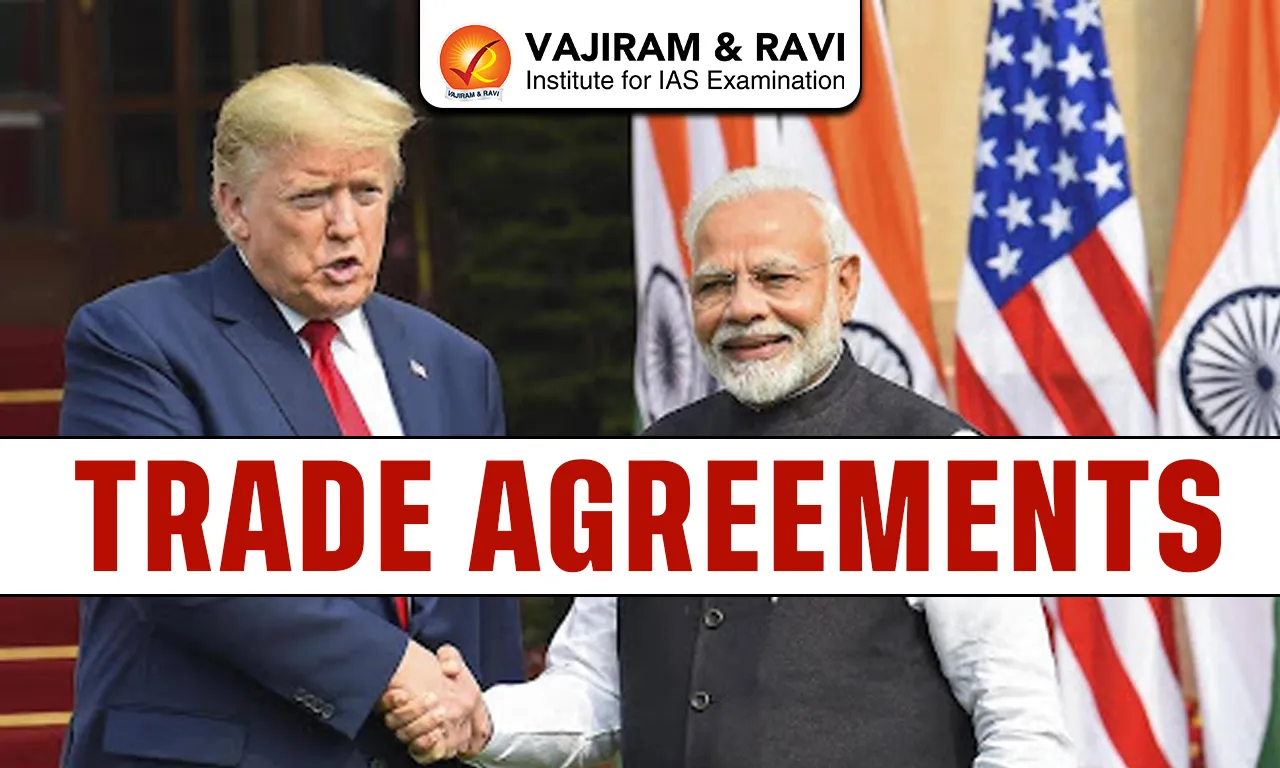
- The evolving nature of trade agreements has gained attention after the United States signed several “Agreements on Reciprocal Trade” (ARTs), including a proposed deal with India, raising questions about their compatibility with WTO rules.
Trade Agreements and Global Trade Governance
- Trade agreements formalise economic relations between countries by reducing tariffs, setting regulatory standards, and facilitating market access.
- Traditionally, international trade governance has revolved around the multilateral framework established under the General Agreement on Tariffs and Trade (GATT) and later the World Trade Organisation (WTO).
- However, recent developments indicate the emergence of new forms of trade arrangements that differ from conventional Free Trade Agreements (FTAs).
- The U.S., under President Donald Trump, has labelled its recent deals as “Agreements on Reciprocal Trade” (ARTs), creating what appears to be a new typology in international trade law.
- This shift has significant implications for global trade multilateralism.


Multilateral Trade Framework under GATT and WTO
- The GATT, established in 1947, laid the foundation for a non-discriminatory global trading regime.
- Its core principle is the Most-Favoured-Nation (MFN) rule, which mandates that any trade concession granted to one member must be extended to all other WTO members.
- The formation of the WTO in 1995 institutionalised this framework by:
- Expanding coverage from goods to services (GATS) and intellectual property (TRIPS).
- Creating a binding dispute settlement mechanism.
- Adopting a one-country-one-vote decision-making principle.
- For developing countries, the WTO system provides a platform to negotiate collectively and challenge unfair trade practices.
- Multilateralism, therefore, is designed to ensure predictability, transparency, and fairness in global trade.
Preferential Trade Agreements and WTO Exceptions
- While the WTO is built on non-discrimination, it permits certain exceptions under Article XXIV of GATT. These include Free Trade Agreements (FTAs) & Customs Unions (CUs).
- Such arrangements allow countries to grant preferential tariff treatment to specific partners without extending the same to all WTO members. However, these agreements must meet strict conditions:
- They must cover “substantially all trade” between members.
- Customs unions must adopt a common external tariff.
- Over the past three decades, FTAs have proliferated. Examples include large regional groupings such as the Regional Comprehensive Economic Partnership (RCEP).
- Many modern FTAs are WTO-plus, meaning they extend beyond tariff reductions to include labour standards, environmental commitments, and investment protection.
- Although FTAs deviate from MFN principles, they are notified to the WTO, allowing scrutiny and transparency.
Agreements on Reciprocal Trade
- The ARTs introduced by the U.S. represent a departure from established WTO-compatible FTAs. Key features include:
- They are not signed under Article XXIV of GATT.
- They are not notified to the WTO.
- They operate independently of multilateral oversight.
- ARTs reflect an “America First” trade policy. While the U.S. continues to impose tariffs that may not align with WTO commitments, partner countries are reportedly pressured into reducing or eliminating tariffs on U.S. goods.
- This asymmetry raises concerns about fairness and legal legitimacy.
WTO-Plus and One-Sided Provisions
- ARTs also contain WTO-plus and unilateral clauses that expand obligations for partner countries. For instance:
- Certain provisions reportedly require partner countries to adopt complementary trade restrictions if the U.S. invokes national security measures.
- Some ARTs restrict data sovereignty by prohibiting customs duties on electronic transmissions.
- These provisions may bind smaller economies more tightly to U.S. strategic and economic interests.
- Unlike WTO-compliant FTAs, ARTs do not provide an institutional mechanism for third-party review or dispute settlement within the WTO framework. This reduces transparency and weakens global oversight.
Implications for India and Developing Countries
- India has traditionally supported multilateralism while simultaneously pursuing bilateral FTAs with partners such as the EU, the U.K., and Australia.
- The proposed India-U.S. trade deal raises important policy questions:
- Should India enter into an ART-style agreement that may fall outside WTO norms?
- How can India safeguard tariff policy autonomy and digital sovereignty?
- What are the long-term implications for developing countries if multilateral rules are bypassed?
- Developing countries benefit from the WTO’s collective bargaining structure. A shift toward unilateral or reciprocal trade arrangements may fragment global trade governance and reduce policy space for smaller economies.
Broader Trends in Trade Governance
- The global trading system is witnessing three parallel trends:
- Multilateral stagnation due to deadlock in WTO negotiations and weakening of the dispute settlement system.
- Rise of bilateral and regional FTAs, many of which are comprehensive and WTO-plus.
- Emergence of unilateral reciprocal deals, which may not conform to WTO norms.
- This evolution reflects geopolitical competition and strategic economic policymaking.
- If ART-style agreements become widespread, they may undermine the foundational principle of non-discrimination and erode the legitimacy of the WTO.
Source: TH

 Last updated on Oct, 2026
→ UPSC 2027 Notification will be released on 13 January 2027 at upsconline.nic.in.
→ Check Nobel Prize 2026 Winners List here.
→ Download PIB PRiSM Monthly Magazine 2026 here.
→ Check UPSC Monthly Current Affairs Magazine The Recitals here.
→ Check out the latest UPSC Syllabus here.
→ Download UPSC Model Answers for Mains 2026
→ UPSC Mains Question Paper 2026 is out now for Essay & GS Paper 1, 2, 3 & 4.
→ UPSC Calendar 2027 has been released.
→ Enroll in Vajiram & Ravi’s UPSC Mains Test Series 2027 for structured answer writing practice, expert evaluation, and exam-oriented feedback.
→ Join Vajiram & Ravi’s UPSC Mentorship Program 2027 for personalized guidance, strategy planning, and one-to-one support from experienced mentors.
→ Go through the UPSC Mains Previous Year Papers to enhance your preparation.
→ UPSC has released UPSC Toppers List 2025 with the Civil Services final result on its official website.
→ Also check Best UPSC Coaching in India
Trade Agreements FAQs
Q1. What is the core principle of the WTO trading system?+
Q2. What does Article XXIV of GATT allow?+
Q3. What are Agreements on Reciprocal Trade (ARTs)?+
Q4. How do ARTs differ from conventional FTAs?+
Q5. Why are ARTs considered legally controversial?+
Tags: mains articles trade agreements upsc current affairs upsc mains current affairs