Bulldozer Justice Latest News
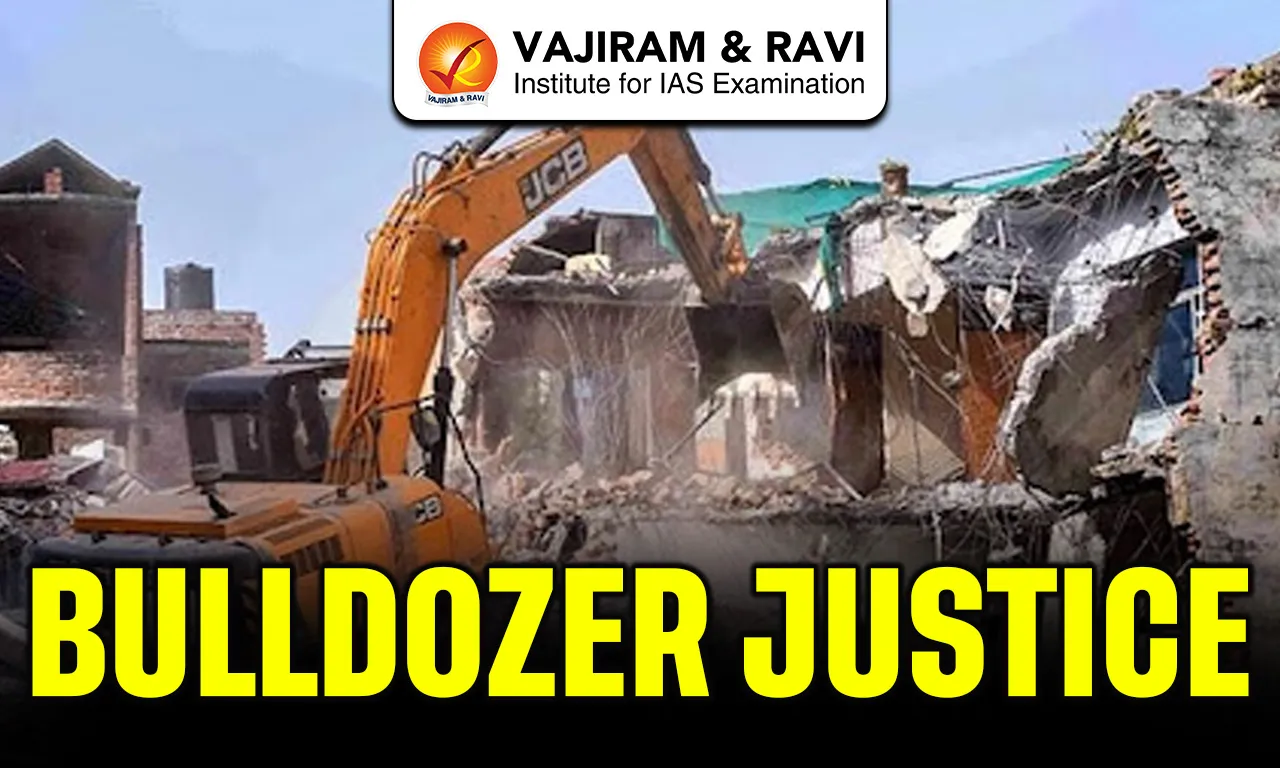
- Recent observations by the Allahabad High Court have brought renewed scrutiny to the practice of “bulldozer justice” in Uttar Pradesh, where properties of individuals accused of crimes are demolished soon after allegations arise.
- Critics argue that such punitive demolitions bypass the constitutional sequence of allegation, investigation, adjudication, and sanction, effectively turning executive discretion into punishment without due process.
- Although the Supreme Court in 2024 issued clear directions against unlawful demolitions, their continued occurrence highlights an ongoing tension between executive action and constitutional safeguards in a democratic system.
The Present Episode Before the Allahabad High Court
- A family from Hamirpur district approached the Allahabad High Court after authorities threatened demolition of their home and commercial property following an FIR against a relative.
- Although the petitioners were not accused, municipal notices were issued and properties sealed soon after the case was registered.
Court’s Observations
- Punishment Is a Judicial Function – The Division Bench noted that such demolition sequences were becoming routine and reaffirmed that punishment lies solely within the judiciary’s domain, not with administrative authorities.
- Constitutional Questions Raised – The court framed five key questions, including whether such demolitions violate Supreme Court directives and infringe constitutional guarantees under Articles 14 (equality) and 21 (right to life and liberty).
Legal Framework Governing Demolitions
- Under laws such as the Uttar Pradesh Municipal Corporation Act, 1959, and the Uttar Pradesh Urban Planning and Development Act, 1973, authorities can remove unauthorised constructions.
- However, demolition must follow due process:
- Identification of violation
- Written notice with grounds
- Opportunity to respond
- Consideration of objections
- Reasoned order
- Appeals and regularisation options are also available.
Limits of Executive Power
- Municipal laws are regulatory in nature and do not determine criminal guilt.
- The mere registration of an FIR does not render a property illegal or justify expedited demolition.
- Demolition is intended as a last-resort regulatory measure, not a substitute for judicial punishment.


The Court’s Guidance on Demolitions
- In Re: Directions in the Matter of Demolition of Structures (2024), the Supreme Court held that property cannot be demolished merely because its owner is accused of a crime.
- Criminal guilt must be established through proper judicial adjudication.
Limits on Municipal Powers
- Regulatory, Not Punitive – While municipal laws permit demolition of unauthorised constructions, these powers cannot be used as parallel instruments of punishment. Doing so would undermine the presumption of innocence and the rule of law.
- Substance Over Form – Courts examine not just the legal authority invoked but the intent and timing of action. Demolitions issued immediately after FIRs and targeting those linked to the accused may indicate punitive intent.
Colourable Exercise of Power
- Using lawful municipal powers to achieve an impermissible objective — such as punishing without trial — constitutes a “colourable exercise of power.”
- Such actions blur the separation of powers and allow the executive to impose consequences reserved for the judiciary.
- Depriving individuals of homes or livelihoods based solely on allegations violates core constitutional principles, including due process, presumption of innocence, and separation of powers.
Larger Constitutional Implications
- The Allahabad High Court’s intervention raises critical questions about whether even the threat of demolition can violate fundamental rights, what standards should govern preventive judicial relief, and how accountability can be ensured when municipal powers are misused.
- These concerns are far from theoretical. Demolitions can cause immediate and irreversible harm to families who may later be found innocent, while also weakening public trust in fair and impartial governance.
A Necessary Balance Between Regulation and Rights
- Enforcing Law Within Constitutional Limits – Urban authorities must enforce building regulations to maintain order. However, such powers must operate strictly within constitutional boundaries and administrative neutrality.
- Due Process as a Constitutional Safeguard – The Constitution protects individuals from deprivation of property without lawful procedure — including notice, hearing, a reasoned decision, and judicial oversight. Demolition before adjudication reverses this process and undermines due process.
- Distinguishing Regulation from Punishment – Bulldozers serve a legitimate purpose in urban governance, not as tools to determine guilt. When regulatory powers are used punitively, they become legally unsustainable and threaten the rule of law.
Source: TH

 Last updated on August, 2026
→ UPSC Mains Question Paper 2026 is out now for Essay & GS Paper 1, 2, 3 & 4.
→ UPSC Mains GS Paper 1 2026 is out now.
→ UPSC Mains GS Paper 2 2026 is out now.
→ UPSC Mains GS Paper 3 2026 is out now.
→ UPSC Mains GS Paper 4 2026 is out now.
→ UPSC Mains Indian Language Paper & English Compulsory Paper are out now.
→ Check out the latest UPSC Syllabus 2026 here.
→ UPSC Mains Admit Card 2026 is now out.
→ Enroll in Vajiram & Ravi’s UPSC Mains Test Series 2027 for structured answer writing practice, expert evaluation, and exam-oriented feedback.
→ Join Vajiram & Ravi’s UPSC Mentorship Program 2027 for personalized guidance, strategy planning, and one-to-one support from experienced mentors.
→ Go through the UPSC Mains Previous Year Papers to enhance your preparation.
→ Download UPSC Mains Essay Paper 2025, UPSC Mains GS Paper-I 2025, UPSC Mains GS Paper-II 2025, UPSC Mains GS Paper-III 2025, UPSC Mains GS Paper-IV 2025, UPSC Mains English (Compulsory) Paper 2025, UPSC Mains Hindi (Qualifying) Paper 2025 here.
→ UPSC has released UPSC Toppers List 2025 with the Civil Services final result on its official website.
→ UPSC Calendar 2027 has been released.
→ Also check Best UPSC Coaching in India
Bulldozer Justice FAQs
Q1. What is Bulldozer Justice?+
Q2. Why is Bulldozer Justice controversial?+
Q3. What did the Supreme Court say about Bulldozer Justice?+
Q4. How does Bulldozer Justice affect fundamental rights?+
Q5. What is the constitutional issue with Bulldozer Justice?+
Tags: Bulldozer Justice mains articles upsc current affairs upsc mains current affairs