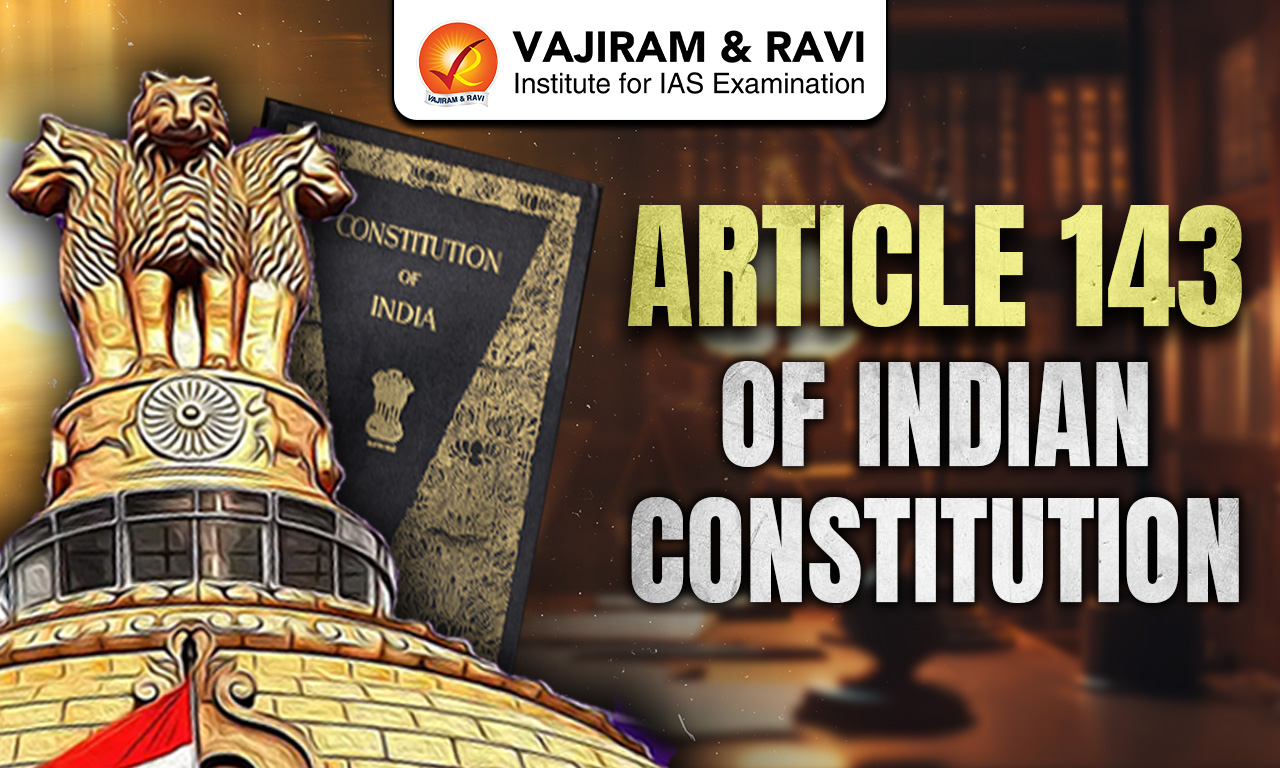
Article 143 of the Indian Constitution establishes the advisory jurisdiction of the Supreme Court of India which enables the President to seek its opinion on questions of law or facts that are of public importance. This provision acts as a constitutional consultative mechanism between the executive and the judiciary. It was adopted on 6 June 1949 by the Constituent Assembly. The Article allows constitutional doubts to be clarified without initiating adversarial litigation, thereby strengthening institutional dialogue and maintaining constitutional balance.
Article 143 of Indian Constitution
Article 143 of Indian Constitution authorizes the President to consult the Supreme Court on significant constitutional matters requiring authoritative legal interpretation. The provision contains two distinct clauses that define the scope of reference, the Court’s discretion, and the procedural framework. The President acts on the aid and advice of the Union Council of Ministers while making such a reference. As per Article 145(3), references under Article 143 are heard by a Constitution Bench of at least five judges, ensuring collective judicial wisdom in matters of national importance.
Article 143 of Indian Constitution Provisions
The provisions under the Article 143 of Indian Constitution lays down as:
Article 143 (1)
- Power to Seek Advisory Opinion: If the President believes that a question of law or fact has arisen, or is likely to arise, and it involves public importance, he may refer it to the Supreme Court for consideration and advisory opinion.
- Court’s Discretion to Respond: After receiving such reference, the Supreme Court may conduct hearings as it considers appropriate and has the discretion to either provide its advisory opinion or decline to answer the question.
Article 143 (2)
- Reference of Certain Federal Disputes: Notwithstanding the proviso to Article 131, the President may refer disputes mentioned in that proviso to the Supreme Court for its advisory opinion, even if they involve matters otherwise excluded from its original jurisdiction.
- Mandatory Opinion by Supreme Court: In cases referred under clause (2), the Supreme Court is required to conduct appropriate hearings and must report its opinion to the President, making its response obligatory rather than discretionary.


Article 143 of Indian Constitution Case Laws
Article 143 of Indian Constitution has been invoked around fifteen times since 1950, shaping major constitutional doctrines.
- Delhi Laws Act Case 1951: Clarified limits of delegated legislation and examined how much legislative power Parliament may transfer to the executive without violating constitutional structure.
- Kerala Education Bill 1958: Harmonized Fundamental Rights with Directive Principles, explaining how state regulation of minority educational institutions must respect constitutional protections.
- Berubari Union Case 1960: Held that transfer of Indian territory to a foreign state requires a constitutional amendment under Article 368, not merely executive action.
- Keshav Singh Case 1965: Explained legislative privileges and confirmed that judicial review can examine legislative actions where constitutional boundaries are crossed.
- Presidential Election Case 1974: Clarified that the election of the President cannot be invalid merely due to vacancies in State Legislative Assemblies.
- Special Courts Bill 1978: Recognized validity of pre-enactment judicial scrutiny, indicating that constitutional courts may examine legislative proposals before they become law.
- Cauvery Water Disputes 1991: Declared that Article 143 cannot be used to review or overturn settled Supreme Court judgments.
- Ram Janmabhoomi Reference 1993: The Court declined to answer, demonstrating discretion under Article 143(1) where issues were considered inappropriate for advisory determination.
Article 143 of Indian Constitution Significance
Article 143 of Indian Constitution ensures preventive constitutional clarification before executive decisions crystallize into disputes.
- Advisory Jurisdiction: Establishes a unique consultative power allowing only the President to trigger Supreme Court review without traditional litigation.
- Constitutional Bench Requirement: Article 145(3) mandates at least five judges, ensuring broad judicial consensus in matters of national constitutional interpretation.
- Non-Binding Nature: Opinions are advisory, not judgments under Article 141, yet carry persuasive authority usually respected by legislature and executive.
- Origin in 1935 Act: Derived from Section 213 of the Government of India Act, 1935, which allowed the Governor-General to consult the Federal Court.
- Federal Harmony: Clarifies Centre-State constitutional boundaries, particularly in legislative competence and assent-related conflicts.
- Judicial Discretion: The Court may decide procedure, including oral hearings or written submissions, preserving procedural autonomy.
- Suo Motu Power: The Supreme Court cannot initiate advisory review independently; Presidential reference is mandatory.
- Comparative Perspective: Unlike the United States Supreme Court, which refuses advisory opinions, India follows a model similar to Canada permitting constitutional consultation.

 Last updated on August, 2026
→ UPSC Mains 2026 commenced on 21st August 2026 and will continue through 30th August 2026, as per the official examination schedule.
→ UPSC Mains Question Paper 2026 is out now for Essay & GS Paper 1, 2, 3 & 4.
→ UPSC Mains GS Paper 1 2026 is out now.
→ UPSC Mains GS Paper 2 2026 is out now.
→ UPSC Mains GS Paper 3 2026 is out now.
→ UPSC Mains GS Paper 4 2026 is out now.
→ UPSC Mains Indian Language Paper & English Compulsory Paper are out now.
→ Check out the latest UPSC Syllabus 2026 here.
→ UPSC Mains Admit Card 2026 is now out.
→ Enroll in Vajiram & Ravi’s UPSC Mains Test Series 2027 for structured answer writing practice, expert evaluation, and exam-oriented feedback.
→ Join Vajiram & Ravi’s UPSC Mentorship Program 2027 for personalized guidance, strategy planning, and one-to-one support from experienced mentors.
→ Go through the UPSC Mains Previous Year Papers to enhance your preparation.
→ Download UPSC Mains Essay Paper 2025, UPSC Mains GS Paper-I 2025, UPSC Mains GS Paper-II 2025, UPSC Mains GS Paper-III 2025, UPSC Mains GS Paper-IV 2025, UPSC Mains English (Compulsory) Paper 2025, UPSC Mains Hindi (Qualifying) Paper 2025 here.
→ UPSC has released UPSC Toppers List 2025 with the Civil Services final result on its official website.
→ UPSC Calendar 2027 has been released.
→ Also check Best UPSC Coaching in India
Article 143 of Indian Constitution FAQs
Q1. What is Article 143 of Indian Constitution?+
Q2. Is the Supreme Court’s opinion under Article 143 of Indian Constitution binding?+
Q3. Can the Supreme Court refuse to answer a reference under Article 143 of Indian Constitution?+
Q4. What is the difference between Article 143(1) and Article 143(2)? +
Q5. How many times has Article 143 of Indian Constitution been used? +
Tags: article 143 of indian constitution constitution