India–Brazil Critical Minerals MoU Latest News
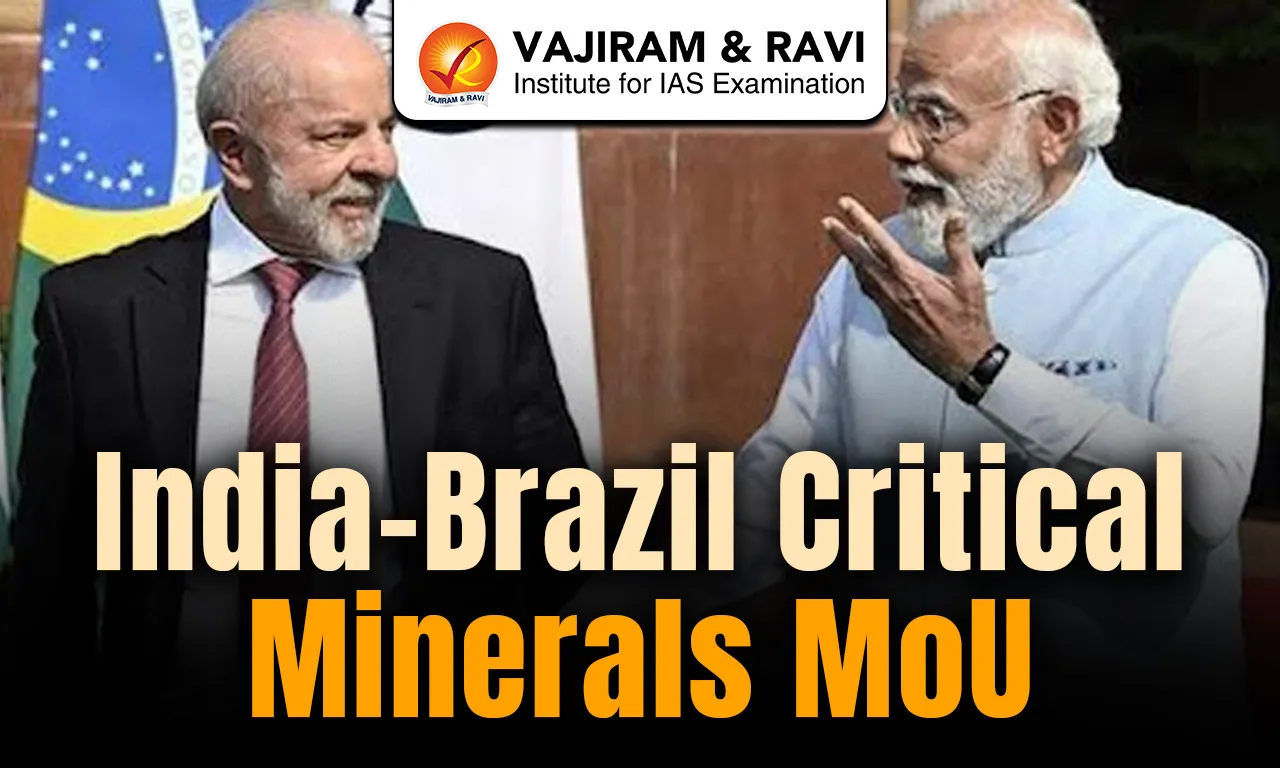
- India and Brazil signed an MoU on rare earths and critical minerals during President Lula da Silva’s visit to India in February 2026.
- The agreement aims to deepen cooperation across the entire mineral value chain — including exploration, mining, processing, refining, and recycling.
- Both countries seek to strengthen supply chains, enhance competitiveness, and secure reliable access to critical resources essential for strategic and industrial sectors.
India’s Strategy on Critical Minerals
- India is working to strengthen its capabilities across the entire critical minerals value chain — from exploration and mining to processing, recycling, and recovery.
- In January 2025, the Union Cabinet approved the National Critical Mineral Mission (2024–25 to 2030–31) to accelerate domestic exploration, beneficiation, processing, and recovery from end-of-life products.
Policy and Regulatory Measures
- Identification of Critical Minerals – In July 2023, India released a list of 30 critical minerals essential for strategic and industrial sectors.
- Legal Reforms – The Mines and Minerals (Development and Regulation) Amendment Act, 2023 empowered the Centre to auction blocks for critical and strategic minerals. By September 2025, multiple auction rounds had been conducted.
- Overseas Partnerships – To reduce reliance on a single country, India is expanding international cooperation. Khanij Bidesh India Ltd. (KABIL) is pursuing overseas acquisitions and exploration agreements in countries such as Argentina and Chile.
- Trade and Cost Rationalisation – India has reduced customs duties on certain critical minerals and recyclable scrap to lower input costs and improve domestic processing capacity.
- Boosting Advanced Manufacturing – The government is promoting late-stage manufacturing. India aims to begin domestic production of rare-earth permanent magnets by end-2026 to cut import dependence in sectors like electric vehicles and defence.


What the India–Brazil MoU Means for India
- Access to Substantial Mineral Reserves – Brazil possesses significant rare earth and critical mineral reserves, of which only about 30% have been explored. The MoU opens avenues for India to partner in exploration and processing, potentially expanding its long-term resource base.
- Strengthening India’s Bargaining Power – Diversifying supply sources enhances India’s leverage in global markets. With Brazil as an alternative partner, India is less dependent on a limited number of suppliers, improving its negotiating position on pricing and terms.
- Enhancing Supply Chain Stability – The agreement signals greater supply security to Indian industries. By reducing vulnerability to export controls or geopolitical disruptions, it can encourage higher private-sector investment in downstream manufacturing.
- Facilitating Standards and Market Access – If India and Brazil harmonise environmental and sourcing standards, Indian manufacturers could more easily access global markets that require transparent and responsible mineral supply chains.
Link Between the India–Brazil MoU and Pax Silica
- Pax Silica is a U.S.-led initiative aimed at securing the “silicon stack” — from raw materials and manufacturing equipment to advanced computing, data centres, and AI hardware.
- India joined the initiative on February 20, 2026.
- The India–Brazil critical minerals MoU complements Pax Silica’s broader goal of securing supply chains.
- By improving access to and processing of key minerals, the MoU could support one component of the secure silicon ecosystem.
- However, the MoU does not make Brazil a Pax Silica member, nor will cooperation under the MoU operate as a Pax Silica project.
- It remains a separate bilateral arrangement aligned with broader supply chain security objectives.
What the India–Brazil MoU Means for Brazil
- Leveraging Vast Mineral Reserves – Brazil holds substantial reserves of rare earths, bauxite, manganese, and lithium. The MoU provides an opportunity to convert this mineral wealth into greater industrial value rather than merely exporting raw materials.
- Attracting Investment and Buyers – The agreement can help Brazil draw Indian investment into exploration, mining, and processing projects. Long-term purchase commitments from a large and growing market like India make financing new mines and processing facilities more viable.
- Moving Up the Value Chain – By covering exploration, mining, refining, recycling, and processing, the MoU aligns with Brazil’s objective to strengthen its domestic value chain and reduce dependence on raw ore exports.
- Enhancing Strategic Leverage – Partnership with India strengthens Brazil’s bargaining power in global critical mineral markets, diversifies its partnerships, and positions it as a more influential player in supply chain negotiations.
Source: TH

 Last updated on Oct, 2026
→ UPSC 2027 Notification will be released on 13 January 2027 at upsconline.nic.in.
→ Check Nobel Prize 2026 Winners List here.
→ Download PIB PRiSM Monthly Magazine 2026 here.
→ Check UPSC Monthly Current Affairs Magazine The Recitals here.
→ Check out the latest UPSC Syllabus here.
→ Download UPSC Model Answers for Mains 2026
→ UPSC Mains Question Paper 2026 is out now for Essay & GS Paper 1, 2, 3 & 4.
→ UPSC Calendar 2027 has been released.
→ Enroll in Vajiram & Ravi’s UPSC Mains Test Series 2027 for structured answer writing practice, expert evaluation, and exam-oriented feedback.
→ Join Vajiram & Ravi’s UPSC Mentorship Program 2027 for personalized guidance, strategy planning, and one-to-one support from experienced mentors.
→ Go through the UPSC Mains Previous Year Papers to enhance your preparation.
→ UPSC has released UPSC Toppers List 2025 with the Civil Services final result on its official website.
→ Also check Best UPSC Coaching in India
India–Brazil Critical Minerals MoU FAQs
Q1. What is the India–Brazil Critical Minerals MoU about?+
Q2. How does the India–Brazil Critical Minerals MoU benefit India?+
Q3. What does the India–Brazil Critical Minerals MoU mean for Brazil?+
Q4. Does the India–Brazil Critical Minerals MoU link to Pax Silica?+
Q5. Why are critical minerals important in the India–Brazil Critical Minerals MoU?+
Tags: India–Brazil Critical Minerals MoU mains articles upsc current affairs upsc mains current affairs