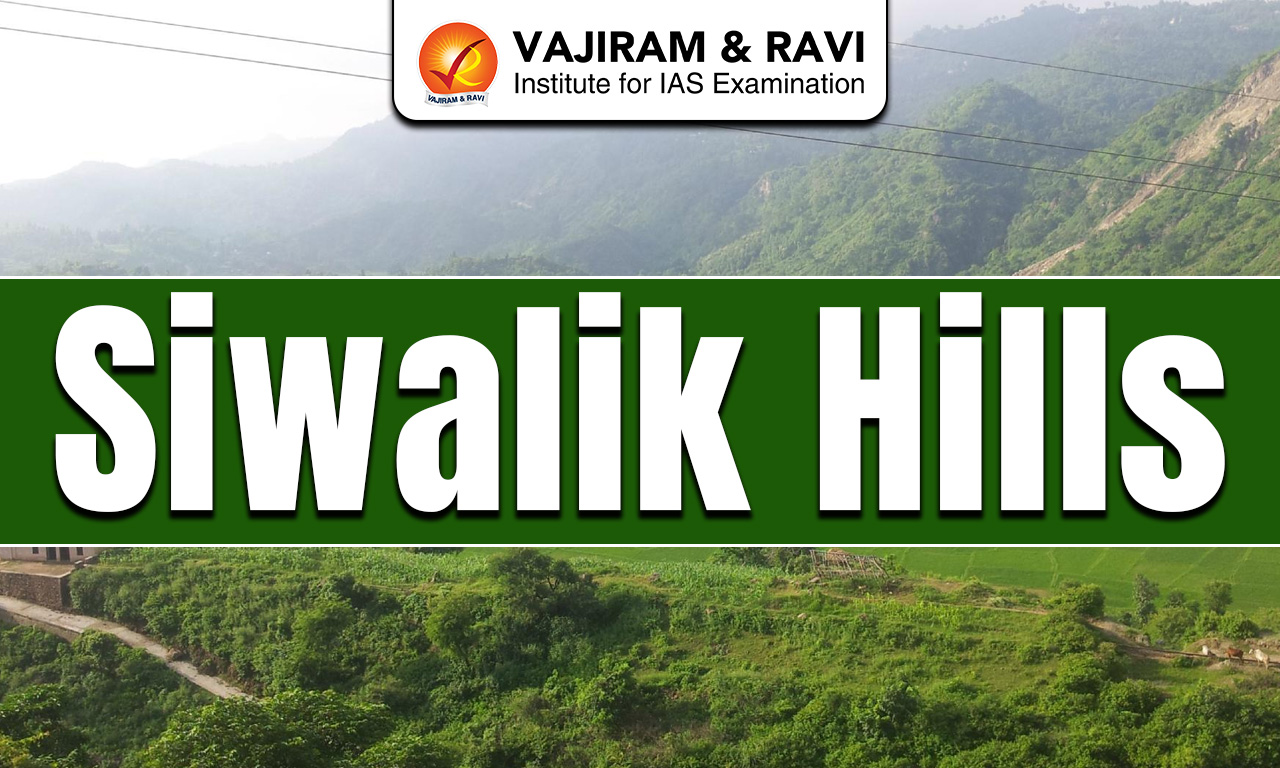
The Siwalik Hills, also called the Shivalik or Outer Himalaya, form the southernmost belt of the Himalayan mountain system. The term “Shivalik” literally means “tresses of Shiva,” reflecting its deep cultural roots in the Indian subcontinent. Stretching nearly 2,400 kilometres from the Indus region in the northwest to areas close to the Brahmaputra basin in the east, this range spreads across India, Nepal, Bhutan and Pakistan. As the youngest Himalayan fold belt, it plays a decisive role in shaping regional drainage, soil formation, biodiversity and human settlement patterns.
Siwalik Hills
The Siwalik Hills constitute the lowest and geologically youngest division of the Himalayas, positioned between the Great Plains to the south and the Lesser Himalaya to the north. Their elevation generally ranges between 600 and 1,500 metres, occasionally rising close to 2,000 metres in certain sectors. The width varies from about 10 to 50 kilometres, being broader in Himachal Pradesh and narrower in Arunachal Pradesh. They are known regionally as Jammu Hills, Churia Hills, Dafla Hills and other names. They display strong east-west continuity while remaining structurally separated by valleys and river gaps.
Siwalik Hills Features
Siwalik Hills display unique geological, structural and geomorphic characteristics shaping northern India’s landscape and ecological systems.
- Classification: The Siwalik sediments are classified into Lower, Middle and Upper Siwaliks based on age and composition.
- Origin: The Siwaliks belong to Tertiary deposits of the Outer Himalayas and were formed between about 16 and 5.2 million years ago through sediment accumulation derived from erosion of higher Himalayan ranges.
- Rock Composition: The range consists mainly of poorly consolidated sandstone, conglomerates, gravel, silt and clay, representing solidified detritus transported by rivers from the Greater Himalaya over millions of years.
- Himalayan Division: They represent the most recent phase of Himalayan uplift, mainly developed during the Neogene and extending into Pleistocene times, making them structurally less stable compared to older Himalayan units.
- Elevation: Heights generally range from 600 to 1,500 metres, rarely exceeding 1,300 metres in many sectors, with some eastern segments approaching around 2,000 metres.
- Extent: The hills extend for approximately 2,400 kilometres from the Indus River region towards areas near the Brahmaputra basin, forming a continuous outer arc of the Himalayas.
- Boundary: The southern margin is defined by the Main Frontal Thrust, a major fault system marking tectonic contact between the Siwaliks and the Indo-Gangetic plains.
- Slope: Southern slopes are generally steeper compared to northern slopes, particularly noticeable in Himachal Pradesh and Punjab where seasonal streams deeply dissect the terrain.
- Seasonal Rivers: Numerous seasonal rivers, locally called “choes,” “khads,” or “raus,” flow across the hills, swelling during monsoon months and transporting heavy sediment loads.
- Alluvial Deposition: Sediments carried by Himalayan rivers accumulate along the foothills, forming coarse alluvial zones known as Bhabar, which gradually transition into the marshy Terai belt further south.
- Dun Valleys: Longitudinal valleys called “duns” such as Dehradun, Kotli Dun and Patli Dun developed between the Siwaliks and Lesser Himalaya due to sediment blockage and later river incision. Initial conglomerate deposition blocked river channels, creating temporary lakes; later river cutting drained these lakes, leaving flat bottomed fertile valleys termed duns in the west and duars in the east.
- River Gaps: A significant gap of about 90 kilometres exists between the Teesta and Raidāk rivers, interrupting the otherwise continuous hill alignment.
- Drainage Influence: Major river systems including the Yamuna, Ganga and Ghaggar pass through or alongside the Siwaliks, contributing fertile soils to adjoining plains.
- Thrusting Mechanism: The formation involved thrusting of younger sedimentary layers over older deposits, reflecting ongoing tectonic convergence in the Himalayan foreland basin.
- Seismic Sensitivity: Being located in a tectonically active zone, the region is prone to earthquakes, and its loose sedimentary composition increases vulnerability to ground shaking.
- Climate Pattern: The climate is predominantly subtropical, characterised by hot summers, cool winters and strong monsoon influence, particularly on southern slopes.
- Fossil: The Siwaliks are globally significant for Neogene and Pleistocene vertebrate fossils dating from roughly 18 million to 600,000 years before present.
- Fossil Species: Important discoveries include Megalochelys atlas, the largest known tortoise; Sivatherium giganteum, a massive giraffid; Megantereon falconeri, a sabertooth cat; and the ape Sivapithecus.
- Cultural Names: Different regions assign local names such as Jammu Hills in Jammu region, Churia Ghat Hills in Nepal, and Dafla or Mishmi Hills in northeastern sectors.
- Isolation: Despite forming a continuous arc, the Siwaliks are considered one of the most isolated Himalayan divisions due to distinct structural and geomorphic separation from adjacent ranges.
- Carbon Sequestration: Forested sectors, especially protected areas, show higher carbon stock and sequestration rates compared to regions under open or degraded forest management regimes.
Also Read: Mountain Ranges in India


Siwalik Hills Biodiversity
The Siwalik Hills support diverse subtropical forests, grasslands and riverine ecosystems sustaining rich plant and animal life.
Flora
- Tropical Deciduous Forests: Dominant vegetation includes tropical deciduous forests, particularly in eastern sectors where rainfall is higher and forest density remains comparatively strong.
- Sal Dominance: Sal forests form a major component in moist zones, providing ecological stability and supporting multiple associated understory species.
- Teak Presence: Teak trees are found in suitable climatic pockets, contributing to timber resources and ecological diversity within subtropical forest belts.
- Sheesham Growth: Sheesham thrives along riverine tracts, benefiting from fertile alluvial soils deposited by seasonal streams.
- Grassland Ecosystems: Fertile valleys and foothill plains support grasslands that sustain herbivore populations and prevent excessive soil erosion.
- Riverine Vegetation: Riparian belts along choes and khads contain moisture loving plant species adapted to seasonal flooding and sediment deposition.
- Forest Cover Gradient: Forest density decreases westward from Nepal towards Punjab and Himachal Pradesh due to declining rainfall from east to west.
- Erosion Impact on Vegetation: Southern slopes in Punjab and Himachal Pradesh show reduced forest cover where seasonal streams have caused deep channel cutting.
- Protected Forest Zones: Areas under formal protection exhibit greater biomass density and improved regeneration compared to exploited or fragmented landscapes.
- Alluvial Soil Fertility: The combination of coarse Bhabar deposits and finer Terai soils enhances plant growth diversity across transitional ecological belts.
Fauna
- Vertebrate Fossil Diversity: Fossil evidence reveals long term faunal diversity including ancient elephants, horses, rhinoceroses and giant reptiles from Miocene to Pleistocene periods.
- Megalochelys Atlas: This gigantic tortoise, one of the largest ever recorded, represents a hallmark discovery from Siwalik fossil beds.
- Sivatherium Giganteum: Recognised as one of the largest giraffids known, this species indicates past grassland and woodland ecosystems in the region.
- Megantereon Falconeri: The presence of this sabertooth cat fossil demonstrates existence of large carnivores during prehistoric times.
- Sivapithecus Evidence: Fossils of this ape genus provide important clues about primate evolution in South Asia during the Miocene epoch.
- Soanian Cultural Association: Stone tool remains linked to Soanian culture indicate coexistence of early human populations with diverse faunal species.
- Elephant Habitats: Present day forests support elephant populations, particularly in protected landscapes along riverine and forest corridors.
- Tiger Presence: Dense forest tracts provide habitat conditions suitable for large predators such as tigers within conserved zones.
- Leopard Distribution: Leopards adapt well to the fragmented hill forests and are reported across multiple Siwalik sectors.
- Deer Species: Grasslands and mixed forests sustain various deer species, forming essential prey base within ecological food chains.
- Monkey Populations: Subtropical forests and human settlement edges support several monkey populations adapted to varied vegetation types.
- Carbon rich Forest Fauna Link: Higher carbon stock forests in protected areas correlate with richer wildlife presence due to better habitat stability and food availability.

 Last updated on Sep, 2026
→ UPSC 2027 Notification will be released on 13 January 2027 at upsconline.nic.in.
→ Asian Games 2026 are being held in Aichi-Nagoya, Japan, from 19 September to 4 October.
→ Check out the latest UPSC Syllabus here.
→ Download UPSC Model Answers for Mains 2026
→ UPSC Mains Question Paper 2026 is out now for Essay & GS Paper 1, 2, 3 & 4.
→ UPSC Calendar 2027 has been released.
→ Enroll in Vajiram & Ravi’s UPSC Mains Test Series 2027 for structured answer writing practice, expert evaluation, and exam-oriented feedback.
→ Join Vajiram & Ravi’s UPSC Mentorship Program 2027 for personalized guidance, strategy planning, and one-to-one support from experienced mentors.
→ Go through the UPSC Mains Previous Year Papers to enhance your preparation.
→ UPSC has released UPSC Toppers List 2025 with the Civil Services final result on its official website.
→ Also check Best UPSC Coaching in India
Siwalik Hills FAQs
Q1. What are the Siwalik Hills?+
Q2. What is the average elevation of the Siwalik Hills?+
Q3. Why are the Siwalik Hills geologically important?+
Q4. What are ‘Dun’ valleys in the Siwalik region?+
Q5. What type of climate do the Siwalik Hills experience?+
Tags: geography siwalik hills