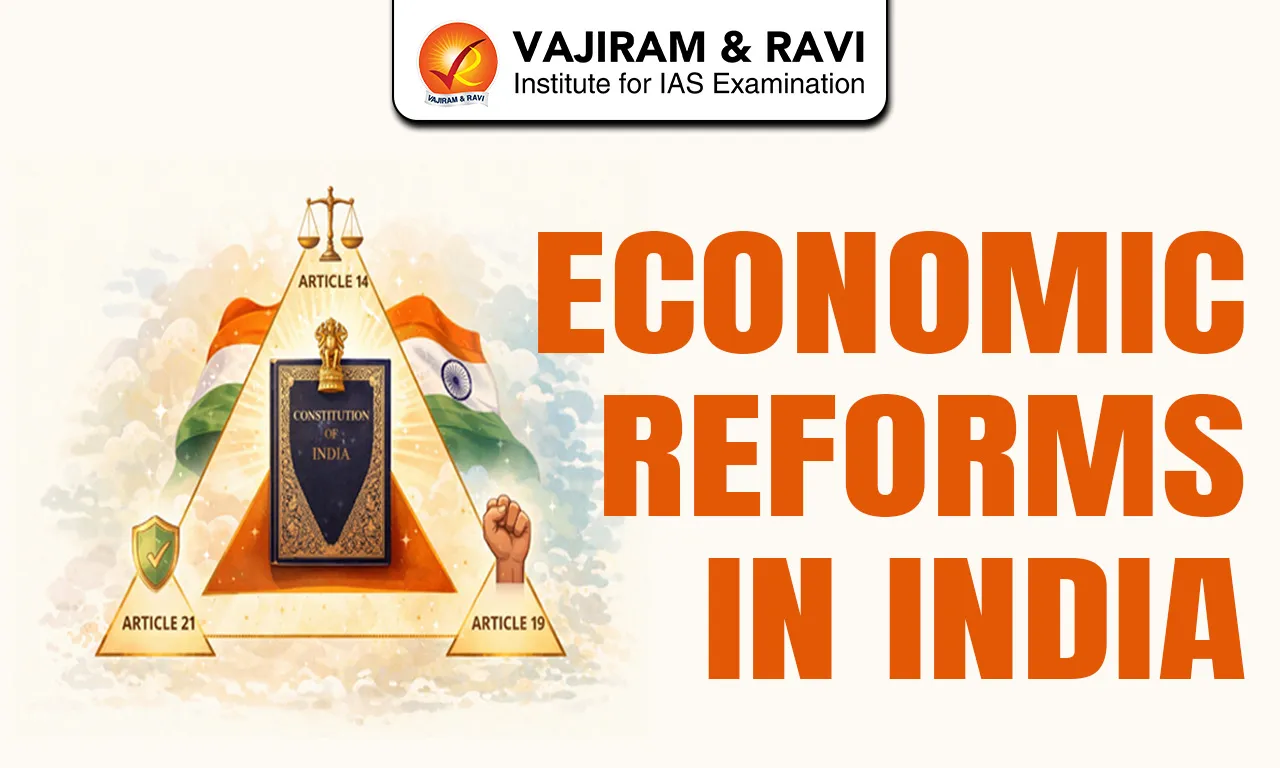
The Golden Triangle of the Indian Constitution refers to the close relationship between Article 14, Article 19, and Article 21. These three Fundamental Rights are considered very important because they protect the basic freedoms and rights of citizens. Together, they form the core of the Fundamental Rights framework and play an important role in safeguarding individual liberty in India. In this article the Golden Triangle of Indian Constitution has been discussed in detail.
Golden Triangle of the Indian Constitution Meaning
- The Golden Triangle of the Indian Constitution refers to the close relationship between Article 14, Article 19 and Article 21 of the Constitution of India. These three Fundamental Rights play a crucial role in ensuring equality, freedom, and personal liberty for all individuals. Article 14 ensures equality before the law, Article 19 provides important freedoms such as freedom of speech, expression, assembly, and movement, and Article 21 guarantees the right to life and personal liberty.
- These rights are closely connected and support one another. Equality before the law helps people enjoy their freedoms without discrimination, and the right to life and personal liberty ensures that individuals can live with dignity. In this way, these three articles together protect the essential rights of citizens.
- Because of this strong connection, the three articles are considered interdependent and cannot be interpreted separately. When they are read together, they create a strong framework that protects individual liberty and prevents unfair actions by the state. For this reason, they are popularly known as the Golden Triangle of the Indian Constitution, forming the core of the Fundamental Rights system and supporting democratic values in India.
Golden Triangle of Indian Constitution Articles
The Golden Triangle of the Indian Constitution refers to the relationship between Article 14, Article 19, and Article 21. These three Fundamental Rights together protect the core values of the Constitution – equality, freedom, and personal liberty. They are considered very important because they ensure that every individual is treated fairly and that the state does not act in an arbitrary or unjust manner. These articles are closely connected and are often understood together to safeguard the basic rights of citizens.
Article 14 – Right to Equality:
It guarantees equality before the law and equal protection of the laws to all persons. It ensures that the state treats everyone fairly and does not discriminate without a reasonable basis.
Article 19 – Right to Freedom:
This article provides several important freedoms to citizens, such as freedom of speech and expression, peaceful assembly, association, movement, residence, and profession. These freedoms are essential for the proper functioning of a democratic society.
Article 21 – Protection of Life and Personal Liberty:
It states that no person can be deprived of life or personal liberty except according to the procedure established by law. Over time, the Supreme Court has interpreted this article broadly to include many aspects necessary for living with dignity.


Golden Triangle of Indian Constitution Case Laws
- Kesavananda Bharati v. State of Kerala (1973): In this landmark case, the Supreme Court introduced the Basic Structure Doctrine, which states that certain fundamental features of the Constitution cannot be changed by Parliament. Fundamental Rights, including the principles of equality, freedom, and liberty reflected in Articles 14, 19, and 21, are considered essential to this basic structure.
- Maneka Gandhi v. Union of India (1978): This is one of the most important cases related to the Golden Triangle. In this case, the Supreme Court expanded the meaning of Article 21 and held that the procedure established by law must be fair, just, and reasonable. The Court also stated that Articles 14, 19, and 21 are closely connected and must be interpreted together. This judgement strengthened the protection of individual liberty and prevented arbitrary actions by the state.
- Parmanand Katara v. Union of India (1989): In this case, the Supreme Court emphasized that the right to life under Article 21 includes the right to receive immediate medical treatment. The Court held that every doctor and hospital must provide emergency medical aid to accident victims without waiting for legal formalities. The judgement also highlighted the importance of the “Golden Hour,” the critical period after an injury when timely treatment can save lives.
Golden Triangle of Indian Constitution Significance
The Golden Triangle of the Indian Constitution, which includes Article 14, Article 19 and Article 21 of India Constitution, plays a very important role in protecting the basic rights of citizens. These three rights together ensure that people are treated equally, can enjoy important freedoms and are able to live with dignity. They also act as a safeguard against unfair or arbitrary actions by the government. When these rights are read together, they make sure that any law or action taken by the state must be fair and reasonable. In this way, the Golden Triangle forms the foundation for protecting individual liberty and maintaining democratic values in India.

 Last updated on Sep, 2026
→ UPSC 2027 Notification will be released on 13 January 2027 at upsconline.nic.in.
→ Check out the latest UPSC Syllabus here.
→ Download UPSC Model Answers for Mains 2026
→ UPSC Mains Question Paper 2026 is out now for Essay & GS Paper 1, 2, 3 & 4.
→ UPSC Calendar 2027 has been released.
→ Enroll in Vajiram & Ravi’s UPSC Mains Test Series 2027 for structured answer writing practice, expert evaluation, and exam-oriented feedback.
→ Join Vajiram & Ravi’s UPSC Mentorship Program 2027 for personalized guidance, strategy planning, and one-to-one support from experienced mentors.
→ Go through the UPSC Mains Previous Year Papers to enhance your preparation.
→ UPSC has released UPSC Toppers List 2025 with the Civil Services final result on its official website.
→ Also check Best UPSC Coaching in India
Golden Triangle of the Indian Constitution FAQs
Q1. What is the Golden Triangle of the Indian Constitution?+
Q2. Why is it called the Golden Triangle?+
Q3. Which articles are included in the Golden Triangle?+
Q4. Why are these three articles considered interdependent?+
Q5. Which Supreme Court case emphasized the right to emergency medical aid?+
Tags: golden golden triangle of indian constitution indian constitution