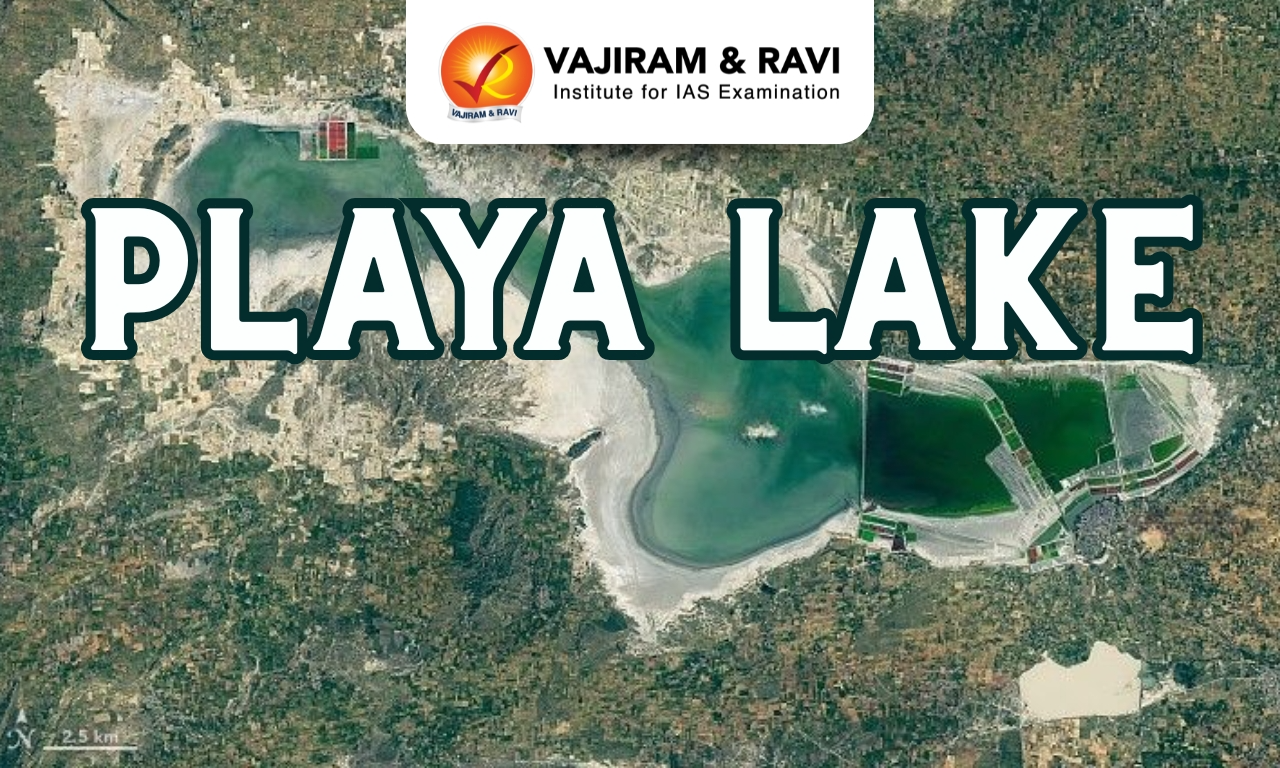
A Playa Lake is a flat bottom depression located in arid and semi arid desert basins where water accumulates temporarily after rainfall but quickly evaporates or infiltrates underground. These landforms are among the flattest on Earth. When shallow water spreads across the basin, it leaves behind deposits of salt, clay, sand and evaporite minerals, gradually forming a dry lake bed or salt flat.
Playa Lake Features
Playa Lakes are temporary desert water bodies formed in closed basins. The key highlighting features of Playas are:
- Interior Drainage Basin: Playa Lakes develop in endorheic basins where water has no outlet to the sea. Rainwater and runoff collect temporarily before evaporating under intense desert heat.
- Flat Surface: These landforms have slopes usually less than 0.2 metres per kilometre. Even a few millimetres of water can flood several kilometres of surface area.
- Mineral Deposition: Evaporation leaves evaporite minerals such as sodium chloride, sodium carbonate, gypsum and borax, forming a white crust over the surface.
- Salt Rings: Mineral precipitation occurs in zones like “Bathtub Rings” with calcium carbonate at margins and highly soluble salts concentrated at the centre.
- Dust Storm: Dry playa surfaces become major sources of dust storms because clay and salt flakes break off and are transported by desert winds.
- Geological Sensitivity: Playa systems respond quickly to climatic shifts such as rainfall change, groundwater inflow and evaporation intensity over long geological timescales.
Playa Lake Biodiversity
Despite harsh conditions, Playa Lake ecosystems support specialised species adapted to salinity, temporary water availability and extreme desert climate.
- Salt Tolerant Vegetation: Surrounding margins support Halophytic Plants like Saltbrush and Shadscale that tolerate highly saline soils and provide grazing fodder.
- Invertebrates: Some playa habitats host rare species such as Giant Fairy Shrimp, etc.
- Rare Plant Species: Certain plants like Davis’ Peppergrass grow only in playa environments where alkaline soil and periodic flooding create specialized habitats.
- Migratory Birds: Temporary water attracts migratory birds that use playas as resting and feeding grounds during long seasonal journeys.
- Desert Wildlife: Animals including Antelope and other desert mammals gather at playas after rainstorms because they provide the only water in many desert regions.


Playa Lake in India
India hosts several seasonal saline Playa Lakes as listed below:
- Sambhar Lake: Located across Jaipur, Ajmer and Nagaur districts, this 230 sq. km inland salt lake produces about 9% of India’s salt and receives water from the Menda, Rupangarh, Kharian and Khari rivers.
- Lunkaransar Lake: Situated about 95 km northeast of Bikaner, this seasonal saline playa forms from monsoon runoff and supports migratory birds such as Bar Headed Geese and Ruddy Shelducks.
- Tal Chhapar Lake: Found within Tal Chhapar sanctuary, this gypsum based seasonal playa supports around 2,000 Blackbucks and attracts raptors like Pallid Harriers and Steppe Eagles.
- Didwana Lake: A hypersaline playa in Nagaur district where salt concentration exceeds 30% in summer, producing halite, gypsum, borax and potash minerals.
- Panchpadra Lake: Located 60 km east of Barmer, this highly saline lake forms thick salt crusts and supplies extremely pure sodium chloride from traditional salt refineries.
- Degana Lake: This Nagaur district playa contains uranium and rare earth elements discovered during geological surveys in the 1980s, while also supporting migratory water birds.
- Kuchaman Lake: Located near Kuchaman Fort, this moderately saline playa receives seasonal runoff and historically supported local water management through step wells and aqueducts.
- Phalodi Lake: A hypersaline playa near Jodhpur where summer temperatures exceed 50°C, historically serving as a major salt trading centre connected to desert caravan routes.
- Rewasa Lake: This clay rich semi saline playa in Sikar district retains monsoon water temporarily and supports Migratory Ducks, Geese and local livestock.
- Kavod Lake: Located in the Jaisalmer desert, this ephemeral playa forms during monsoon rains and leaves gypsum and halite crusts after evaporation, occasionally supporting desert amphibians.

 Last updated on Oct, 2026
→ UPSC 2027 Notification will be released on 13 January 2027 at upsconline.nic.in.
→ Check Nobel Prize 2026 Winners List here.
→ Download PIB PRiSM Monthly Magazine 2026 here.
→ Check UPSC Monthly Current Affairs Magazine The Recitals here.
→ Check out the latest UPSC Syllabus here.
→ Download UPSC Model Answers for Mains 2026
→ UPSC Mains Question Paper 2026 is out now for Essay & GS Paper 1, 2, 3 & 4.
→ UPSC Calendar 2027 has been released.
→ Enroll in Vajiram & Ravi’s UPSC Mains Test Series 2027 for structured answer writing practice, expert evaluation, and exam-oriented feedback.
→ Join Vajiram & Ravi’s UPSC Mentorship Program 2027 for personalized guidance, strategy planning, and one-to-one support from experienced mentors.
→ Go through the UPSC Mains Previous Year Papers to enhance your preparation.
→ UPSC has released UPSC Toppers List 2025 with the Civil Services final result on its official website.
→ Also check Best UPSC Coaching in India
Playa Lake FAQs
Q1. What is a Playa Lake? +
Q2. Where are Playa Lakes commonly found? +
Q3. How are Playa Lakes formed? +
Q4. What minerals are commonly found in Playa Lakes? +
Q5. Which is the largest Playa Lake in India? +
Tags: geography physical geography playa lake