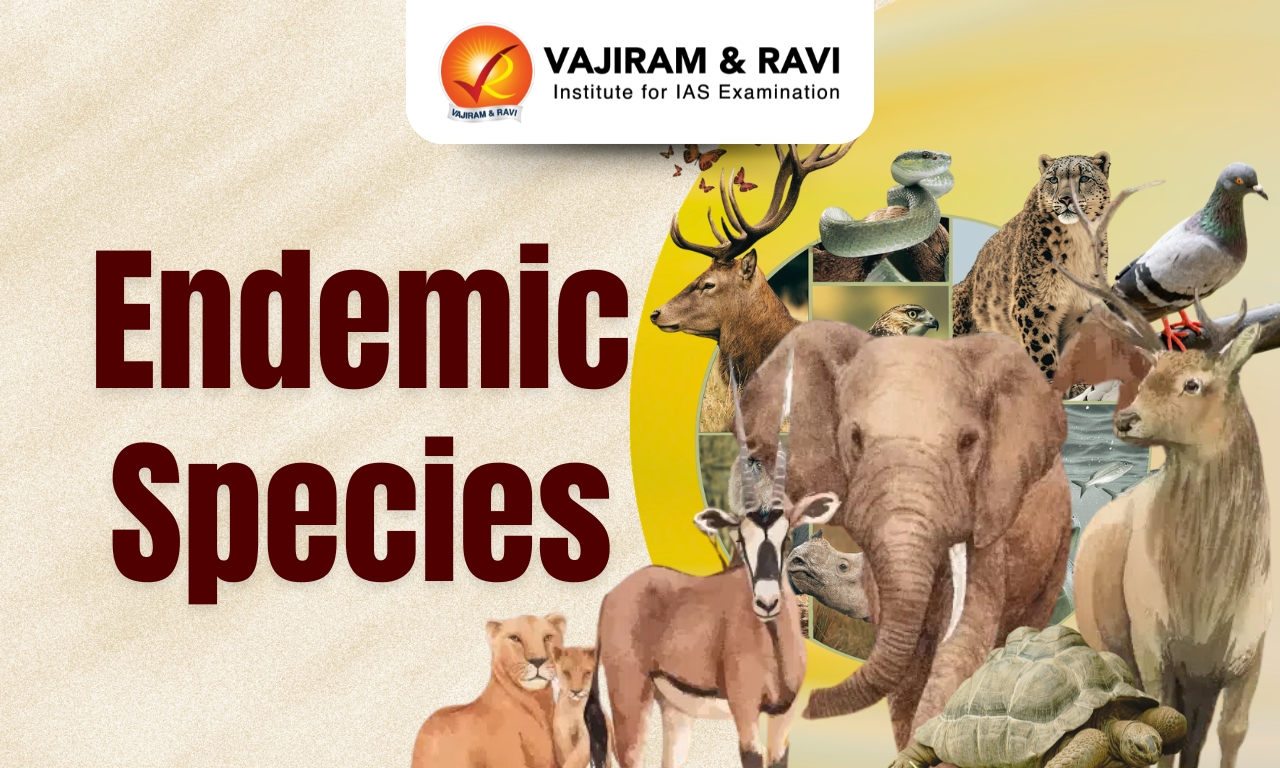
Endemic Species are organisms that exist naturally in only one specific geographic region and nowhere else on Earth. Their restricted distribution usually develops due to long geographical isolation, specialised environmental adaptations and evolutionary processes. Such species often evolve unique traits suited to narrow habitats, which also makes them highly vulnerable to habitat loss, pollution, climate change and human disturbance.
Endemic Species Features
Endemic Species have limited geographic distribution and evolve specialised adaptations to survive in particular environmental conditions, increasing vulnerability significantly.
- Geographic Distribution: Endemic organisms occur naturally in only one defined region such as a mountain range, island, or forest ecosystem and cannot naturally survive outside that location.
- Specialised Environmental Adaptation: Many endemic organisms develop unique physical or behavioural traits that allow survival only within specific ecological conditions or micro habitats.
- High Extinction Vulnerability: Because their population exists only in one location, any habitat destruction, pollution, or ecological disturbance can rapidly push them towards extinction.
- Evolution: Some species became endemic when populations that were once widespread gradually disappeared from most regions due to climate shifts or environmental pressures.
- Pollution Effects: Contamination of water, soil and air significantly affects Endemic Species because they cannot easily migrate to safer habitats.
- Adaptation to Local Climate: Endemic Species are usually finely tuned to local temperature, rainfall patterns and food availability, making them sensitive to climatic shifts.
- Conservation Significance: Protecting Endemic Species is important because their extinction would permanently remove a unique genetic lineage from the planet.
List of Endemic Species in India
India hosts numerous Endemic Species concentrated mainly in biodiversity hotspots such as the Western Ghats, Himalayas, North-East India and island ecosystems. The list of Endemic Species found in India are:
- Asiatic Lion (Gir Forest): The Asiatic lion survives naturally only in Gir National Park of Gujarat. It is smaller than African lions and listed as endangered.
- Kashmir Stag (Hangul): The Hangul lives mainly in Dachigam National Park in Kashmir Valley and nearby regions. It represents the only surviving red deer lineage in India.
- Lion Tailed Macaque: This rare primate inhabits evergreen forests of the Western Ghats and is recognised for its distinctive silver mane surrounding the face.
- Purple Frog: Also called the Pignose frog, this amphibian remains underground for most of the year in Western Ghats rainforests and emerges briefly during breeding season.
- Sangai Deer: Known as the Brow Antlered Deer, this species survives only in Keibul Lamjao National Park of Manipur located in the floating wetlands of Loktak Lake.
- Nilgiri Tahr: A mountain goat species adapted to steep rocky slopes of the Nilgiri Hills in the Western Ghats and classified as endangered.
- Pygmy Hog: Found mainly in Assam’s Manas region, it is the world’s smallest wild pig species and depends on tall grassland ecosystems.
- Malabar Grey Hornbill: A fruit eating bird endemic to Western Ghats forests, recognised by its curved beak and casque structure.
- Rufous Babbler: This small forest bird with reddish plumage occurs mainly in dense vegetation of the Western Ghats.
- Black and Orange Flycatcher: A colourful bird inhabiting montane forests of the Western Ghats and known for its distinctive black and orange feathers.
- Nilgiri Wood Pigeon: This large forest pigeon lives in dense evergreen forests of the Nilgiri Hills region.
- Bare Bellied Hedgehog: A rare nocturnal mammal from southern India characterised by spiny protective structures on its body.
- Brown Palm Civet: A tree dwelling nocturnal mammal found in Western Ghats forests feeding mainly on fruits and small animals.
- Malabar Large Spotted Civet: A critically endangered carnivore inhabiting dense Western Ghats forests with distinct body markings.
- Red Crowned Roofed Turtle: A freshwater turtle endemic to the Ganges river basin with a distinctive red marking on its head.
- Nilgiri Flycatcher: A small blue bird species confined to high altitude forests of the Nilgiri hills.
- White Cheeked Barbet: A green bird with characteristic white cheek patches found mainly in forest regions of the Western Ghats.
- Nilgiri Pipit: A grassland bird adapted to high altitude mountain ecosystems in the Nilgiri region.
- White Bellied Treepie: A long tailed tree dwelling bird found exclusively in forest ecosystems of the Western Ghats.
- Malabar Gliding Frog: A large tree frog capable of gliding between trees using webbed feet in humid Western Ghats forests.
- Great Nicobar Serpent Eagle: A bird of prey endemic to Great Nicobar Island feeding mainly on reptiles.
- Andaman Woodpecker: A black woodpecker species inhabiting dense forest ecosystems of the Andaman Islands.
- Narcondam Hornbill: A rare hornbill species restricted to Narcondam Island in the Andaman Sea.
- Green Avadavat: A bright green finch species found mainly in central India.
- Yellow Throated Bulbul: A bird species with a distinctive yellow throat inhabiting rocky hills and dry forests of peninsular India.
- Kokum Plant: A medicinal plant species native to evergreen forests of the Western Ghats region.
- Kurinji Plant: A flowering shrub famous for blooming once every twelve years across hills of the Western Ghats.
- Indian Pitcher Plant: A carnivorous plant species confined mainly to Khasi Hills of Meghalaya.
- Andhra Pradesh Cycas: A gymnosperm plant endemic to dry forest ecosystems of Andhra Pradesh.
- Hermit’s Spittoon Plant: A parasitic flowering plant related to Rafflesia that occurs mainly in parts of north-eastern India.


List of Endemic Species of the World
Many unique organisms exist globally due to geographic isolation in continents, islands and remote ecological zones. The List of Endemic Species of the World has been given below:
- Kangaroo: Native only to Australia and nearby islands, kangaroos represent classic endemic marsupials adapted to grasslands and dry ecosystems.
- Tasmanian Devil: The largest carnivorous marsupial currently living, naturally confined to Tasmania island of Australia.
- Galápagos Tortoise: One of the largest tortoise species in the world that evolved uniquely on the isolated Galápagos Islands.
- Lemurs: Madagascar hosts numerous lemur species that evolved independently after the island separated from mainland Africa millions of years ago.
- Komodo Dragon: The largest living lizard species found naturally only on Komodo Island and nearby islands of Indonesia.
- Red Kangaroo: The largest marsupial species adapted to Australia’s arid and semi arid landscapes.
- Giant Panda: A bear species native to mountain forests of China known for its distinctive black and white fur pattern.
- Bornean Orangutan: One of the three great ape species found only on Borneo island in Southeast Asia.
- Dragon Tree: A subtropical evergreen tree endemic to Canary Islands, producing characteristic umbrella shaped canopy structures.
- Sow Thistles Tree: A rare flowering plant endemic to Robinson Crusoe Island in Chile and considered extremely endangered.
- Green Pitcher Plant: A carnivorous plant native to North America that traps insects using pitcher shaped leaves.
- Redwood Forest Trees: Once widespread in North America, coastal redwood trees now survive primarily along a narrow region of California’s Pacific coast.
- Rafflesia arnoldii: A giant parasitic flowering plant from Southeast Asia famous for producing one of the largest flowers on Earth.
- Nepenthes rajah: A giant carnivorous pitcher plant endemic to Borneo capable of trapping insects using fluid filled leaf structures.
- Welwitschia mirabilis: A desert plant endemic to Namibia, characterised by two long ribbon like leaves that grow continuously throughout its life.
- Giant Sequoia: Massive conifer trees confined mainly to the Sierra Nevada mountain range in California.
- Bristlecone Pine: One of the longest living tree species found mainly in high altitude regions of southwestern United States.
- Attenborough’s Pitcher Plant: A large carnivorous plant endemic to specific mountain habitats of the Philippines.

 Last updated on Oct, 2026
→ UPSC 2027 Notification will be released on 13 January 2027 at upsconline.nic.in.
→ Asian Games 2026 are being held in Aichi-Nagoya, Japan, from 19 September to 4 October.
→ Check Nobel Prize 2026 Winners List here.
→ Download PIB PRiSM Monthly Magazine 2026 here.
→ Check UPSC Monthly Current Affairs Magazine The Recitals here.
→ Check out the latest UPSC Syllabus here.
→ Download UPSC Model Answers for Mains 2026
→ UPSC Mains Question Paper 2026 is out now for Essay & GS Paper 1, 2, 3 & 4.
→ UPSC Calendar 2027 has been released.
→ Enroll in Vajiram & Ravi’s UPSC Mains Test Series 2027 for structured answer writing practice, expert evaluation, and exam-oriented feedback.
→ Join Vajiram & Ravi’s UPSC Mentorship Program 2027 for personalized guidance, strategy planning, and one-to-one support from experienced mentors.
→ Go through the UPSC Mains Previous Year Papers to enhance your preparation.
→ UPSC has released UPSC Toppers List 2025 with the Civil Services final result on its official website.
→ Also check Best UPSC Coaching in India
Endemic Species FAQs
Q1. What are Endemic Species? +
Q2. Why are Endemic Species highly vulnerable to extinction? +
Q3. Which regions in India have the highest number of Endemic Species? +
Q4. What is an example of an Endemic Species in India? +
Q5. How do species become endemic to a region? +
Tags: biology ecology endemic species