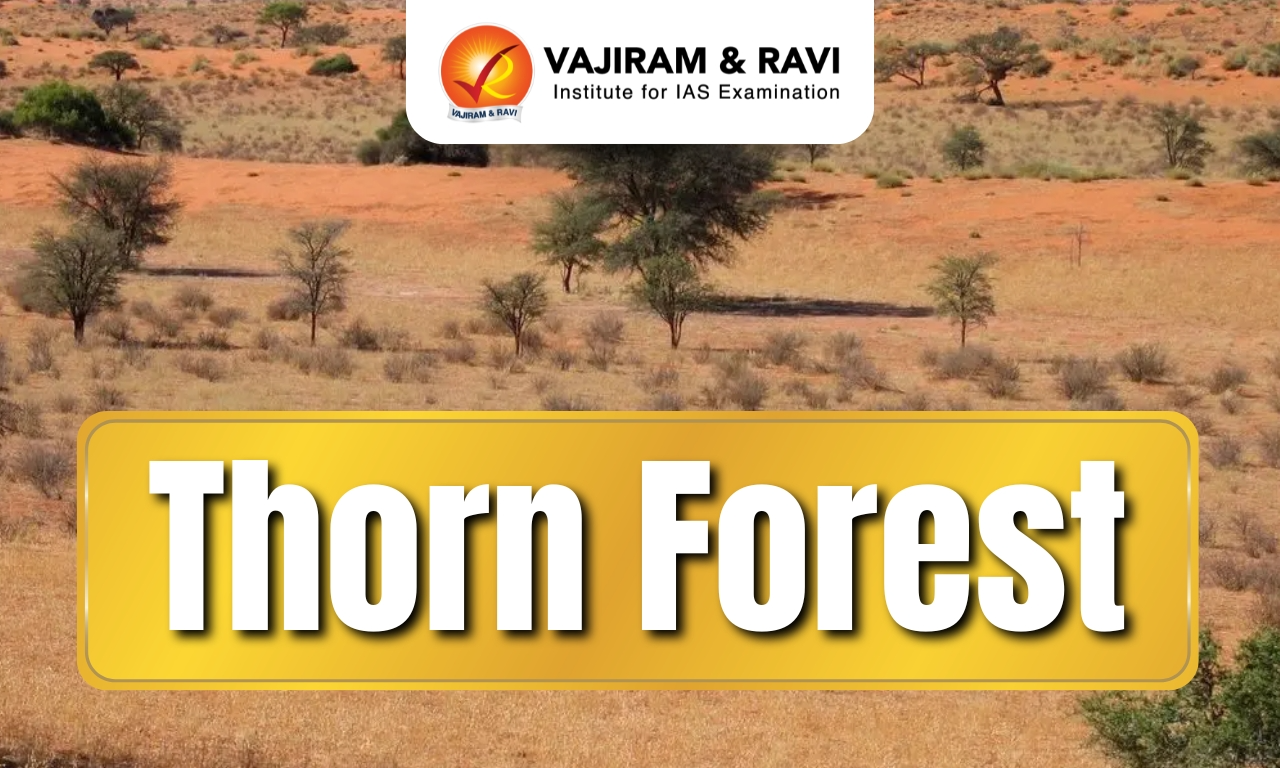
Thorn Forests are a unique type of natural vegetation found in dry and semi-arid regions of the world. These forests are characterized by thorny trees, shrubs, and plants that are specially adapted to survive in areas with very low rainfall and extreme temperatures. In India, thorn forests are commonly found in regions like Rajasthan, Gujarat, and parts of the Deccan Plateau.
Climate of Thorn Forest
Thorn forests grow in areas with harsh climatic conditions. The main climatic features are:
- Low Rainfall: Usually less than 25–70 cm annually
- High Temperature: Summers are extremely hot
- Dry Climate: Long dry seasons and short rainy periods
- High Evaporation Rate: Water loss is more than water availability
Thorn Forest Characteristics
Thorn forests are found in dry and semi-arid regions where rainfall is very low and conditions are harsh. The vegetation mainly consists of thorny trees and shrubs that are specially adapted to conserve water.
- Sparse vegetation – Trees and shrubs are widely spaced due to low rainfall.
- Thorny leaves – Leaves are modified into thorns to reduce water loss.
- Deep roots – Long roots help absorb underground water.
- Small or no leaves – Minimizes transpiration in dry conditions.
- Water storage – Thick stems store water (e.g., cactus).
- Seasonal leaf fall – Plants shed leaves during extreme dryness.
- Drought adaptation – Survive in high temperature and low rainfall regions.
Also Read: Soils of India


Distribution of Thorn Forest
The distribution of thorn forest are found in various parts of India and the world.
- In India, they are extensively found in the north-western part, especially the Thar Desert, where extreme heat and low rainfall dominate.
- Large areas of Rajasthan and Gujarat have well-developed thorn forest vegetation due to desert and semi-desert conditions.
- They also occur in the dry parts of Punjab and Haryana, particularly in areas with sandy soil and low moisture.
- In central India, thorn forests are found in the western regions of Madhya Pradesh, where rainfall is comparatively low.
- These forests extend into the rain-shadow regions of the Deccan Plateau, including parts of Maharashtra, Karnataka, and Andhra Pradesh.
- Globally, thorn forests are widely distributed across semi-arid regions of Africa, especially in savanna margins with seasonal rainfall.
- They are also found in the interior dry regions of Australia, where desert-like conditions prevail.
- In South America, thorn forests occur in countries like Brazil and Argentina in dry tropical zones.
- Parts of the Middle East also support thorn forest vegetation due to hot climate and water scarcity.
- Overall, thorn forests are distributed in areas with high temperature, low humidity, sandy or rocky soil, and prolonged dry seasons.
Also Read: Types of Forests in India
Thorn Forest Importance
- Thorn forests help prevent soil erosion by holding loose, sandy soil with their deep roots, especially in desert regions like the Thar Desert.
- They are an important source of fuelwood, as trees like babool and acacia are commonly used for firewood in rural areas.
- Thorn forests provide fodder for livestock, as grasses and shrubs serve as grazing material for animals like goats, sheep, and camels.
- These forests help in maintaining ecological balance by supporting wildlife adapted to dry conditions.
- They play a role in combating desertification by stabilizing land and preventing the expansion of deserts.
- Thorn forest plants have medicinal value, as many species are used in traditional medicine.
- They support rural livelihoods, providing resources like wood, gum, and small forest products.
- Thorn vegetation helps in conserving water by reducing surface runoff and improving soil moisture retention.
- They act as a natural barrier against strong winds, protecting agricultural fields in dry regions.

 Last updated on Sep, 2026
→ UPSC 2027 Notification will be released on 13 January 2027 at upsconline.nic.in.
→ Asian Games 2026 are being held in Aichi-Nagoya, Japan, from 19 September to 4 October.
→ Check out the latest UPSC Syllabus here.
→ Download UPSC Model Answers for Mains 2026
→ UPSC Mains Question Paper 2026 is out now for Essay & GS Paper 1, 2, 3 & 4.
→ UPSC Calendar 2027 has been released.
→ Enroll in Vajiram & Ravi’s UPSC Mains Test Series 2027 for structured answer writing practice, expert evaluation, and exam-oriented feedback.
→ Join Vajiram & Ravi’s UPSC Mentorship Program 2027 for personalized guidance, strategy planning, and one-to-one support from experienced mentors.
→ Go through the UPSC Mains Previous Year Papers to enhance your preparation.
→ UPSC has released UPSC Toppers List 2025 with the Civil Services final result on its official website.
→ Also check Best UPSC Coaching in India
Thorn Forest FAQs
Q1. What is a thorn forest?+
Q2. Where are thorn forests found in India?+
Q3. Why do plants in thorn forests have thorns?+
Q4. What type of climate is suitable for thorn forests?+
Q5. What are common plants found in thorn forests?+
Tags: geography thorn forest