


Ladakh Magmatic Arc Latest News
Recently, scientists have traced the evolution of the Ladakh Magmatic Arc (LMA) in North West Himalaya.
About Ladakh Magmatic Arc
- It is a belt of igneous rocks in the Trans-Himalaya formed in the period Jurassic to Eocene– 201.3 million years ago to 33.9 Million Year (Ma).
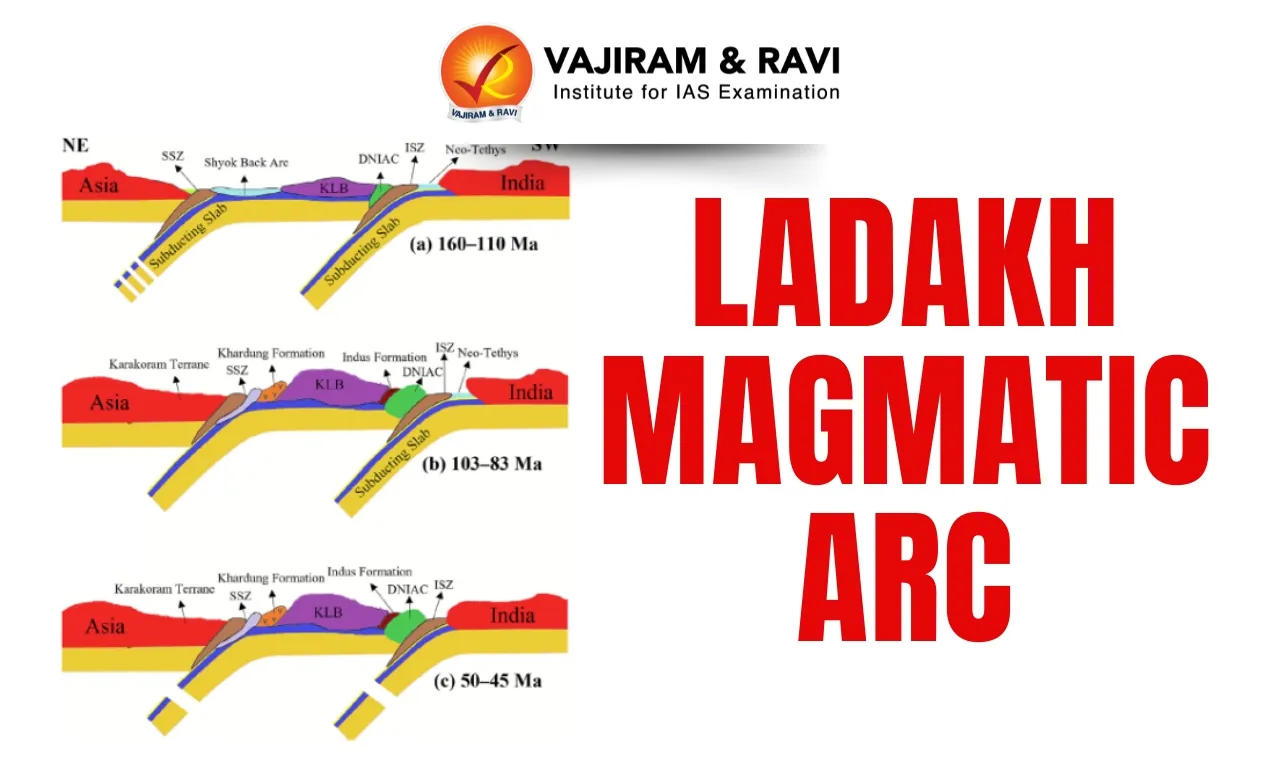
- The LMA is a long-extinct volcanic system evolved through three major phases of geological activity over tens of millions of years.
- 160–110 million years ago: Early island arc formation
- 103–45 million years ago: Intensified magmatism during plate convergence
- Less than 45 million years ago: Post-collisional magmatic activity


Process of Formation of Ladakh Magmatic Arc
- Millions of years before the region that is now called Ladakh lay above an ocean called the Neo-Tethys Ocean.
- Below that ancient sea, giant slabs of Earth’s crust slowly plunged into the mantle in a process known as subduction leading to the formation of the Ladakh Magmatic Arc (LMA).
Phases of Formation of Ladakh Magmatic Arc
- Island Arc Formation: In its earliest stage, Ladakh resembled a chain of volcanic islands rising from the Neo-Tethys Ocean.
- Represented by the Dras–Nidar Island Arc Complex (DNIAC)
- Magma primarily originated from the mantle
- Minimal contribution from subducted sediments
- Crustal Enrichment and Batholith Formation: As tectonic plates converged, the system evolved:
- Formation of large granite bodies known as the Ladakh Batholith (LB)
- Increased input from continental crust and recycled sediments
- Chemical signatures indicate deep crustal processes and magma mixing
- This phase coincides with the approaching collision between India and Eurasia.
- Post-Collision Magmatism: After the plates collided and the Neo-Tethys Ocean closed, tectonic activity continued:
- Formation of mafic dykes—vertical sheets of volcanic rock
- Magma derived from a previously enriched mantle source
- Indicates lingering tectonic and magmatic activity even after collision
Source: PIB

 Last updated on Oct, 2026
→ UPSC 2027 Notification will be released on 13 January 2027 at upsconline.nic.in.
→ Check Nobel Prize 2026 Winners List here.
→ Download PIB PRiSM Monthly Magazine 2026 here.
→ Check UPSC Monthly Current Affairs Magazine The Recitals here.
→ Check out the latest UPSC Syllabus here.
→ Download UPSC Model Answers for Mains 2026
→ UPSC Mains Question Paper 2026 is out now for Essay & GS Paper 1, 2, 3 & 4.
→ UPSC Calendar 2027 has been released.
→ Enroll in Vajiram & Ravi’s UPSC Mains Test Series 2027 for structured answer writing practice, expert evaluation, and exam-oriented feedback.
→ Join Vajiram & Ravi’s UPSC Mentorship Program 2027 for personalized guidance, strategy planning, and one-to-one support from experienced mentors.
→ Go through the UPSC Mains Previous Year Papers to enhance your preparation.
→ UPSC has released UPSC Toppers List 2025 with the Civil Services final result on its official website.
→ Also check Best UPSC Coaching in India
Ladakh Magmatic Arc FAQs
Q1. Which tectonic process is associated with the Ladakh Magmatic Arc?+
Q2. What is the Ladakh Magmatic Arc?+
Tags: ladakh magmatic arc prelims pointers upsc current affairs upsc prelims current affairs









