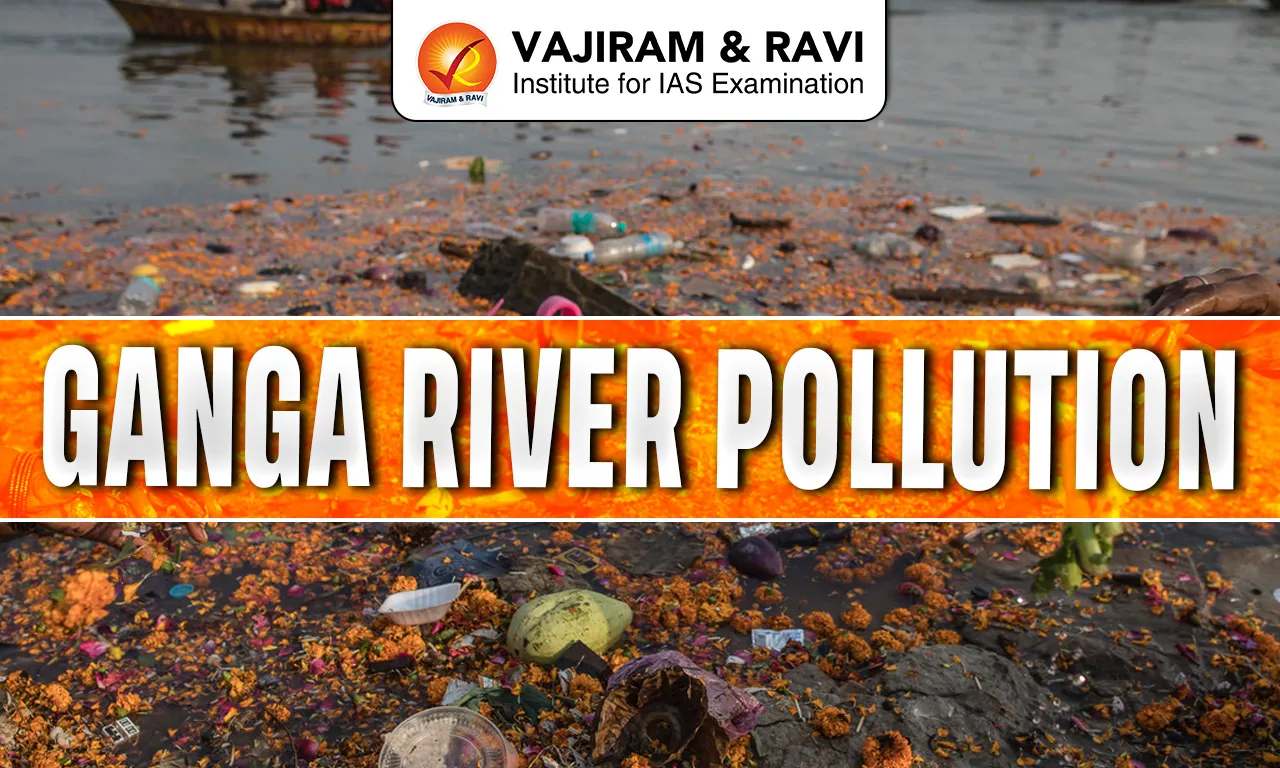
The Ganga River is the cultural soul and economic backbone of India. Nearly 47% of the country’s population depends on Ganga river, making it one of the most densely populated river basins in the world. Traditionally revered as sacred and life-sustaining, the river has played a central role in shaping India’s civilisation, agriculture, and settlement patterns.
However, in recent decades, Ganga river pollution has emerged as a critical environmental challenge.
Nature and Sources of Pollution
The Ganga River shows significant spatial variation in pollution levels. In the upper reaches, especially in Uttarakhand, the river remains relatively clean due to low population pressure and better natural flow. However, as it moves into the plains, particularly in Uttar Pradesh and Bihar, pollution levels rise sharply.
The pollution of the Ganga is multi-dimensional, arising from a complex interplay of anthropogenic pressures.
Sewage Pollution (Primary Source):
- According to the Central Pollution Control Board, about 71% of monitoring stations on the Ganga River exceed the permissible faecal coliform limit (2,500 MPN/100 ml), with levels often above 11,000 MPN and reaching 92,000 MPN in parts of Bihar.
Industrial Effluents:
- Industrial clusters along the river, especially tanneries in Kanpur and chemical industries, release toxic substances such as chromium, arsenic, and lead.
- Approximately 500 MLD of industrial waste is discharged daily, especially in the middle Ganga basin.
- These pollutants are not only harmful to aquatic ecosystems but also pose long-term health risks to humans through bioaccumulation.
Agricultural Runoff:
- With over 65% of the Ganga Basin under agriculture, excessive use of fertilisers and pesticides in the Indo-Gangetic plains leads to nutrient-rich runoff entering the river, causing eutrophication, algal blooms, and depletion of dissolved oxygen.
Solid Waste and Plastics:
- As per the Central Pollution Control Board, Indian cities generate over 1.5 lakh tonnes of municipal solid waste per day, and a significant portion remains unprocessed.
- Poor waste management systems lead to plastics and other non-biodegradable waste entering the river through drains and open dumping, causing persistent environmental damage.
Religious and Cultural Practices:
- While culturally significant, practices such as immersion of idols, disposal of partially cremated bodies, and ritual bathing contribute to microbial contamination and organic pollution.
Ganga River Pollution Impacts
The impacts of pollution in the Ganga River are wide-ranging, affecting public health, ecological balance, economic activities, and the overall sustainability of the river system.
Public Health Concerns:
- High faecal contamination in the Ganga River increases incidence of water-borne diseases such as cholera, diarrhoea etc, creating a persistent health risk for millions dependent on the river.
Ecological Impact:
- Elevated Biological Oxygen Demand (BOD) and reduced dissolved oxygen levels have degraded aquatic habitats, threatening species like the Ganges River Dolphin and leading to a decline in fish populations.
- High organic and chemical pollution disrupts ecological processes such as nutrient cycling and reduces the river’s natural assimilative capacity.
Impact on Agriculture:
- Use of polluted water for irrigation leads to soil degradation and accumulation of harmful substances, affecting crop quality and long-term agricultural productivity.
Livelihood Challenges:
- Communities dependent on the river for fisheries, agriculture, and related activities face economic hardship due to declining resource availability and deteriorating river health.
Groundwater contamination:
- Pollution in the river system contributes to the degradation of connected groundwater sources, increasing the presence of contaminants such as arsenic, fluoride, and nitrates in several basin regions.
Increased economic burden:
- The need for medical treatment, safe drinking water, and river cleaning initiatives results in significant financial costs for both households and the government.
- As highlighted by World Bank estimates, water pollution costs India nearly 3% of its GDP annually; additionally, under the Namami Ganga Programme, the government has allocated over ₹32,000 crore for river cleaning, while households bear rising expenses on healthcare and access to safe drinking water.
Rapid urbanisation, inadequate sewage treatment, industrial discharge, and intensive agricultural practices have significantly degraded the river’s water quality. These anthropogenic pressures, coupled with excessive water extraction and institutional inefficiencies, have pushed the river into a state of ecological stress,


Government Initiatives to Address Ganga River Pollution
Over the years, the government has made several attempts to clean and restore the Ganga River. These efforts show a gradual shift from narrow pollution control measures to a more integrated and long-term river rejuvenation approach.
Ganga Action Plan (GAP), 1985:
- This was the first major step taken by the government to tackle pollution in the Ganga.
- The focus was mainly on intercepting drains and setting up sewage treatment plants in major cities.
- However, the plan could not achieve its objectives due to poor maintenance of infrastructure, lack of coordination among agencies, and underestimation of sewage generation.
Ganga Action Plan Phase II, 1993:
- In the second phase, the programme was extended to tributaries and more towns. While the scope increased, the fundamental issues such as weak implementation and lack of local participation remained unresolved.
National Ganga River Basin Authority (NGRBA), 2009:
- The National Ganga River Basin Authority (NGRBA) was established in 2009 as an empowered body for planning, financing, monitoring, and coordinating all efforts to clean and conserve the Ganga River.
- The NGRBA’s main objective is to ensure effective pollution abatement and conservation by adopting a river basin approach, maintaining minimum ecological flows, and promoting environmentally sustainable development across the entire Ganga basin.
- It was chaired by the Prime Minister of India and includes Union Ministers and the Chief Ministers of states through which the Ganga flows.
- Presently, National Ganga River Basin Authority (NGRBA) no longer exists as a separate body. It was merged into the Ministry of Jal Shakti after the launch of the Namami Gange Programme (2014).
Today, all river cleaning, conservation, and management efforts under the basin-level approach are implemented through the National Mission for Clean Ganga (NMCG), which serves as the operational arm of the government for pollution abatement, river rejuvenation, and ecological restoration.
Namami Gange Programme:
The Government of India (GoI) launched the Namami Gange Programme (NGP) in 2014-15 for the rejuvenation of river Ganga and its tributaries with a budgetary outlay of ₹ 20,000 crore, for five years, up to March 2021 and has been further extended to March 2026 with a budgetary outlay of ₹ 22,500 crore.
The programme is implemented by the National Mission for Clean Ganga (NMCG) with a total budget of over ₹32,000 crore.
Main Pillars of the Namami Gange Programme
The Namami Gange Programme (2014) is structured around eight main pillars to ensure comprehensive cleaning, ecological restoration, and sustainable management of the Ganga River:
- Sewage Treatment Infrastructure: Construction, augmentation, and proper operation of sewage treatment plants (STPs) to prevent untreated domestic wastewater from entering the river.
- River-Front Development: Restoration and development of ghats, crematoria, and riverfront areas to support cultural, social, and ecological functions.
- River-Surface Cleaning: Removal of floating debris, plastics, and solid waste from the river to improve water quality and aesthetics.
- Biodiversity Conservation: Protection and restoration of aquatic and riparian biodiversity, including endangered species such as the Ganges River Dolphin.
- Afforestation: Plantation along riverbanks to prevent erosion, improve soil quality, and enhance ecological resilience.
- Public Awareness and Community Engagement: Campaigns and initiatives to involve citizens, NGOs, and religious institutions in river conservation.
- Industrial Effluent Monitoring: Regulation and monitoring of industrial discharges, including promotion of Zero Liquid Discharge (ZLD) systems in polluting industries.
- Ganga Gram Initiative: Development of villages along the Ganga basin with sustainable sanitation, solid waste management, and ecological awareness.
To give strategic direction to these pillars, the Namami Gange Programme also works under four thematic components:
- Pollution Abatement (Nirmal Ganga): Focuses on reducing pollution from sewage, industrial effluents, and other contaminants.
- Improving Ecology and Flow (Aviral Ganga): Ensures continuous water flow and restores ecological health, including biodiversity conservation.
- Strengthening People-River Connect (Jan Ganga): Encourages community participation, awareness campaigns, and cultural engagement to build a sustainable relationship with the river.
- Facilitating Research and Policy (Gyan Ganga): Promotes scientific research, river mapping, and evidence-based policymaking for effective river management.
Legal and Institutional Framework:
The National Green Tribunal and the Supreme Court have played active roles in monitoring pollution levels and enforcing compliance. The Ganga has also been accorded the status of a “living entity” by the Uttarakhand High Court, although with legal complexities.
Challenges in River Cleaning Efforts
Despite initiatives like the Namami Gange Programme, the Ganga River continues to face serious challenges:
- Inadequate Sewage Infrastructure: Treatment capacity remains insufficient relative to waste generation.
- Fragmented Governance: Multiple agencies operate at different levels, leading to fragmentation and lack of coordination. This weakens accountability and delays implementation.
- Lack of Behavioural Change: Rituals, idol immersion, and open defecation continue to contribute directly to river pollution, highlighting the need for stronger public awareness campaigns.
- Environmental Flow (E-flow) Issues: Excessive water extraction for irrigation reduces the river’s natural ability to dilute pollutants.
- Urbanisation Pressure: Rapid urban growth in cities like Kanpur, Varanasi, and Patna has increased sewage and solid waste loads, outpacing existing infrastructure.
Way Forward
A long-term solution requires a holistic and multi-pronged strategy:
- Strengthening Sewage Treatment: Expansion of modern sewage treatment plants (STPs) with real-time monitoring is essential.
- Industrial Regulation: Strict enforcement of zero liquid discharge norms and adoption of cleaner technologies must be ensured.
- Ecological Restoration: Maintaining environmental flows, afforestation along riverbanks, and wetland conservation can enhance the river’s self-purification capacity.
- Community Participation: Local communities, religious leaders, and civil society must be actively involved in conservation efforts.
- Sustainable Agriculture Practices: Promoting organic farming and rational fertiliser use can reduce runoff pollution.
- Integrated River Basin Management: A basin-wide approach considering upstream-downstream linkages is crucial for effective governance.

 Last updated on Sep, 2026
→ UPSC 2027 Notification will be released on 13 January 2027 at upsconline.nic.in.
→ Asian Games 2026 are being held in Aichi-Nagoya, Japan, from 19 September to 4 October.
→ Check out the latest UPSC Syllabus here.
→ Download UPSC Model Answers for Mains 2026
→ UPSC Mains Question Paper 2026 is out now for Essay & GS Paper 1, 2, 3 & 4.
→ UPSC Calendar 2027 has been released.
→ Enroll in Vajiram & Ravi’s UPSC Mains Test Series 2027 for structured answer writing practice, expert evaluation, and exam-oriented feedback.
→ Join Vajiram & Ravi’s UPSC Mentorship Program 2027 for personalized guidance, strategy planning, and one-to-one support from experienced mentors.
→ Go through the UPSC Mains Previous Year Papers to enhance your preparation.
→ UPSC has released UPSC Toppers List 2025 with the Civil Services final result on its official website.
→ Also check Best UPSC Coaching in India
Ganga River Pollution FAQs
Q1. What is the current state of Ganga River Pollution?+
Q2. What are the main sources of Ganga River Pollution?+
Q3. What are the impacts of Ganga River Pollution?+
Q4. What government initiatives exist to tackle Ganga River Pollution?+
Q5. What are the main challenges in addressing Ganga River Pollution?+
Tags: ganga river pollution