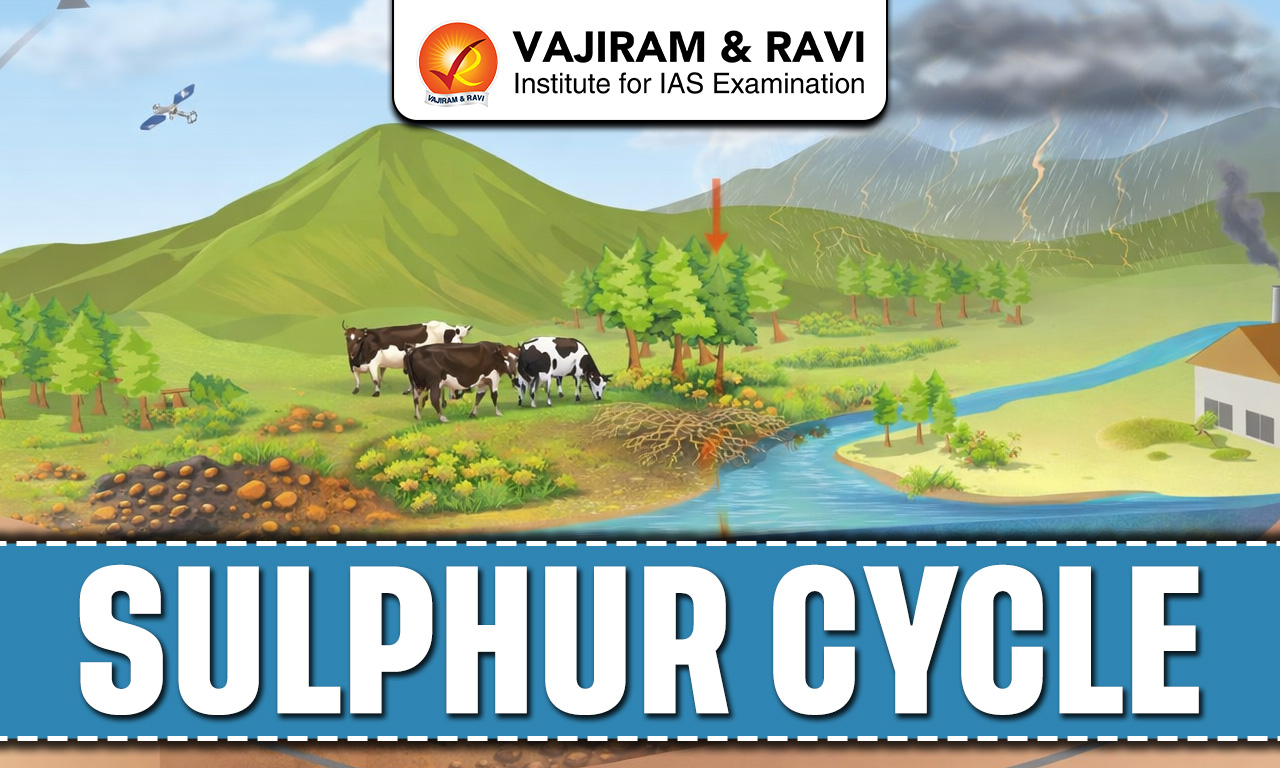
The sulphur cycle is the natural movement of sulphur between the air, soil, water, and living organisms. It is an essential element for plant and animal growth and enters the environment through natural processes and human activities. This cycle helps maintain ecological balance, though excess sulphur can cause problems like acid rain.
About Sulphur Cycle
- The sulphur cycle is a type of biogeochemical cycle in which sulphur moves between the land, air, water, and living organisms. It is called a sedimentary cycle because most of the sulphur is stored in rocks and soil rather than in the atmosphere.
- This cycle mainly involves oxidation and reduction processes, where sulphur keeps changing its chemical form as it moves through different parts of the environment.
- The largest reservoir of sulphur is the soil, where it is stored in different forms. Apart from soil, sulphur is also found in oceans, swamps, marshes, and volcanic areas, which act as important natural sources.
- When sulphur is exposed to air, it reacts with oxygen and gets converted into sulphate (SO₄), which is the form that plants and microorganisms can easily absorb.
- Plants absorb sulphate from the soil and convert it into organic substances like proteins and amino acids, which are essential for their growth and development.
- When animals consume plants, sulphur enters the food chain and moves from one organism to another.
- After plants and animals die, decomposers like bacteria and fungi break down organic matter, releasing sulphur back into the soil and completing the cycle.
- Some microorganisms also play an important role by converting sulphur into different forms, especially in oxygen-rich (aerobic) and oxygen-poor (anaerobic) conditions.
- In the biosphere, sulphur exists in three main forms:
- Elemental sulphur, which is found in natural deposits and mineral ores.
- Inorganic sulphur, which exists as sulphates in oxygen-rich soils and sulphides in oxygen-deficient environments.
- Organic sulphur, which is present in living organisms, especially in proteins and amino acids.
- Human activities such as burning fossil fuels and industrial processes release sulphur into the atmosphere, which can lead to environmental problems like acid rain.
Process of Sulphur Cycle
- The sulphur cycle is a continuous process in which sulphur moves through the atmosphere, land (soil and rocks), water bodies, and living organisms. It mainly involves chemical changes like oxidation and reduction, where sulphur changes its form again and again.
- Atmosphere (Sulphur in Air)
-
- The main form of sulphur present in the air is sulphur dioxide (SO₂), which is largely released due to human activities like burning coal, petrol, and diesel in industries and vehicles.
- Natural sources also add sulphur to the atmosphere. For example, volcanic eruptions release large amounts of sulphur gases into the air.
- Another important gas is hydrogen sulphide (H₂S), which is produced when bacteria break down dead plants and animals, especially in wetlands, marshes, and oceans.
- When hydrogen sulphide comes in contact with oxygen in the air, it gets converted into sulphur dioxide, continuing the cycle.
- Biosphere (Movement into Land and Water)
-
- Sulphur enters the biosphere through rainfall and weathering of rocks. When sulphur dioxide mixes with water in the atmosphere, it forms weak sulphuric acid, which falls on the earth with rain.
- This process helps sulphur move from the air into the soil and water bodies, making it available for plants and microorganisms.
- Sulphur particles and aerosols from the atmosphere also settle on land and water, adding to the sulphur content.
- Another important process is weathering of rocks, where sulphur stored in rocks is slowly released into the soil and water over time.
- Absorption by Living Organisms
-
- Once in the soil and water, sulphur becomes available to plants, bacteria, and other organisms.
- Plants absorb sulphur mainly in the form of sulphates through their roots, which are essential for making proteins and enzymes.
- Certain bacteria, such as green sulphur bacteria, use sulphur as a source of energy and play an important role in maintaining the cycle.
- Animals, including humans, do not take sulphur directly from the environment. Instead, they get it indirectly by eating plants or other animals, allowing sulphur to move through the food chain.
- In living organisms, sulphur is an important part of amino acids, proteins, and some vitamins, making it essential for growth and survival.
- Release (Return to Environment)
-
- The final stage of the sulphur cycle is the release of sulphur back into the environment.
- When plants and animals die, decomposers like bacteria and fungi break down their bodies, releasing sulphur back into the soil.
- During this process, sulphur is often converted into hydrogen sulphide (H₂S) or other inorganic forms.
- Special bacteria called sulphate-reducing bacteria help convert sulphates into sulphides, while other bacteria convert them back, keeping the cycle active.
- Some sulphur returns to the atmosphere as gases, while some remains stored in soil, water, or gets locked deep inside the Earth in the form of rocks and sediments for long periods.
- Human Impact
-
- Human activities like industrial pollution and burning fossil fuels have increased the amount of sulphur in the atmosphere, which can lead to environmental issues such as acid rain, affecting soil, water, plants, and buildings.


Economic Importance of Sulphur
- A major use of sulphur is in the production of sulphuric acid, which is one of the most widely used chemicals in industries. It is essential for making fertilizers, chemicals, detergents, paints, and explosives, making sulphur crucial for industrial growth.
- In the energy sector, sulphur is associated with the formation of fossil fuels like coal, petroleum, and natural gas. Its presence influences the quality and processing of these fuels.
- Sulphur has the ability to act as both an oxidising and reducing agent, which makes it important in many chemical and metallurgical processes.
- It is also closely linked with the formation of metal ores and mineral deposits. Many valuable metals such as copper, zinc, and lead are found in sulphide ores, making sulphur important in mining and extraction industries.

 Last updated on Sep, 2026
→ UPSC 2027 Notification will be released on 13 January 2027 at upsconline.nic.in.
→ Asian Games 2026 are being held in Aichi-Nagoya, Japan, from 19 September to 4 October.
→ Check out the latest UPSC Syllabus here.
→ Download UPSC Model Answers for Mains 2026
→ UPSC Mains Question Paper 2026 is out now for Essay & GS Paper 1, 2, 3 & 4.
→ UPSC Calendar 2027 has been released.
→ Enroll in Vajiram & Ravi’s UPSC Mains Test Series 2027 for structured answer writing practice, expert evaluation, and exam-oriented feedback.
→ Join Vajiram & Ravi’s UPSC Mentorship Program 2027 for personalized guidance, strategy planning, and one-to-one support from experienced mentors.
→ Go through the UPSC Mains Previous Year Papers to enhance your preparation.
→ UPSC has released UPSC Toppers List 2025 with the Civil Services final result on its official website.
→ Also check Best UPSC Coaching in India
Sulphur Cycle FAQs
Q1. What is the sulphur cycle?+
Q2. Why is the sulphur cycle called a sedimentary cycle?+
Q3. In what forms does sulphur exist in the biosphere?+
Q4. How does sulphur enter the atmosphere?+
Q5. How do plants and animals obtain sulphur?+
Tags: environment environment notes Sulphur Cycle