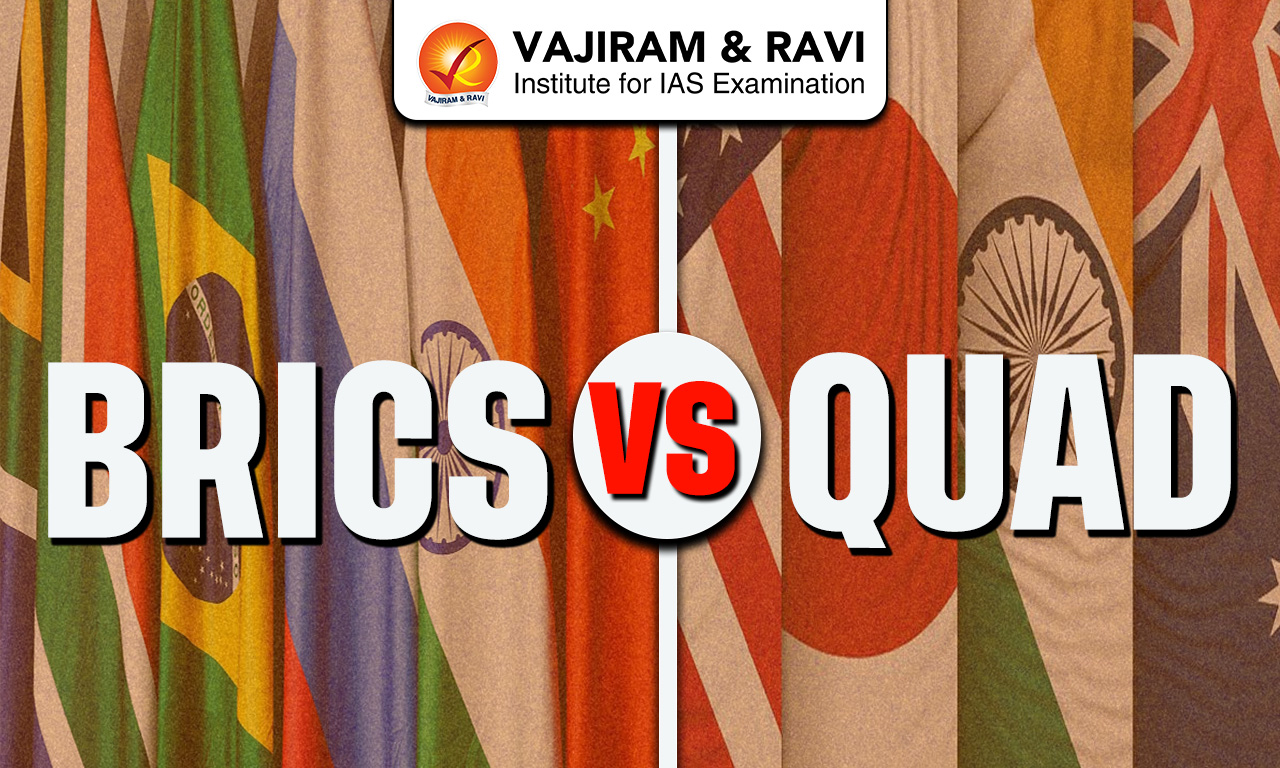
In today’s globalized world, countries often come together in groups to pursue common interests and strengthen cooperation. Two such important groupings are BRICS and the Quadrilateral Security Dialogue (QUAD). These platforms reflect different ways in which nations collaborate to deal with global economic and strategic challenges. BRICS vs QUAD has been discussed in detail in this article.
BRICS vs QUAD
The BRICS and the Quadrilateral Security Dialogue (QUAD) are two major international groupings. The two groupings differ significantly in their purpose and approach, BRICS mainly promotes economic growth and cooperation among emerging economies, whereas QUAD focuses on security, strategy, and stability in the Indo-Pacific region. The table below provides a clear comparison of their key features.
| BRICS vs QUAD | ||
|
Aspect |
BRICS |
Quadrilateral Security Dialogue (QUAD) |
|
Meaning |
A group of major emerging economies of the world |
An informal strategic partnership focused on security and regional stability |
|
Origin of Name |
Term BRIC was coined in 2001 by Jim O’Neill |
Idea proposed in 2007 by Shinzo Abe |
|
Formation |
First meeting in 2006; regular summits since 2009 |
Formed in 2007 as a dialogue among four countries |
|
Members |
Brazil, Russia, India, China, South Africa, Iran, Egypt, Ethiopia, UAE, Saudi Arabia and Indonesia (2025) |
India, USA, Japan, Australia |
|
Nature |
Formal group with structured meetings and institutions |
Informal group (not a formal organization) |
|
Main Focus |
Economic growth, development, and global cooperation |
Security, strategic cooperation, and regional stability |
|
Key Objective |
Promote economic cooperation and give more voice to developing countries |
Ensure a free, open, and inclusive Indo-Pacific region |
|
Important Initiative |
New Development Bank (2014) for infrastructure funding |
Malabar Exercise for joint naval cooperation |
|
Geographical Focus |
Global (focus on emerging economies worldwide) |
Indo-Pacific region |
|
Additional Role |
Works on trade, climate change, and development issues |
Focuses on maritime security, disaster relief, and supply chains |
About BRICS
- The term BRIC was first used in 2001 by economist Jim O’Neill for Brazil, Russia, India, and China.
- The group started meeting formally in 2006, and the first summit took place in 2009.
- In 2010, South Africa joined, and BRIC became BRICS.
- Over time, the group expanded further (often called BRICS), adding countries like Egypt, Iran, and UAE.
- Main Aim: To make global governance more inclusive and provide alternatives to Western-dominated systems.
- Structure: BRICS works on three main areas
- Political and security cooperation
- Economic and financial cooperation
- Cultural and people-to-people connections
- Global Presence: BRICS countries together represent nearly half of the world’s population, about 40% of global GDP, and a significant share of global trade.
- India’s BRICS Presidency 2026: Brazil has officially handed over the presidency of BRICS to India for the year 2026. India’s leadership is built around four key ideas – Resilience, Innovation, Cooperation, and Sustainability. These pillars show India’s focus on growth, stability, and long-term development.


India’s BRICS Presidency Significance
- Reforming Global Institutions: India supports improving global institutions like the International Monetary Fund, World Bank, and United Nations Security Council rather than replacing them. The aim is to make them more fair and less dominated by Western countries.
- Voice of the Global South: India is trying to act as a bridge between developed and developing nations. It wants to represent the concerns of the Global South and promote a more balanced, multipolar world.
- Digital Public Infrastructure (DPI): India is promoting its digital systems (like Aadhaar and UPI) as models that other developing countries can adopt for faster and inclusive growth.
- Strategic Autonomy: India continues to maintain a balanced approach working with Western countries as well as maintaining relations with countries like China, without depending too much on any one side.
Strengths of BRICS
- Strong Economies: Together, BRICS economies are very large and contribute heavily to global growth.
- Huge Population Base: With around 3.5 billion people, these countries have a massive market and workforce.
- Rich in Natural Resources: They have large reserves of oil, gas, minerals, and agricultural resources.
- Growing Technology Sector: Countries like India and China are making rapid progress in technology, innovation, and research.
- Global Influence: BRICS plays an important role in raising the voice of developing nations in global discussions.
- Increasing Trade and Cooperation: Trade among BRICS countries is growing, helping them tackle shared challenges together.
Importance of BRICS for India
- Economic Benefits: India benefits from financial support through institutions like the New Development Bank, which funds infrastructure projects.
- Platform for Global Reform: India uses BRICS to push for fair representation in global financial institutions.
- Cultural and Educational Exchange: BRICS promotes interaction among people, students, and researchers, strengthening relationships.
About QUAD
- The Quadrilateral Security Dialogue (QUAD) was formally shaped in 2007 under the leadership of Japan’s then Prime Minister Shinzo Abe.
- It consists of four countries – India, Australia, Japan, and the United States.
- QUAD is not a formal alliance like NATO. Instead, it is an informal strategic partnership made up of maritime democracies that share common values and interests.
- Purpose: The main goal of QUAD is to promote a free, open, stable, and inclusive Indo-Pacific region. Together, these four democracies aim to contribute positively to global peace, stability, and development.
- Vision: In 2023, QUAD released its Vision Statement titled “Enduring Partners for the Indo-Pacific”, highlighting long-term cooperation and commitment in the region.
- Key Meetings: QUAD leaders meet regularly through
- Annual Leaders’ Summits
- Foreign Ministers’ Meetings
- Global Presence: Together, QUAD countries represent:
- About 24% of the world’s population
- Around 35% of global GDP
- Nearly 18% of global trade
India’s Role in the QUAD
- India plays an important and balanced role in the Quadrilateral Security Dialogue (QUAD), which includes India, the US, Japan, and Australia. Its role is not just about security, but also about economic growth, technology, and regional stability.
- Security and Defence Cooperation: India works closely with other QUAD countries to improve security in the Indo-Pacific region. Joint military exercises like the Malabar Exercise help India strengthen its naval power and coordination with partners.
- Free and Open Indo-Pacific: India supports the idea of a free, open, and inclusive Indo-Pacific. This means ensuring that sea routes remain open for trade and are not dominated by any single country. It also helps India balance China’s growing influence in the region.
- Linking with India’s Own Initiatives: India has tried to connect QUAD’s goals with its own policies like:
- SAGAR (Security and Growth for All in the Region)
- Indo-Pacific Oceans Initiative
- These focus on peaceful use of oceans and regional cooperation.
- Economic and Technology Cooperation: QUAD is increasingly focusing on areas like
- Secure supply chains
- 5G and emerging technologies
- Digital infrastructure
- Humanitarian Assistance and Disaster Relief: India plays a key role in providing help during natural disasters like cyclones and earthquakes. It is often one of the first responders in the region.
- Promoting Regional Stability: Through QUAD, India works with like-minded countries to maintain peace and stability. It also gives India a stronger voice in regional and global matters.
Challenges Faced by QUAD
Even though QUAD is important, it faces several challenges:
- No Formal Structure: Unlike organizations like NATO, QUAD is informal, so decisions may take longer.
- Unequal Responsibilities: Member countries differ in military power and economic strength, leading to imbalance.
- Different Partnerships:
- India has strong ties with Russia and groups like SCO
- Australia and Japan have strong trade links with China
- Different Approaches to China: All members are cautious about China, but their strategies are not the same.
- “Asian NATO” Concern: Some people worry QUAD could turn into a military alliance, increasing tensions in the region.
Challenges Before India
India faces several challenges in managing its role in global groups like BRICS and the Quadrilateral Security Dialogue (QUAD), especially in today’s complex global situation.
- Weakening Role of Global Institutions: The influence of bodies like the United Nations Security Council is declining. Conflicts such as the Russia-Ukraine war and the Israel-Gaza crisis have shown that international rules are often ignored. At the same time, closer ties among countries like Russia, China, Iran, and North Korea make it harder to push for reforms in global institutions.
- Rising Influence of China: China’s power is increasing not just in Asia but globally. In regions like the Indo-Pacific, especially the South China Sea, tensions are rising. Smaller regional groups like ASEAN are struggling to respond effectively, which creates challenges for India’s strategic interests.
- QUAD Being Seen as “Asian NATO”: China often criticizes QUAD and portrays it as a military alliance similar to NATO. This creates suspicion and increases regional tensions, even though QUAD is officially not a military bloc.
- Mixed Signals from Other Countries: Some QUAD members and even European countries continue to maintain strong economic ties with China. This makes it difficult to maintain a united approach towards China within the group.
- India’s Close Relations with Russia: India has traditionally maintained strong ties with Russia and prefers diplomatic solutions, especially in conflicts like the Ukraine war. However, this balanced approach can sometimes create friction with Western countries, who expect stronger alignment.
- Expansion of BRICS: India has been cautious about expanding BRICS, as adding more members may reduce its influence within the group. Earlier, even Russia showed hesitation about expansion.

 Last updated on Oct, 2026
→ UPSC 2027 Notification will be released on 13 January 2027 at upsconline.nic.in.
→ Check Nobel Prize 2026 Winners List here.
→ Download PIB PRiSM Monthly Magazine 2026 here.
→ Check UPSC Monthly Current Affairs Magazine The Recitals here.
→ Check out the latest UPSC Syllabus here.
→ Download UPSC Model Answers for Mains 2026
→ UPSC Mains Question Paper 2026 is out now for Essay & GS Paper 1, 2, 3 & 4.
→ UPSC Calendar 2027 has been released.
→ Enroll in Vajiram & Ravi’s UPSC Mains Test Series 2027 for structured answer writing practice, expert evaluation, and exam-oriented feedback.
→ Join Vajiram & Ravi’s UPSC Mentorship Program 2027 for personalized guidance, strategy planning, and one-to-one support from experienced mentors.
→ Go through the UPSC Mains Previous Year Papers to enhance your preparation.
→ UPSC has released UPSC Toppers List 2025 with the Civil Services final result on its official website.
→ Also check Best UPSC Coaching in India
BRICS vs QUAD
Q1. What is the main difference between BRICS and (QUAD)?+
Q2. Why was BRICS formed?+
Q3. What is the main objective of QUAD?+
Q4. Why is India’s BRICS Presidency in 2026 important?+
Q5. How does QUAD benefit India?+
Tags: BRICS vs QUAD international relations international relations notes