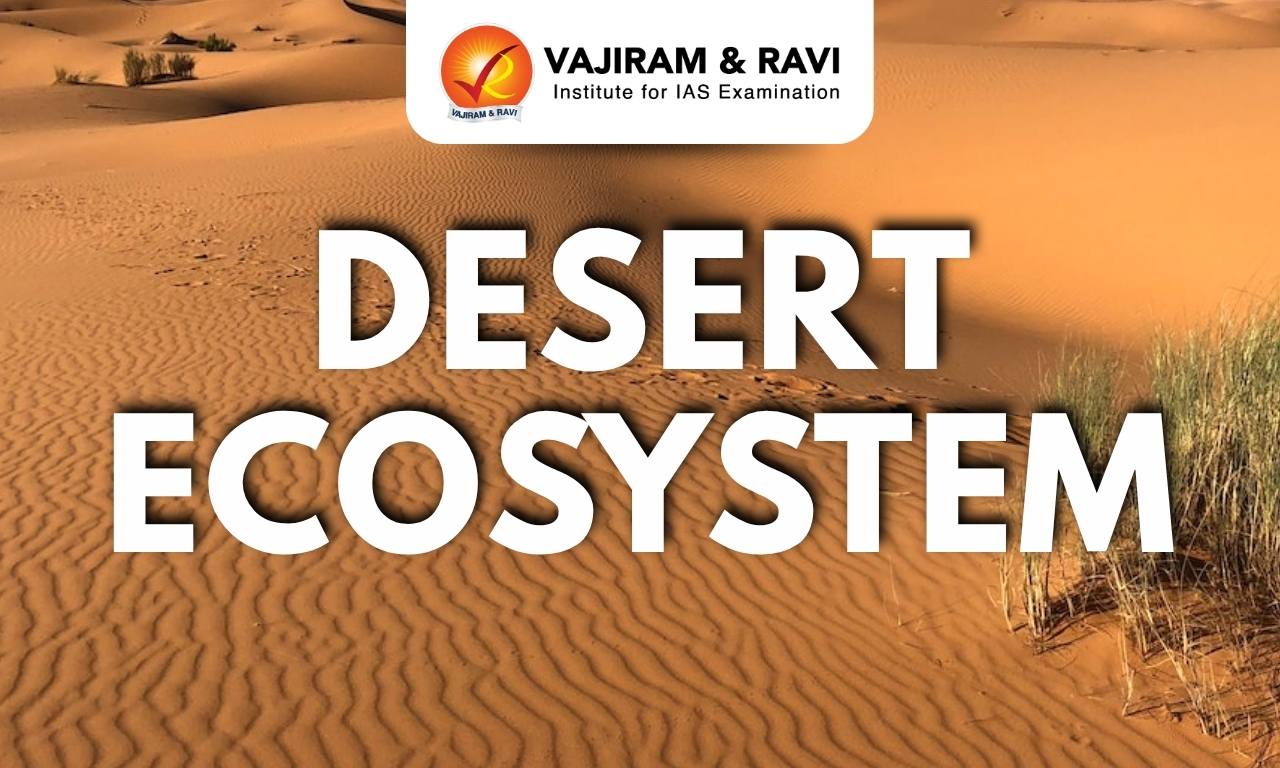
A desert ecosystem is a type of natural environment that is characterized by very low rainfall, extreme temperatures, and limited vegetation. These regions are generally dry and have harsh living conditions. Despite these challenges, deserts support specially adapted plants and animals that can survive with very little water. Deserts are found in different parts of the world and are broadly classified into hot and cold deserts based on their temperature.
Desert Ecosystem
- A desert ecosystem is a natural system where living organisms (plants, animals, microbes) interact with non-living elements like soil, air, temperature, and water in very dry conditions.
- It is found in regions that receive very little rainfall (usually less than 50 cm per year) and experience extreme temperatures either very hot or very cold.
- Deserts are considered the driest terrestrial ecosystems on Earth, which is why they have low biodiversity compared to other ecosystems like forests or grasslands.
- Despite harsh conditions, the plants and animals present are highly adapted to survive with limited water and extreme climate.
Desert Ecosystem Types
The different types of desert ecosystems have been classified below in detail:
Hot Desert
- Hot deserts are found in tropical and subtropical regions where there is very little rainfall and very high temperatures. They are usually located on the western sides of continents between 15° and 30° latitudes due to dry air and high-pressure conditions.
- The climate is extremely harsh, with very hot days and cold nights, showing a large difference in temperature within a single day. Rainfall is very low, generally less than 25 cm per year. The soil is sandy, dry, and often salty, with very little ability to hold water.
- Plants in these regions are mostly drought-resistant (xerophytic) such as cactus, acacia, and date palms. Animals like camels, reptiles, foxes, and hyenas are adapted to survive with very little water.
- A major example is the Sahara Desert, the largest hot desert in the world, where temperatures can reach up to 50°C during the day.
Cold Desert
- Cold deserts are found in higher altitudes or temperate regions, often in the interior of continents or in rain-shadow areas where mountains block rainfall.
- These deserts have a very cold and dry climate, with most precipitation falling as snow. They experience extreme winters and cool summers, with a large annual temperature range. Strong cold winds are also common.
- Vegetation includes grasses, shrubs, and small trees like juniper and birch. Animals such as the Snow Leopard, Bactrian camel, and Tibetan wolf are adapted to these conditions.
- An important example is Ladakh, which is known as India’s cold desert. It lies at a high altitude and has very low temperatures and dry conditions throughout the year.


Desert Ecosystem Six Biogeographic Domains
Deserts across the world are grouped into different biogeographic domains based on their location, climate, and ecological features. There are six main desert regions:
- Australian Deserts: These deserts are located in the interior of Australia and are extremely dry. They have very low population density, often less than one person per square kilometre, making them some of the least populated deserts in the world.
- Afrotropical Deserts: These deserts are found mainly in Sub-Saharan Africa and also extend into parts of the Arabian Peninsula. Human activities have put pressure on these ecosystems, especially in regions like Madagascar and the Horn of Africa.
- Indo-Malay Region: This region includes deserts like the Thar Desert and areas around the Indus Valley. It has a high human population, and human impact on the environment is quite strong. It is also known as the Oriental region.
- Neotropical Deserts: These deserts are spread across South America, Central America, and the Caribbean.A large portion lies in South America, but only a small part (about 6%) is protected, which raises concerns for conservation.
- Nearctic Deserts: These are found in North America, covering a large area.
- Due to urban development, especially in cities like Phoenix, human population and activities are increasing in these desert regions.
- Palearctic Domain: This is the largest desert domain in the world, covering about 63% of all desert areas. It includes famous deserts like the Sahara Desert. These deserts are known for their extreme dryness and difficult terrain, and in some areas, there are mountains, basins, and varied landscapes.
Desert Ecosystem Climate
- Desert regions experience extreme temperature variations between day and night. During the day, temperatures become very high because there is very little moisture in the atmosphere. This lack of moisture means that the sun’s rays directly reach the surface without much obstruction, causing intense heating of the ground.
- The Earth’s surface absorbs this heat and then warms the surrounding air. However, deserts cannot retain this heat effectively. At night, the situation reverses the heat stored during the day and is quickly radiated back into the atmosphere.
- As a result, temperatures drop rapidly after sunset, and desert nights become very cold. In some cases, temperatures may even fall below 0°C.
Desert Ecosystem Precipitation
- Precipitation in deserts varies between hot deserts and cold deserts.
- Hot deserts receive very little rainfall, usually around 15 cm per year. The rain is irregular and unpredictable, often coming in short, heavy bursts.
- Cold deserts, on the other hand, receive slightly more precipitation. Instead of rain, much of it falls as snow during winter. They also receive some rainfall in the spring season. On average, total precipitation in cold deserts ranges from 15 to 26 cm per year.
Desert Ecosystem Seasons
- During the summer season, temperatures are very high, usually ranging from 30°C to 49°C. Rainfall is extremely low or almost absent during this time. Because of the intense heat, evaporation is much higher than precipitation, which makes the environment even drier.
- In contrast, winter temperatures are much cooler, generally ranging between 10°C and 20°C. Compared to summer, some deserts may receive slightly more precipitation in winter, especially in the form of light rain (in hot deserts) or snow (in cold deserts).
Desert Ecosystem Soil
- In any ecosystem, the type of soil plays an important role in deciding what kind of plants can grow there. Different plants need different soil conditions to survive.
- In deserts, the soil is generally dry, sandy, and rocky. It contains very little organic matter and lacks important nutrients like nitrogen and phosphorus, which are essential for plant growth. Due to very low rainfall, the soil cannot retain moisture for long.
- Because of these poor conditions, the soil is not suitable for the growth of large plants or trees. As a result, big trees are usually absent in desert regions.
- However, some plants have adapted to survive in such harsh conditions. These include cacti, thorny bushes, and small shrubs, which have special features like deep roots, thick stems to store water, and reduced leaves to minimize water loss.
Desert Ecosystem Flora
- Desert ecosystems receive very little rainfall and experience large temperature differences between day and night. These harsh conditions make it difficult for most plants to survive.
- However, some plants have adapted very well to this environment. As a result, deserts still support a variety of specially adapted vegetation. Common types of plants found in deserts include cacti, small shrubs, succulents, and grasses.
- These plants have unique adaptations such as:
- Thick stems to store water (e.g., cacti)
- Deep or widespread roots to absorb water quickly
- Small or no leaves to reduce water loss
- Waxy coating on leaves or stems to prevent evaporation
Desert Fauna
- Desert ecosystems have very little water and extreme temperatures, making survival difficult for animals. However, many animals have adapted to live in these harsh conditions.
- Common desert animals include rabbits and wild cats. Among wild cats, mountain lions and bobcats are often found in desert regions.
- Reptiles are very common in deserts because they can survive with less water. These include snakes such as rattlesnakes, coral snakes, and king snakes, and lizards like horned lizards, banded geckos, and tree lizards. Horned lizards are unique because they mainly feed on ants and beetles and have spines and horns for protection.
- Birds are also well adapted to desert life. Some common desert birds include the roadrunner, vulture, and golden eagle.
Desert Ecosystem Adaptations
Adaptations in Desert Plants
- Desert plants have developed special features (adaptations) to survive in very hot and dry conditions.
- One of the most important adaptations is water storage. Many plants, like cacti, store water in their thick stems or leaves so they can survive for long periods without rain. They also have a waxy coating on their surface, which helps reduce water loss.
- Some desert plants have very long roots (taproots) that go deep into the ground to reach underground water. Others have shallow roots that spread widely to quickly absorb rainwater when it falls.
- Many plants also have small leaves or no leaves at all. This reduces the loss of water through evaporation. In some cases, leaves are modified into spines (like in cactus) which also help protect the plant from animals.
- Certain desert plants can become dormant (inactive) during very dry periods and start growing again when it rains.
- For example, the cactus is well adapted to desert life. It can grow tall, store large amounts of water, and live for many years even in extreme conditions.
- Another example is the Mugma Tree, which has small upward-growing leaves. These leaves act like a funnel during rainfall, directing water towards the base of the plant, where it is absorbed by its roots.
- Additional Adaptations
- Some plants open their stomata at night to reduce water loss (CAM photosynthesis)
- Seeds of some plants remain inactive for years and grow only after rainfall
- Light-colored surfaces help reflect sunlight
Adaptations in Desert Animals
- Desert animals survive in very harsh conditions such as extreme heat during the day, cold nights, and very little water availability. To live in such an environment, they have developed special adaptations.
- One of the most important adaptations is water conservation. Many desert animals can survive for long periods without drinking water. For example, the camel can go for many days without water because it stores fat in its hump, which can be converted into energy and water.
- Camels also have several physical adaptations:
- Long legs that keep their body away from the hot sand
- Thick fur that protects them from heat during the day and cold at night
- Closable nostrils to prevent sand from entering
- Long eyelashes to protect their eyes from dust and sunlight
- Wide, padded feet that help them walk on sand without sinking
- Many desert animals are nocturnal, meaning they are active at night when temperatures are lower. This helps them avoid the extreme daytime heat.
- Animals like the desert fox survive by living in burrows. Burrowing helps them stay cool during the day and protects them from predators.
- The desert fox also has large ears, which help in releasing excess body heat. Its light-colored fur reflects sunlight and provides camouflage in the sandy environment.
- Reptiles such as snakes and lizards are common in deserts because they can survive with very little water. They get most of their moisture from the food they eat.
- Some animals, like the kangaroo rat, can survive without drinking water at all. They obtain water from seeds and produce very little urine to conserve water.
- Many desert animals show behavioral adaptations such as:
- Panting to reduce body heat
- Hiding in shade or burrows during the hottest part of the day
- Becoming inactive (aestivation) during extremely dry conditions
- Some animals also migrate seasonally to areas with better conditions when food and water are scarce.
- Desert animals often have light-colored bodies, which help reflect sunlight and keep their bodies cooler.
Desert Ecosystem Significance
- Desert ecosystems support a wide variety of plants and animals. Even though conditions are harsh, many unique species live here and are specially adapted to survive.
- These plants and animals are interdependent. They form food chains and food webs, which help in maintaining the ecological balance of the desert.
- Desert soils contain microorganisms like bacteria, which play an important role in nutrient cycling. Some of these bacteria can store carbon dioxide (CO₂), helping the desert act as a carbon sink and reducing the amount of CO₂ in the atmosphere.
- Deserts are rich in mineral resources such as natural gas, oil, and valuable minerals. These resources are important for economic development and energy production.
- Deserts have unique landforms such as sand dunes, rocky plateaus, and oases. These features make deserts geographically important and interesting to study.
- The presence of oases supports human settlements and agriculture in otherwise dry regions by providing water and fertile land.

 Last updated on Oct, 2026
→ UPSC 2027 Notification will be released on 13 January 2027 at upsconline.nic.in.
→ Check Nobel Prize 2026 Winners List here.
→ Download PIB PRiSM Monthly Magazine 2026 here.
→ Check UPSC Monthly Current Affairs Magazine The Recitals here.
→ Check out the latest UPSC Syllabus here.
→ Download UPSC Model Answers for Mains 2026
→ UPSC Mains Question Paper 2026 is out now for Essay & GS Paper 1, 2, 3 & 4.
→ UPSC Calendar 2027 has been released.
→ Enroll in Vajiram & Ravi’s UPSC Mains Test Series 2027 for structured answer writing practice, expert evaluation, and exam-oriented feedback.
→ Join Vajiram & Ravi’s UPSC Mentorship Program 2027 for personalized guidance, strategy planning, and one-to-one support from experienced mentors.
→ Go through the UPSC Mains Previous Year Papers to enhance your preparation.
→ UPSC has released UPSC Toppers List 2025 with the Civil Services final result on its official website.
→ Also check Best UPSC Coaching in India
Desert Ecosystem FAQs
Q1. What is a desert ecosystem?+
Q2. What are the main types of deserts?+
Q3. Why do deserts have extreme temperatures?+
Q4. What kind of soil is found in deserts?+
Q5. What types of plants are found in deserts?+
Tags: Desert Ecosystem geography geography notes