CAPF Bill Latest News
- The Union government has proposed the Central Armed Police Forces (General Administration) Bill, 2026, to codify IPS deputation and address recent Supreme Court directions.
Central Armed Police Forces and IPS Deputation
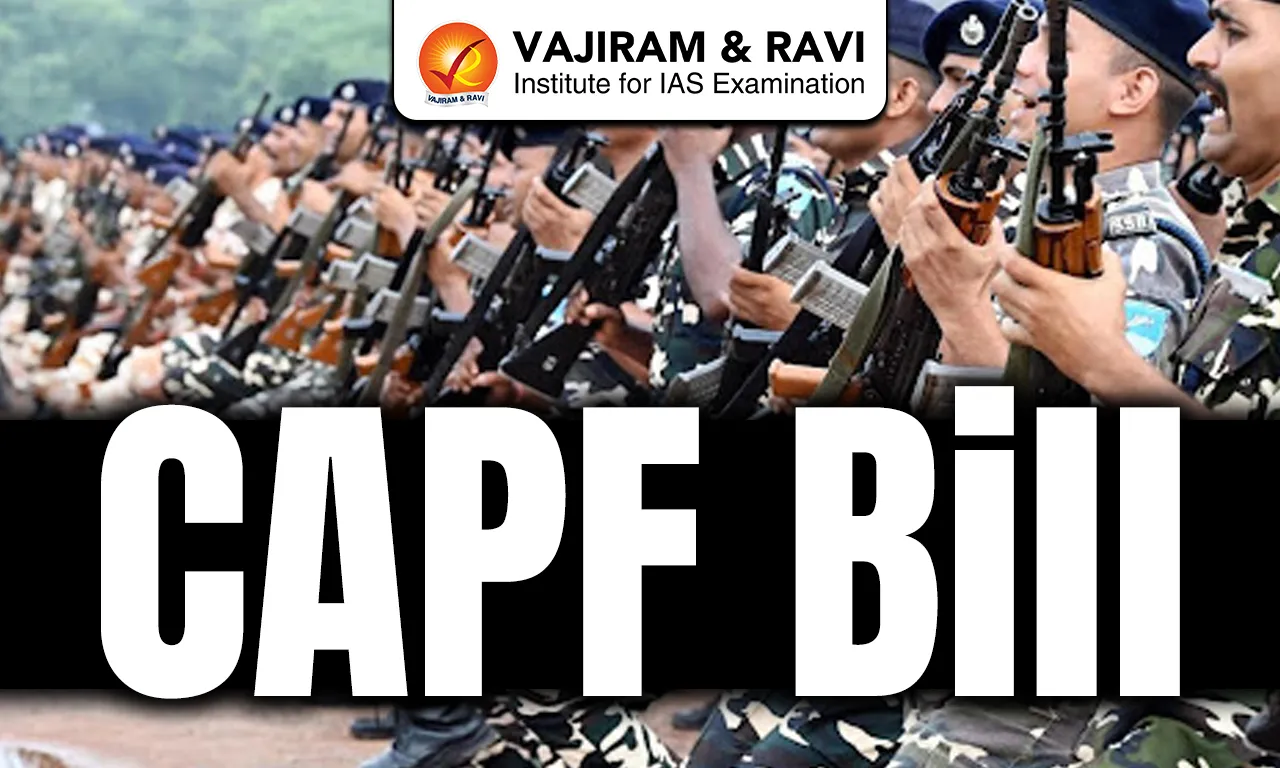
- The Central Armed Police Forces (CAPFs) are key pillars of India’s internal security architecture.
- They include forces such as CRPF, BSF, ITBP, CISF, and SSB, which perform functions like border guarding, counter-insurgency, and maintaining internal security.
- Historically, leadership positions in CAPFs have been shared between:
- Cadre officers (direct recruits within CAPFs)
- Indian Police Service (IPS) officers on deputation
- IPS officers, being part of an All India Service under Article 312, have traditionally occupied senior leadership roles in CAPFs to ensure coordination between the Centre and States.


Existing System of Deputation
- Before the proposed Bill, IPS deputation in CAPFs was governed by executive orders.
- Around 20% of posts at the DIG level are reserved for IPS officers
- Around 50% of posts at the IG level are filled through IPS deputation
- There was no comprehensive statutory framework governing these appointments, leading to ambiguity and litigation.
Structural Issues in CAPFs
- The controversy also highlights deeper structural challenges:
- Around 10 lakh personnel in CAPFs
- Only about 13,000 Group A officers
- Nearly 93,000 vacancies across ranks
- These issues point to systemic gaps in manpower planning, promotions, and cadre management.
Key Provisions of the CAPF Bill 2026
- The proposed Bill seeks to formalise and expand IPS deputation in CAPFs.
- 50% of Inspector General (IG) posts to be filled by IPS officers
- At least 67% of Additional Director General (ADG) posts to be held by IPS officers
- All posts of Special DG and DG to be reserved for IPS officers
- The Bill aims to create an umbrella legal framework to regulate recruitment and service conditions of Group A officers in CAPFs.
Rationale Behind the Bill
- Administrative Clarity: The absence of a statutory law led to fragmented rules and multiple court cases. The Bill aims to bring uniformity.
- Reducing Litigation: Frequent disputes between CAPF cadre officers and IPS officers have resulted in prolonged litigation. The Bill seeks to “avoid unnecessary litigation.”
- Strengthening Coordination: Since CAPFs operate closely with State police, IPS officers are considered essential for maintaining Centre-State coordination.
- National Security Imperative: CAPFs perform critical roles such as Border security, Counter-insurgency operations and Internal security management.
- The government argues that experienced IPS leadership enhances operational efficiency.
Supreme Court Judgment and Policy Response
- The Bill comes in the backdrop of a May 2025 Supreme Court judgment, which directed progressive reduction of IPS deputation in CAPFs up to IG level.
- Additionally:
- CAPF officers were granted Organised Group A Services (OGAS) status
- The Court called for a cadre review and new service rules
- The government’s Bill is seen as a legislative response to balance judicial directions with administrative needs.
Concerns Raised by CAPF Officers
- The proposal has faced strong opposition from retired and serving CAPF officers.
- Career Stagnation
- Limited senior posts for cadre officers
- First promotion often takes 15-18 years
- Perceived Discrimination
- Cadre officers argue that reserving top posts for IPS officers undermines their career progression despite operational experience.
- Ignoring Judicial Intent
- Critics contend that the Bill contradicts the Supreme Court’s directive to reduce IPS deputation.
Significance of the Bill
- Institutionalising Administrative Practices: The Bill converts executive practices into statutory provisions, reducing ambiguity.
- Federal Balance: By emphasising IPS deputation, it reinforces Centre-State administrative linkages.
- Civil Services Reform Debate: The issue has reopened debates on:
- Role of All India Services
- Autonomy of specialised forces
- Career progression within uniformed services

 Last updated on Oct, 2026
→ UPSC 2027 Notification will be released on 13 January 2027 at upsconline.nic.in.
→ Asian Games 2026 are being held in Aichi-Nagoya, Japan, from 19 September to 4 October.
→ Check Nobel Prize 2026 Winners List here.
→ Download PIB PRiSM Monthly Magazine 2026 here.
→ Check UPSC Monthly Current Affairs Magazine The Recitals here.
→ Check out the latest UPSC Syllabus here.
→ Download UPSC Model Answers for Mains 2026
→ UPSC Mains Question Paper 2026 is out now for Essay & GS Paper 1, 2, 3 & 4.
→ UPSC Calendar 2027 has been released.
→ Enroll in Vajiram & Ravi’s UPSC Mains Test Series 2027 for structured answer writing practice, expert evaluation, and exam-oriented feedback.
→ Join Vajiram & Ravi’s UPSC Mentorship Program 2027 for personalized guidance, strategy planning, and one-to-one support from experienced mentors.
→ Go through the UPSC Mains Previous Year Papers to enhance your preparation.
→ UPSC has released UPSC Toppers List 2025 with the Civil Services final result on its official website.
→ Also check Best UPSC Coaching in India
CAPF Bill FAQs
Q1. What is the CAPF Bill 2026?+
Q2. Why is the Bill being introduced?+
Q3. What did the Supreme Court direct in 2025?+
Q4. Why are CAPF officers opposing the Bill?+
Q5. What role do CAPFs play in India?+
Tags: CAPF Bill mains articles upsc current affairs upsc mains current affairs