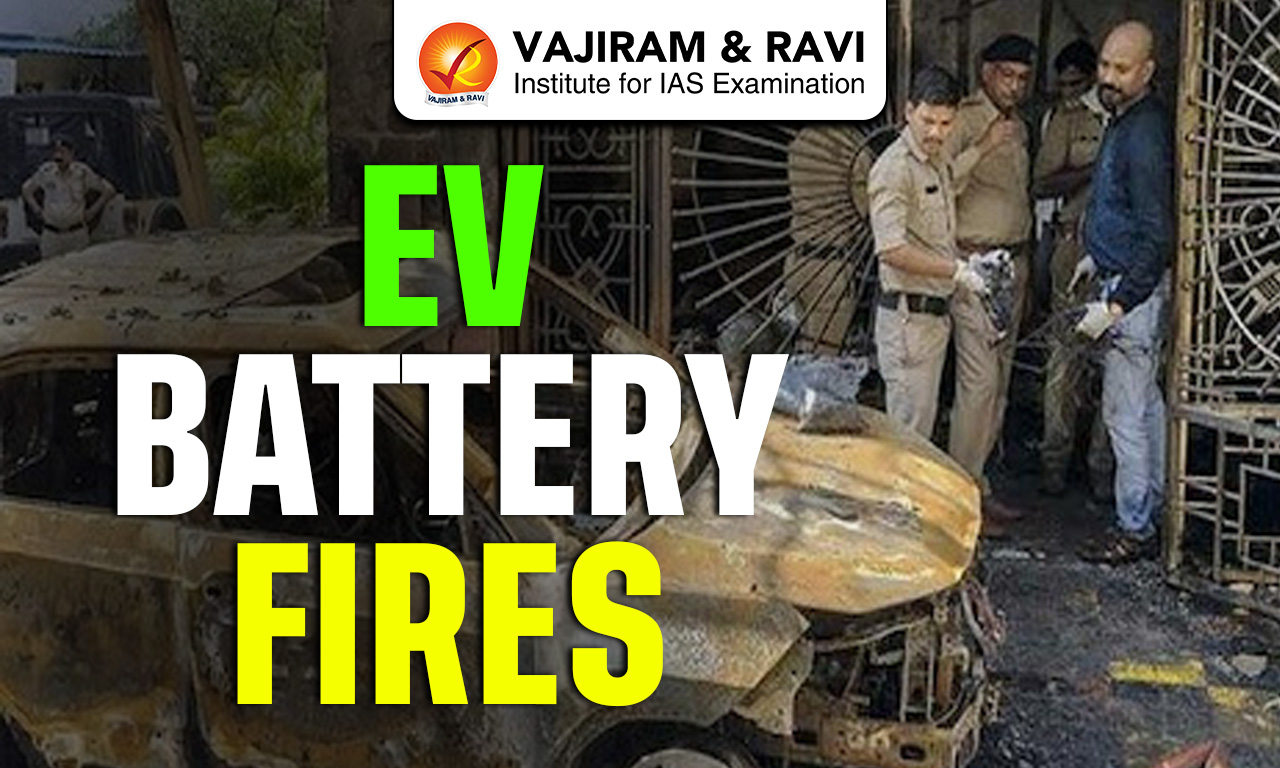
EV Battery Fires Latest News
- A devastating fire tore through a house in Indore recently, killing 8 people — including 2 children.
- The blaze is suspected to have originated from an EV charging point located outside the house. An official investigation is currently underway.
Safety of EV Batteries
- Lithium-Ion Batteries: Common but Efficient – Most EVs use lithium-ion batteries, similar to those in smartphones and laptops. They offer high energy density and are generally safe when properly managed.
- Role of Battery Management System (BMS) – EVs are equipped with a Battery Management System (BMS). It regulates temperature and ensures the battery operates within safe limits during charging and discharging.
- Risk of Thermal Runaway – A key risk is thermal runaway, where:
- One battery cell overheats
- Heat spreads to nearby cells
- A chain reaction occurs, overwhelming the cooling system.
- Fire and Toxic Gas Risk – During thermal runaway, batteries release flammable and toxic gases such as hydrogen fluoride. These gases can intensify fire risk and make incidents more hazardous.
- Overall Insight – EV batteries are generally safe, but rare failures like thermal runaway can lead to serious fire hazards if not properly controlled.


Causes of Thermal Runaway in EV Batteries
- Physical Damage to Battery Pack – Strong impacts (especially to the undercarriage) can damage the battery casing. This may puncture or deform cells, leading to internal short circuits and overheating.
- Overcharging and Faulty Chargers – Charging beyond safe limits can cause charge buildup in unstable areas of the battery. Use of third-party or damaged chargers increases this risk. Repeated overnight charging with unsafe chargers can worsen the problem.
- Manufacturing Defects – Rare defects like metal protrusions inside cells can connect positive and negative electrodes. This leads to sudden high current flow, generating excessive heat and triggering thermal runaway.
- Electrical Infrastructure Issues – Weak or old wiring and extension cords may not handle sustained current. This can cause overheating during charging, indirectly increasing fire risk.
Impact of External Conditions on EV Battery Safety
- Heat and Thermal Stress – High temperatures, especially during Indian summers, can strain the cooling system. Parking in direct sunlight or charging immediately after long drives increases thermal stress on batteries.
- Battery Age and Maintenance – Over time, batteries degrade internally, increasing risk. Ignoring warning signs or skipping inspections may hide issues like swelling or chemical breakdown.
- Risk from Flooding – Floodwater can enter battery packs, causing short circuits. Several EV fires have been reported days after vehicles were submerged.
- EV vs Petrol Vehicle Fires – EVs are not uniquely dangerous—petrol vehicles catch fire more often. However, EV battery fires:
- Burn hotter and faster
- Are harder to extinguish due to oxygen release
- Firefighting requires large amounts of water or special equipment.
- Role of Surrounding Factors – Fire risks can increase due to external elements like: LPG cylinders stored nearby; Presence of other vehicles; Power failure affecting safety systems (e.g., electronic locks).
Industry and User Measures to Improve EV Battery Safety
- Advanced Cooling Technologies – EVs use coolant channels to absorb and dissipate heat. New systems are being developed where coolant evaporates to improve heat transfer, helping manage sudden temperature spikes.
- Safer Battery Design Innovations – Shift towards solid-state batteries (using solid electrolytes) to reduce fire risks. Improved internal firewalls to prevent fire from spreading between cells if one fails
User-Level Safety Precautions
- Use only manufacturer-approved chargers.
- Avoid unattended or overnight charging with unsafe setups.
- Ensure home electrical systems can handle high loads.
- Get batteries checked after impacts.
- Allow battery to cool after long drives before charging and keep charging areas clear.
Strengthened Safety Standards in India
- Bureau of Indian Standards (BIS) updated EV battery safety norms in 2023.
- Under AIS-156 standards, batteries must:
- Undergo tests for heat propagation
- Provide at least five minutes for passenger evacuation in case of fire
Source: TH

 Last updated on Oct, 2026
→ UPSC 2027 Notification will be released on 13 January 2027 at upsconline.nic.in.
→ Asian Games 2026 are being held in Aichi-Nagoya, Japan, from 19 September to 4 October.
→ Check Nobel Prize 2026 Winners List here.
→ Download PIB PRiSM Monthly Magazine 2026 here.
→ Check UPSC Monthly Current Affairs Magazine The Recitals here.
→ Check out the latest UPSC Syllabus here.
→ Download UPSC Model Answers for Mains 2026
→ UPSC Mains Question Paper 2026 is out now for Essay & GS Paper 1, 2, 3 & 4.
→ UPSC Calendar 2027 has been released.
→ Enroll in Vajiram & Ravi’s UPSC Mains Test Series 2027 for structured answer writing practice, expert evaluation, and exam-oriented feedback.
→ Join Vajiram & Ravi’s UPSC Mentorship Program 2027 for personalized guidance, strategy planning, and one-to-one support from experienced mentors.
→ Go through the UPSC Mains Previous Year Papers to enhance your preparation.
→ UPSC has released UPSC Toppers List 2025 with the Civil Services final result on its official website.
→ Also check Best UPSC Coaching in India
EV Battery Fires FAQs
Q1. What are EV battery fires and why do they occur?+
Q2. What is thermal runaway in EV battery fires?+
Q3. Are EV battery fires more dangerous than petrol fires?+
Q4. What precautions can prevent EV battery fires?+
Q5. What steps are being taken to reduce EV battery fires?+
Tags: EV Battery Fires mains articles upsc current affairs upsc mains current affairs