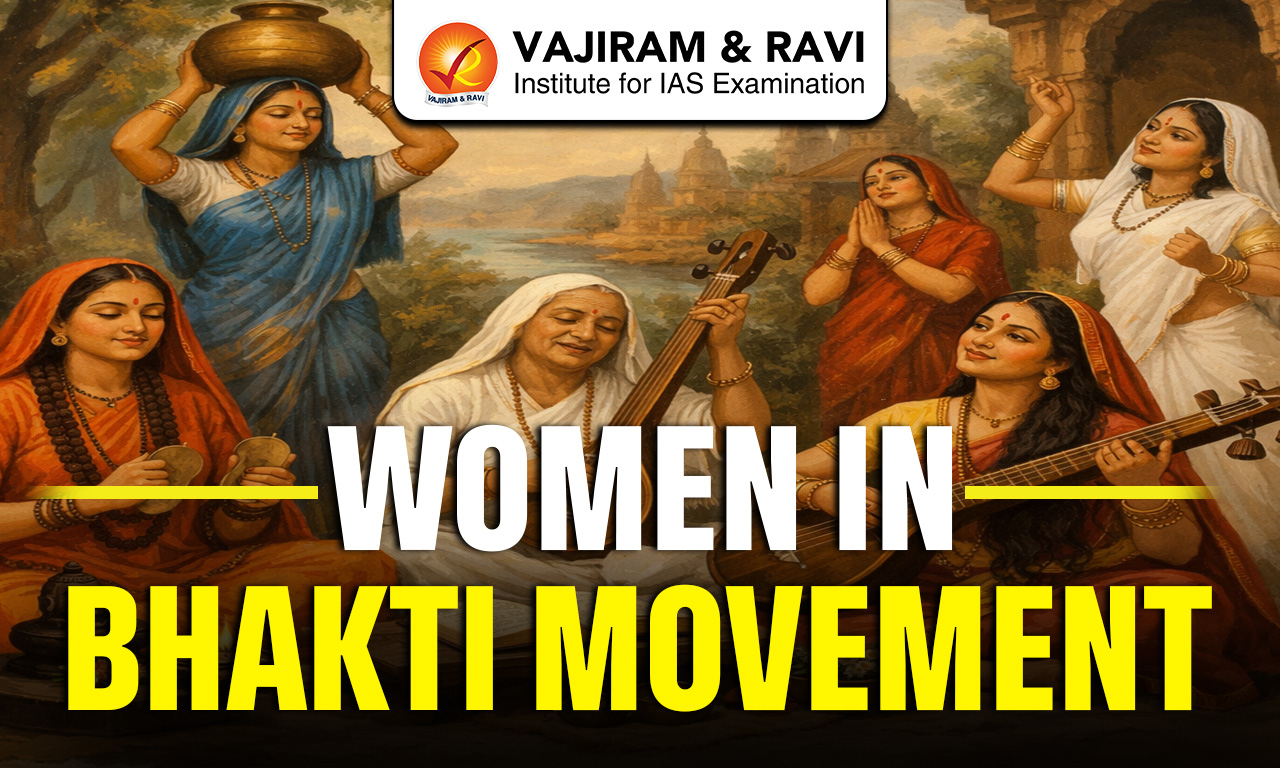
The Bhakti Movement was a major religious and social reform movement in medieval India (6th-17th century) that emphasized personal devotion (bhakti) to God over rituals, caste divisions, and priestly control. It spread across different regions through saints who preached in local languages, making religion more accessible and inclusive.
Within this movement, women Bhakti saints played a crucial role. Despite living in a patriarchal society, they expressed deep devotion through poetry and songs, challenged social restrictions, and asserted their right to a direct relationship with the divine. Their contributions not only enriched devotional traditions but also promoted ideas of equality, dignity, and social reform.
Features of Women Bhakti Saints
Women Bhakti saints shared certain distinctive characteristics:
- Rejection of ritualism: They emphasized love and devotion rather than elaborate ceremonies.
- Spiritual equality: They believed that all individuals, regardless of gender or caste, could attain God.
- Use of vernacular languages: Their compositions in regional languages made their message accessible to common people.
- Challenge to patriarchy: Many defied societal expectations of marriage, family, and gender roles.
- Reflection of everyday life: Their poetry often included domestic experiences and social struggles.
Major Women Bhakti Saints and Their Contributions
Women in the Bhakti Movement played an important role by composing devotional songs and poems, expressing their love for God, sharing spiritual teachings, and inspiring people across different regions and communities.
Key women Saints and their contributions:
Andal:
- Andal, also known as Kothai and Nachiyar is one of the 12 Alvars, who are Tamil saints who patronised Vaishnavism during the Bhakti movement.
- She was the only female Alvar saint from South India and a great devotee of Lord Vishnu.
- Her compositions, such as Tiruppavai, advocate complete surrender (prapatti) to God.
- She rejected ritual formalism and emphasized pure love and devotion as the highest path to salvation.
Lal Ded (Lalleshwari):
- Lal Ded was a 14th-century Kashmiri mystic saint, poet, and philosopher.
- She was associated with Kashmir Shaivism.
- She is revered by both Hindus and Muslims – known as Lalleshwari in Shaivism and Lalla Arifa in Sufi tradition.
- She emphasized non-dualism and the importance of self-realization over ritualistic practices.
- Through her simple yet profound Kashmiri verses, known as Vakhs, she made spiritual ideas accessible to the common people.
Sant Soyarabai:
- Soyarabai was a saint from the Mahar caste in 14th-century Maharashtra, India.
- She was associated with the Varkari tradition, a popular Bhakti tradition of Maharashtra centered on the worship of Lord Vithoba (Vithoba).
- Her teachings focused on the idea that true devotion to God, especially Vithoba, depends on inner purity and sincere faith, not on caste or rituals.
- Her works strongly criticized untouchability and highlighted the hypocrisy of caste-based hierarchies
- Through her simple Marathi devotional compositions known as Abhangas, she conveyed ideas of equality, dignity, and direct connection with the divine, making spirituality accessible to the common people.
Meerabai:
- Meerabai was a prominent saint of the Bhakti Movement, known for her intense devotion to Krishna.
- She was born in a Rajput royal family at Merta in present-day Rajasthan.
- From childhood, she developed deep devotion to Krishna, whom she considered her divine husband.
- She was married to Bhoj Raj, the crown prince of Mewar, the son of Rana Sanga, but she remained emotionally detached from worldly marriage.
- After marriage, she faced strong resistance from her in-laws, who disapproved of her public singing, interaction with sadhus, and disregard for royal customs.
- She refused to conform to patriarchal expectations, including practices like purdah and devotion to family deities, which marked her as socially rebellious.
- Due to continuous persecution and constraints, she renounced royal life and became a wandering saint, traveling to places like Vrindavan and Dwarka.
- Her philosophy was rooted in Saguna Bhakti, focusing on a personal God with form (Krishna).
- She emphasized Prem Bhakti (devotion through love), where the devotee seeks complete emotional and spiritual union with God.
- Meerabai strongly rejected ritualism, priestly dominance, and caste discrimination, advocating a direct and personal connection with the divine.
- Her teachings promoted spiritual equality, asserting that devotion is open to all irrespective of gender or social status.
- She composed numerous bhajans (devotional songs) in Braj Bhasha and Rajasthani, making religious ideas accessible to the common people.
- She played a crucial role in popularizing the Bhakti Movement in North India, especially among women and marginalized groups.
Karaikal Ammaiyar:
- Karaikal Ammaiyar was one of the earliest and most prominent women saints of the Bhakti Movement in South India.
- She belonged to the Nayanar tradition (devotees of Lord Shiva) in Tamil Nadu and lived around the 6th century CE.
- She renounced worldly life and is revered for her intense devotion to Lord Shiva.
- Her hymns emphasize asceticism, love, and total surrender to the divine, making her a foundational figure in Tamil devotional literature.
Akka Mahadevi:
- Akka Mahadevi was a prominent woman saint of the Virashaiva / Lingayat Bhakti Movement in Karnataka.
- She was a devoted follower of Shiva, whom she worshipped as Chenna Mallikarjuna (Lord of beauty).
- She rejected marriage and worldly life, choosing a path of complete devotion and renunciation.
- Known for her radical stance, she is believed to have abandoned clothing, symbolizing detachment from material and social norms.
- She composed devotional poems called Vachanas in Kannada, expressing intense love and union with God.
- She was associated with the Anubhava Mantapa, a spiritual assembly of saints led by Basavanna.
- Advocated equality and rejection of caste hierarchy, key features of the Lingayat movement.
- Played a crucial role in strengthening the Bhakti Movement in South India, especially among women.
Janabai:
- Janabai was a prominent woman saint of the Varkari Bhakti tradition in Maharashtra.
- She was a devotee of Vithoba (Vitthala), the presiding deity of Pandharpur.
- Born in a low-caste (Shudra) family, she spent much of her life working as a domestic servant in the household of Namdev.
- She composed devotional songs called Abhangas in Marathi, written in simple language accessible to common people.
- Her poetry reflects deep devotion and personal bond with Vithoba, everyday life experiences of women and labourers and criticism of caste hierarchy and social inequality
- She often portrayed God as participating in her daily chores, symbolizing intimacy between devotee and divine.
- Advocated spiritual equality, emphasizing that devotion is above caste, gender, and social status.
Bahinabai (Bahina Bai):
- A 17th-century saint from Maharashtra, Bahinabai composed devotional songs that reflect the working lives of rural women, especially in agrarian settings.
- Her writings integrate devotion with daily toil, illustrating how spirituality permeates ordinary life.


Significance of Women in Bhakti Movement
Women saints played a pivotal role in the Bhakti Movement by demonstrating that devotion transcended social hierarchies, gender barriers, and ritual formalism, thereby making spirituality accessible to all.
- Spiritual Democratization: Women saints helped transform Bhakti into a mass-based movement, making religious experience accessible irrespective of gender or caste.
- Challenge to Patriarchy: By rejecting marriage norms, domestic confinement, and male authority, they asserted women’s agency in spiritual and social spheres.
- Literary Contributions: Through their poetry, hymns, and songs (bhajans, abhangas, vachanas, vakhs), they enriched regional languages and devotional literature.
- Popularization of Bhakti: Their compositions were in vernacular languages, making devotion accessible to common people and spreading Bhakti beyond elite circles.
- Integration of Daily Life and Devotion: Saints like Bahinabai demonstrated that spirituality could coexist with household responsibilities and labor, showing Bhakti as a practical way of life.
- Inspiration for Future Generations: Their lives and works became a source of inspiration for later saints, reformers, and social movements advocating equality, devotion, and moral courage.

 Last updated on Oct, 2026
→ UPSC 2027 Notification will be released on 13 January 2027 at upsconline.nic.in.
→ Check Nobel Prize 2026 Winners List here.
→ Download PIB PRiSM Monthly Magazine 2026 here.
→ Check UPSC Monthly Current Affairs Magazine The Recitals here.
→ Check out the latest UPSC Syllabus here.
→ Download UPSC Model Answers for Mains 2026
→ UPSC Mains Question Paper 2026 is out now for Essay & GS Paper 1, 2, 3 & 4.
→ UPSC Calendar 2027 has been released.
→ Enroll in Vajiram & Ravi’s UPSC Mains Test Series 2027 for structured answer writing practice, expert evaluation, and exam-oriented feedback.
→ Join Vajiram & Ravi’s UPSC Mentorship Program 2027 for personalized guidance, strategy planning, and one-to-one support from experienced mentors.
→ Go through the UPSC Mains Previous Year Papers to enhance your preparation.
→ UPSC has released UPSC Toppers List 2025 with the Civil Services final result on its official website.
→ Also check Best UPSC Coaching in India
Women in Bhakti Movement FAQs
Q1. Who were the women in Bhakti Movement?+
Q2. What was the role of women in Bhakti Movement?+
Q3. What were the main themes of women in Bhakti Movement?+
Q4. In which languages did women in Bhakti Movement write?+
Q5. Why are women in Bhakti Movement significant?+
Tags: women in bhakti movement