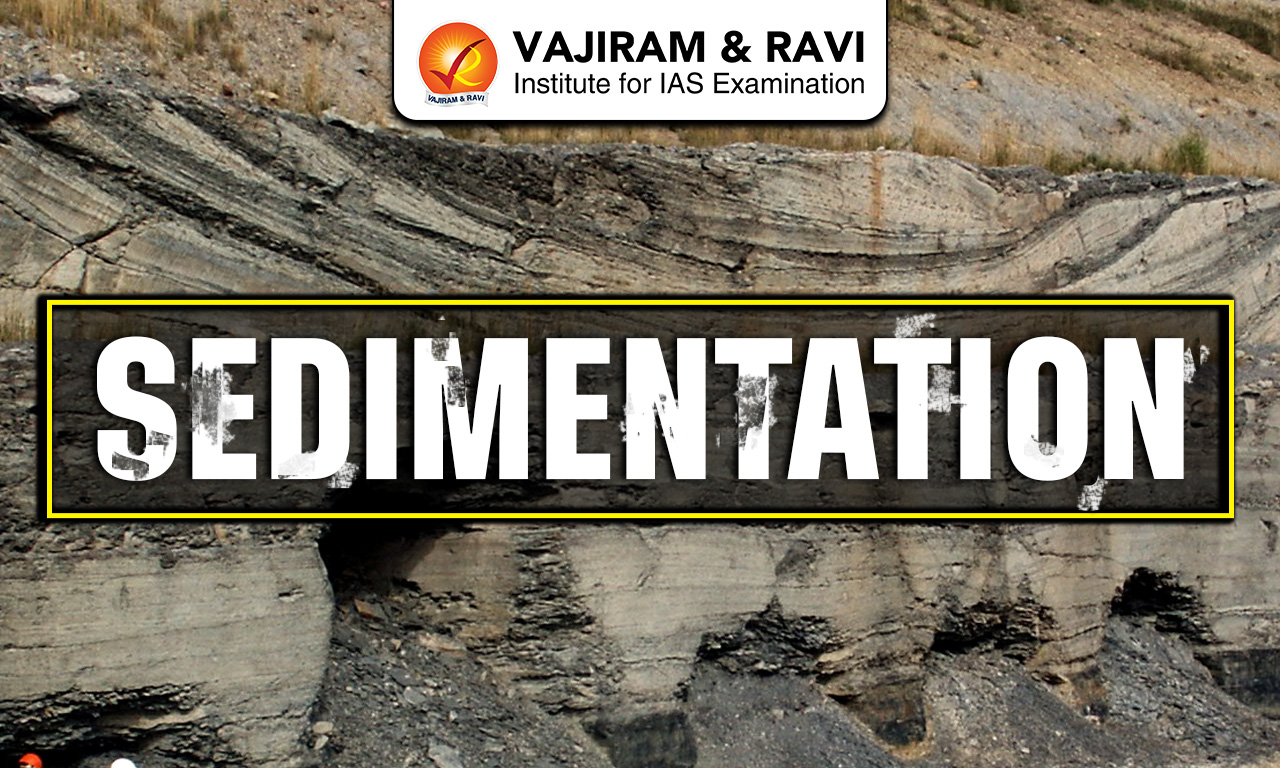
Sedimentation is the process of deposition of sediments, where particles carried in a fluid like water or air settle down due to forces such as gravity, centrifugal force or electromagnetism. It represents the final stage of transport, where suspended materials come to rest against a surface or barrier. This process occurs across a wide range of particle sizes, from large rock fragments to fine dust and even microscopic particles and plays a crucial role in shaping landforms and forming sedimentary deposits over time.
Sedimentation
In geology, Sedimentation refers to the deposition of sediments after erosion and transportation, leading to the formation of sedimentary rocks and depositional landforms. It is considered the opposite of erosion and marks the final stage in the cycle of denudation. Sediments transported by rivers, wind, glaciers, or waves eventually settle when the transporting energy decreases, resulting in layered deposits that may later harden into sedimentary rocks.
Sediments
Sediments are solid particles like rock fragments, minerals, and organic matter that are transported by water, wind, ice or gravity. They vary in size from fine dust to large boulders and often accumulate to form Landforms or Sedimentary Rocks over time.


Factors Affecting Sedimentation
Sedimentation depends on physical, environmental and human factors that influence particle settling, transport conditions and deposition patterns across different environments.
- Gravity and Forces: Gravity is the main force causing particles to settle, along with centrifugal and electromagnetic forces in certain conditions.
- Particle Size and Density: Larger and denser particles settle faster, while finer particles like silt and clay settle slowly.
- Fluid Velocity: Slower water or wind speeds promote deposition, while high velocity keeps particles suspended.
- Viscosity of Fluid: Higher viscosity slows down particle settling, affecting Sedimentation rate.
- Vegetation Presence: Plants like mangroves reduce wave energy and help sediments settle in coastal areas.
- Climate and Weathering: Rainfall, flooding and erosion rates influence the amount of sediment available for deposition.
- Human Activities: Deforestation, agriculture and dam construction alter sediment supply and deposition patterns.
- Water Body Characteristics: Depth, size and flow conditions of rivers, lakes and oceans affect sediment accumulation.
Sedimentation Landforms
Sedimentation leads to the formation of various depositional landforms where transported materials accumulate and build up over time in different environments. The examples of major Depositional Landforms formed due to Sedimentation are:
- Alluvial Fans: Cone shaped deposits formed when fast flowing streams deposit sediments at the base of mountains.
- Deltas: Formed at river mouths where sediments are deposited into seas or lakes, creating fertile landforms.
- Floodplains: Flat areas along rivers formed by repeated deposition of fine sediments during floods.
- Natural Levees: Raised river banks formed due to deposition of heavier sediments during flooding.
- Oxbow Lakes: Formed when river meanders are cut off and filled with deposited sediments.
- Sand Dunes: Wind deposited landforms made of sand particles in desert regions.
- Moraines: Deposits left behind by glaciers consisting of mixed rock debris.
Difference Between Sedimentation, Deposition and Settling
Sedimentation, Deposition and Settling are related but distinct processes.
- Settling is the downward movement of suspended particles in a fluid due to forces like gravity.
- Deposition is the accumulation of these particles at a place.
- Sedimentation is the overall process that includes settling and final deposition of sediments.

 Last updated on Sep, 2026
→ UPSC 2027 Notification will be released on 13 January 2027 at upsconline.nic.in.
→ Asian Games 2026 are being held in Aichi-Nagoya, Japan, from 19 September to 4 October.
→ Check out the latest UPSC Syllabus here.
→ Download UPSC Model Answers for Mains 2026
→ UPSC Mains Question Paper 2026 is out now for Essay & GS Paper 1, 2, 3 & 4.
→ UPSC Calendar 2027 has been released.
→ Enroll in Vajiram & Ravi’s UPSC Mains Test Series 2027 for structured answer writing practice, expert evaluation, and exam-oriented feedback.
→ Join Vajiram & Ravi’s UPSC Mentorship Program 2027 for personalized guidance, strategy planning, and one-to-one support from experienced mentors.
→ Go through the UPSC Mains Previous Year Papers to enhance your preparation.
→ UPSC has released UPSC Toppers List 2025 with the Civil Services final result on its official website.
→ Also check Best UPSC Coaching in India
Sedimentation FAQs
Q1. What is Sedimentation? +
Q2. What causes Sedimentation? +
Q3. What is the difference between Settling and Sedimentation? +
Q4. What are common landforms formed by Sedimentation? +
Q5. How do human activities affect Sedimentation? +
Tags: geography geography notes sedimentation