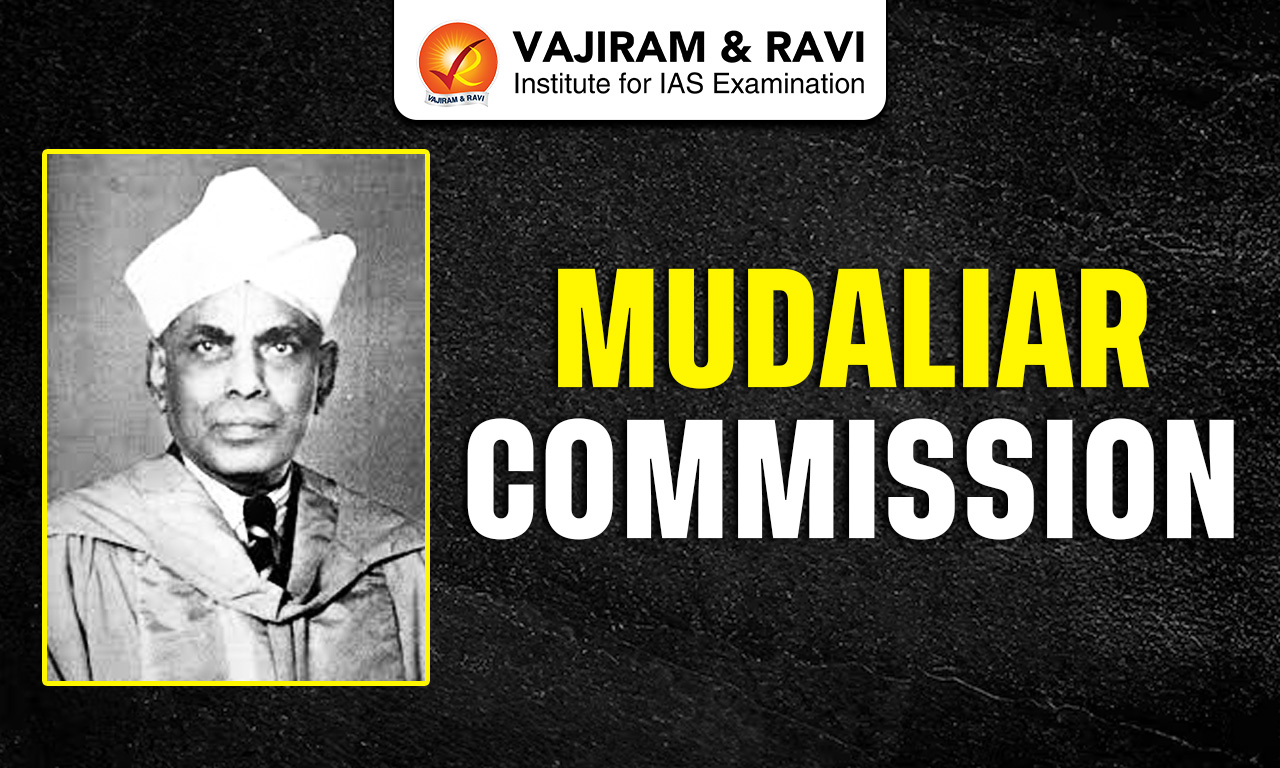
The Secondary Education Commission, also called the Mudaliar Commission, was set up by the Government of India to improve the education system and make it more useful for the country. Dr. A. Lakshmanswami Mudaliar, who was the Vice-Chancellor of Madras University, served as the chairman of this commission.
Background and Need for the Mudaliar Commission
- In the early years after independence, India’s education system was largely based on the British model. It mainly focused on rote learning and passing exams, with little attention to practical knowledge or overall development of students. This system was not suitable for the needs of a newly independent and democratic country.
- To address these issues, the Government of India set up the Secondary Education Commission (1952-53) under the chairmanship of Dr. A. Lakshmanswami Mudaliar. The main purpose was to examine the condition of secondary education and suggest improvements.
- The Commission aimed to make education more practical, skill-based, and relevant to real life. It also focused on preparing students to become responsible citizens and contribute to nation-building in a modern India.
Aim of Establishing the Mudaliar Commission
- Develop Ideal Citizens: Education should foster patriotism, social responsibility, cooperation, and a sense of sacrifice. Students should take pride in India’s culture, reflect on their own strengths and weaknesses, and cultivate universal brotherhood.
- Vocational Skills: Secondary education should equip students to earn a living, introducing vocational subjects for self-reliance.
- Leadership Qualities: Schools should develop leadership skills to strengthen democracy and national development.
- Human Values: Education must promote discipline, humility, kindness, cooperation, and brotherhood through subjects like science, arts, literature, and music.
- Personality and Creativity: Students should explore creative skills and appreciate cultural heritage through music, dance, drama, and crafts.
- Vocational Efficiency: Education should encourage productive work for self-sufficiency and national prosperity.


Mudaliar Commission Recommendations
- Duration of Secondary Education:
- Ages 11-17, divided into Junior High (3 years) and High School (4 years).
- Suggested integration of 12th class into university degree to abolish intermediate colleges.
- Curriculum Recommendations:
- Multi-purpose schools to match student interests, near industrial institutions for practical learning.
- Agriculture should be compulsory in rural schools; home science for girls; technical and commercial subjects in cities.
- Lower Secondary Subjects: Mathematics, general science, languages, social studies, physical education, arts, handicraft, music.
- Secondary Stage: Seven groups – Humanities, Sciences, Agriculture, Fine Arts, Industrial, Commercial, Home Science.
- Core Curriculum: Common for all (languages, science, social studies, craft).
- Students choose three subjects from the seven groups; optional additional subjects allowed.
- Medium of Instruction:
- Mother tongue or regional language.
- At least two languages in junior stage; three languages in secondary stage (national, regional, foreign).
- Textbooks and Resources:
- Selection by a High-Power Committee based on quality, content, and utility.
- Recommended stability in textbooks; supplementary reading for students and teachers encouraged.
- Character and Health Education:
- Focus on character formation as the foundation of national development.
- Medical examinations twice a year; knowledge of health principles taught.
- Teaching Methods and Teacher Improvement:
- Trained teachers with proper qualifications and two-year training.
- Better salaries, pension, medical benefits, and educational facilities for teachers.
- Retirement at 60; restrictions on private tuition.
- Central committee to improve teaching methods and encourage innovation.
- School Management and Administration:
- Education Director to advise the minister, organize boards for secondary education and teacher training.
- Schools should be recognized only if conditions met; principals to have autonomy in management.
- Finance:
- Government support for vocational and technical education; financial aid from Centre to States.
- No taxes on educational goods.
- School Infrastructure and Session:
- Schools in peaceful, ventilated locations; max 40 students per class.
- Facilities include halls for assemblies, reading rooms with books and periodicals.
- 200 days per year, 35 teaching hours per week; summer vacation two months.
Mudaliar Commission Highlighted the Defects in Secondary Education
- Overemphasis on book learning; lack of critical thinking and expression.
- Neglect of co-curricular activities due to heavy curriculum and limited resources.
- One-sided education focusing on intellect, ignoring social, emotional, and moral development.
- Lack of diversification; all students follow the same rigid track.
- Outdated and ineffective teaching methods; insufficient research and dynamic teaching aids.
- Overcrowded classrooms; weak teacher-student interaction.
- Poor quality textbooks and teaching materials.
- The examination system focused on rote learning, not skills or understanding.
- Inadequate guidance and counseling for students.
Mudaliar Commission Significance
- Brought focus from rote learning to practical and skill-based education.
- Introduced the idea of structured stages in schooling.
- Emphasized teacher training and improvement of teaching methods.
- Encouraged regular evaluation and inspection of schools.
- Influenced later policies like National Education Policy (1968).
- Its ideas are still relevant in NEP 2020 (experiential learning, flexible curriculum).
- Inspired schemes like Samagra Shiksha and DIKSHA for better education.
- Overall, it made education more useful, student-centered, and linked to real life.

 Last updated on Sep, 2026
→ UPSC 2027 Notification will be released on 13 January 2027 at upsconline.nic.in.
→ Asian Games 2026 are being held in Aichi-Nagoya, Japan, from 19 September to 4 October.
→ Check out the latest UPSC Syllabus here.
→ Download UPSC Model Answers for Mains 2026
→ UPSC Mains Question Paper 2026 is out now for Essay & GS Paper 1, 2, 3 & 4.
→ UPSC Calendar 2027 has been released.
→ Enroll in Vajiram & Ravi’s UPSC Mains Test Series 2027 for structured answer writing practice, expert evaluation, and exam-oriented feedback.
→ Join Vajiram & Ravi’s UPSC Mentorship Program 2027 for personalized guidance, strategy planning, and one-to-one support from experienced mentors.
→ Go through the UPSC Mains Previous Year Papers to enhance your preparation.
→ UPSC has released UPSC Toppers List 2025 with the Civil Services final result on its official website.
→ Also check Best UPSC Coaching in India
Mudaliar Commission FAQs
Q1. What was the Mudaliar Commission?+
Q2. What were its main objectives?+
Q3. What structure of education was suggested?+
Q4. What were the key curriculum changes?+
Q5. What was suggested about language/medium?+
Tags: governance governance notes Mudaliar Commission