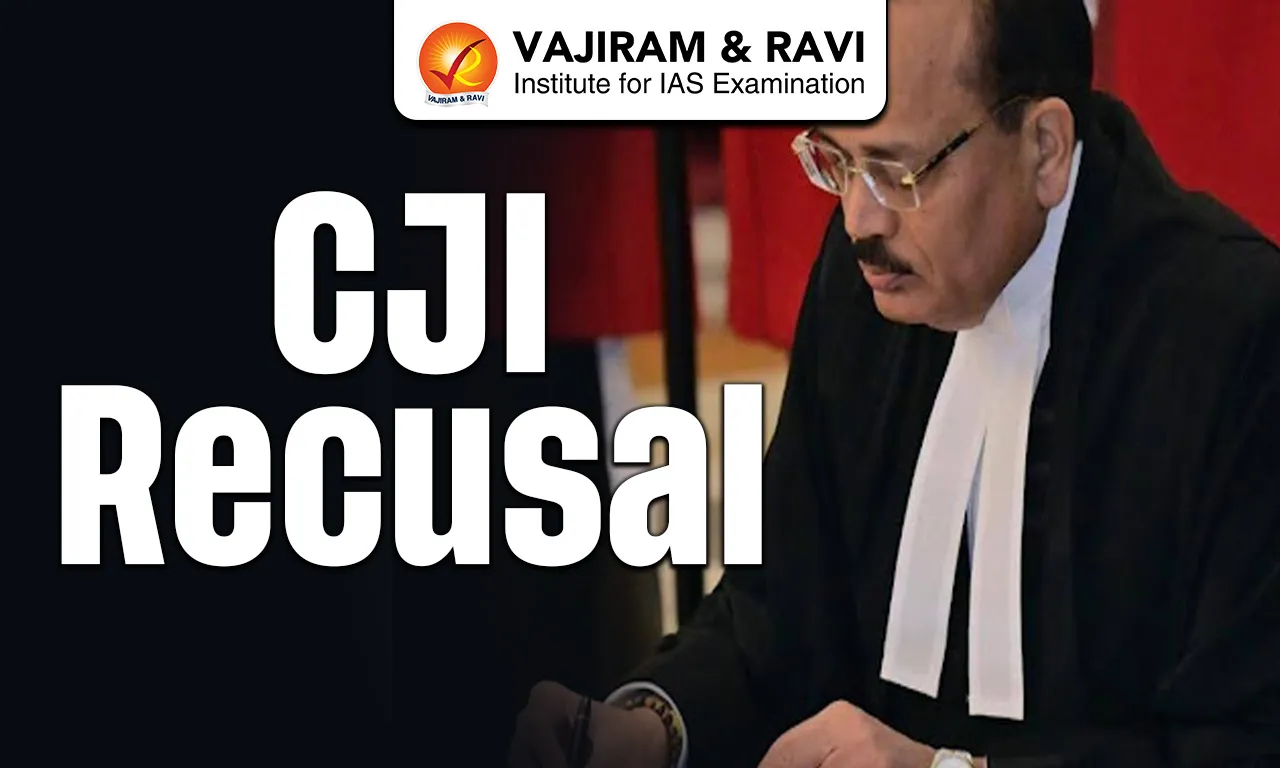
CJI Recusal Latest News
- Recently, CJI Surya Kant recused himself from hearing petitions challenging the Chief Election Commissioner and Other Election Commissioners (Appointment, Conditions of Service and Term of Office) Act, 2023 — legislation that replaced the CJI with a Union Minister on the panel for appointing Election Commissioners, thereby superseding the Supreme Court’s own 2023 interim arrangement.
- Citing potential conflict of interest, the CJI directed that the case (Dr. Jaya Thakur v. Union of India, 2024) be listed before a bench comprising judges not in the line of succession to the office of CJI.
- Notably, this is the second consecutive recusal — CJI Sanjiv Khanna had similarly stepped away from the same case in 2024. While the administrative direction is clear, the CJI’s oral remarks have raised questions that are likely to outlast the constitution of the new bench.
The Doctrine of Recusal: Foundations and Framework
- Recusal is rooted in one of the oldest maxims of natural justice: Nemo judex in causa sua — “No one shall be a judge in their own cause”
- This principle ensures that justice is not only done but is seen to be done, free from bias or conflict of interest.
Evolution of the Standard in India
- Indian courts have progressively refined the recusal standard through key judgments:
- Manak Lal v. Dr. Prem Chand (1957) – Strict automatic disqualification for pecuniary (financial) interest.
- Ranjit Thakur v. Union of India (1987) – Shifted to reasonable apprehension of bias — not merely a remote possibility — as the threshold for recusal.
- The evolution reflects a move from a rigid, interest-based test to a more perception-based standard — what a reasonable person would think about the judge’s impartiality.
Who Decides: The Judge’s Own Conscience
- A critical feature of India’s recusal framework is that:
- The decision to recuse rests solely on the judge’s own conscience
- No party can compel a judge to recuse
- No statute in India codifies the standards or procedure for recusal


The NJAC Precedent: When Recusal Was Refused
- In Supreme Court Advocates-on-Record Association v. Union of India (2015), a five-judge Constitution Bench was hearing a challenge to the National Judicial Appointments Commission (NJAC) Act, 2014.
- The legislation sought to replace the Collegium system for judicial appointments.
- Recusal was sought against Justice J.S. Khehar on the ground that he would eventually become CJI and therefore had an institutional stake in whether the Collegium or NJAC governed future appointments.
- Justice Khehar refused, on two grounds:
- Universal conflict — The conflict infected every judge on the bench, since all would either benefit from the Collegium (if petitioners succeeded) or be subject to the NJAC (if they failed).
- Doctrine of Necessity — When the only available forum itself faces a disqualifying conflict, institutional obligation must override the conflict
- Justice Kurian Joseph added an important dimension — that a judge who chooses to recuse has a constitutional duty of transparency.
- Stating reasons for withdrawal, he held, is itself part of the oath of office taken under the Third Schedule of the Constitution.
The Present Case: Was CJI’s Recusal Justified
- The logic that compelled Justice Khehar to stay on in the NJAC case applies equally to the current CEC law challenge:
- Under the seniority convention established by the Second Judges Case, every sitting Supreme Court judge is a potential future CJI.
- Therefore, the same conflict of interest that moved CJI Surya Kant to recuse afflicts every judge of the court simultaneously.
- If the conflict is universal — touching every judge equally — then the doctrine of necessity compels the court to hear the case regardless, because:
- No alternative court of equivalent jurisdiction exists;
- The conflict should be openly acknowledged, as the NJAC bench did, rather than used as grounds for stepping away.
- Viewed through the NJAC precedent, CJI Surya Kant’s recusal represents a departure from a principle the court itself laid down a decade ago — that universal institutional conflict is not a valid ground for individual recusal; it is precisely the situation where the doctrine of necessity must apply.
The Problematic Direction: Binding Future Judges
- Beyond the recusal itself, the CJI’s oral direction — that the replacement bench must exclude judges in line to become CJI — raises a deeper constitutional problem.
- Recusal is an act of individual judicial conscience; it cannot be mandated in advance by a predecessor for judges who have not yet considered the question themselves.
- A further incongruity arises: if CJI Surya Kant recused himself due to conflict of interest, how can he — as Master of the Roster — decide which judges hear the case?
- The order authorises him to earmark the bench, even after stepping away.
The Case for Codifying Judicial Recusal in India
- India currently has:
- No statute governing judicial recusal
- No binding code of conduct enforceable against Supreme Court judges
- No mechanism to review a recusal decision once made
- Recusal remains entirely a matter of individual judicial conscience — with no external check or objective standard.
- The US model — under Section 455, Title 28 of the United States Code — provides a codified, objective standard for judicial disqualification.
Why the CEC Case Makes It Urgent
- The current dispute — where two successive Chief Justices have recused from the same case — exposes the institutional cost of this vacuum.
- A question as consequential as who appoints the guardians of India’s elections is being left to a bench constituted by informal direction rather than principled rule.
- The deficit, as the article notes, is institutional as much as it is individual.
The Way Forward
- India’s constitutional framework benefits from judges who exercise recusal with care and conscience.
- But a robust democracy demands more — a framework that transforms judicial discretion into enforceable obligation, bringing transparency, consistency, and accountability to one of the judiciary’s most sensitive decisions.
Source: TH

 Last updated on Sep, 2026
→ UPSC 2027 Notification will be released on 13 January 2027 at upsconline.nic.in.
→ Asian Games 2026 are being held in Aichi-Nagoya, Japan, from 19 September to 4 October.
→ Check out the latest UPSC Syllabus here.
→ Download UPSC Model Answers for Mains 2026
→ UPSC Mains Question Paper 2026 is out now for Essay & GS Paper 1, 2, 3 & 4.
→ UPSC Calendar 2027 has been released.
→ Enroll in Vajiram & Ravi’s UPSC Mains Test Series 2027 for structured answer writing practice, expert evaluation, and exam-oriented feedback.
→ Join Vajiram & Ravi’s UPSC Mentorship Program 2027 for personalized guidance, strategy planning, and one-to-one support from experienced mentors.
→ Go through the UPSC Mains Previous Year Papers to enhance your preparation.
→ UPSC has released UPSC Toppers List 2025 with the Civil Services final result on its official website.
→ Also check Best UPSC Coaching in India
CJI Recusal FAQs
Q1. Why did CJI Surya Kant recuse himself from the CEC appointment case?+
Q2. What is the doctrine of necessity in judicial recusal?+
Q3. How did the NJAC case set a precedent on CJI recusal in India?+
Q4. What is the current legal standard for judicial recusal in India?+
Q5. Why should India codify judicial recusal standards?+
Tags: CJI recusal mains articles upsc current affairs upsc mains current affairs