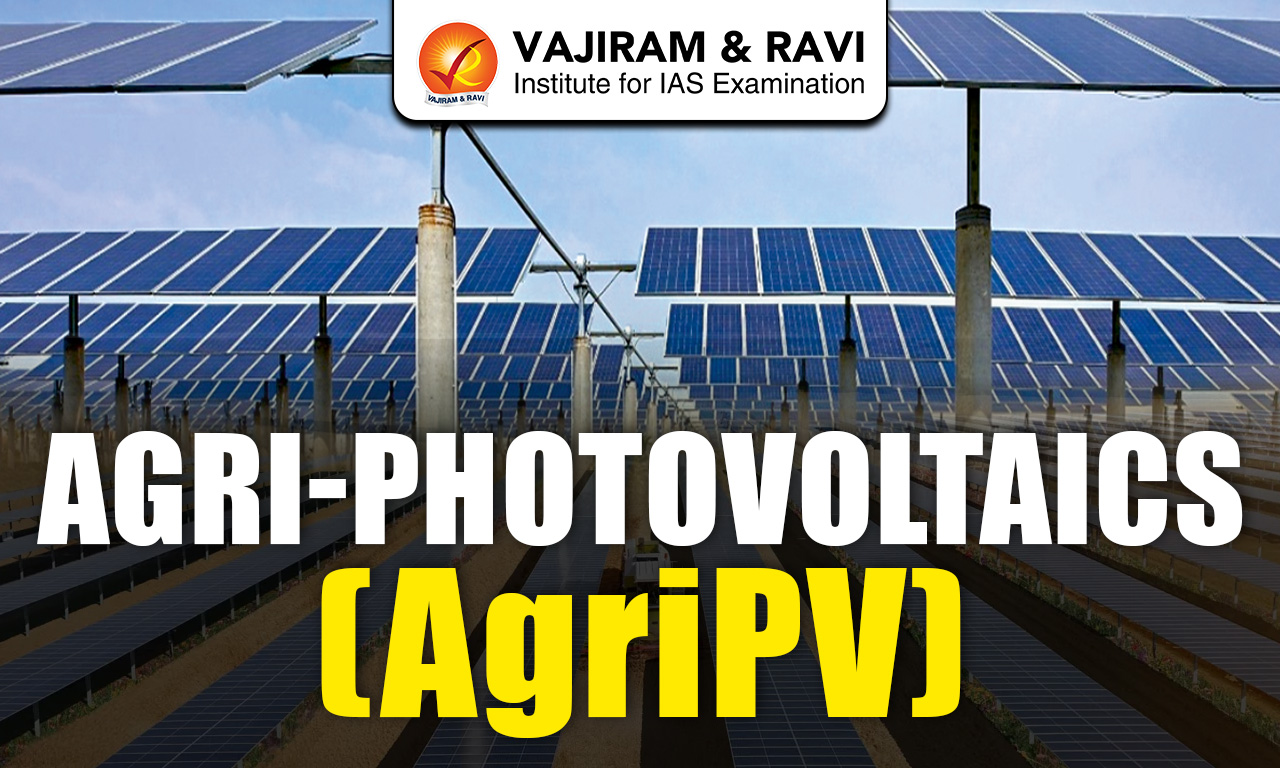
As India accelerates its transition towards renewable energy while ensuring food security. The Union Budget 2026-27, with increased allocation to PM-KUSUM, highlights a stronger push for solarisation in agriculture. In this context, Agri-Photovoltaics (AgriPV) has emerged as a viable approach to enable the simultaneous use of land for solar energy generation and agricultural production.
What is Agri-Photovoltaics?
Agri-Photovoltaics (AgriPV) refers to the integration of solar photovoltaic systems with farming activities on the same land. Solar panels are installed at an appropriate height or arrangement so that agricultural operations can continue underneath or between them. This enables farmers to produce both food and electricity from the same plot, increasing land-use efficiency.
Types of Agri-Photovoltaics (AgriPV) Systems
Agri-Photovoltaics (AgriPV) designs vary depending on crop type, geography, and climatic conditions:
- Elevated systems: Solar panels are mounted several metres above the ground, allowing normal farming below.
- Row-based systems: Panels are placed between crop rows to reduce shading impact.
- Vertical systems: Upright panels capture sunlight from both sides, suitable for certain crops.
- Greenhouse-integrated systems: Panels are incorporated into greenhouse structures to regulate light and temperature.


Significance of Agri-Photovoltaics (AgriPV) in India
Agri-Photovoltaics (AgriPV) is significant for India because it helps balance the country’s energy and agricultural needs.
- Dual Use of Land: Agri-Photovoltaics (AgriPV) enables dual use of agricultural land by allowing simultaneous crop cultivation and solar power generation, thereby reducing the opportunity cost of land in a land-scarce economy.
- Food-Energy Security Nexus: It addresses the “food vs fuel” dilemma by ensuring expansion of renewable energy capacity without compromising agricultural output.
- Energy Transition Goals: Supports India’s targets of 300 GW solar capacity by 2030 and net-zero by 2070, without diverting productive agricultural land.
- Income Diversification: In a farm-dependent economy, AgriPV provides additional income sources through electricity sales, leasing, and revenue-sharing, while allowing continued cultivation.
- Water-Use Efficiency: Partial shading from panels reduces evapotranspiration, helping soil retain moisture and improving water-use efficiency.
- Climate Resilience: Solar panels act as a protective shield against heatwaves, heavy rainfall, and hail, improving crop resilience under climate variability.
- Decarbonisation of Agriculture: Promotes solar-based irrigation, reducing fossil fuel dependence and carbon emissions in the agricultural sector.
- Rural Economic Growth: Supports rural entrepreneurship by enabling energy access for local activities, boosting economic development.
- Strengthening Rural Value Chains: Agri-Photovoltaics (AgriPV) can power cold storage, food processing units, and farm equipment, improving agricultural value chains.
Agri-Photovoltaics (AgriPV) Status in India
Agri-Photovoltaics (AgriPV) in India is currently at a nascent and pilot-based stage, with nearly 50 installations across the country experimenting with different crop–panel combinations and assessing their economic viability. While recent policy discussions have increasingly recognised its potential, large-scale commercial deployment has not yet taken off, mainly due to the need for more empirical evidence across diverse agro-climatic regions to identify optimal system designs and crop configurations.
Challenges in Adoption of Agri-Photovoltaics (AgriPV)
Large-scale adoption of Agri-Photovoltaics (AgriPV) in India face economic, regulatory, and institutional barriers:
- High Capital Cost: Agri-Photovoltaics (AgriPV) requires elevated structures and specialised mounting systems, making it costlier than conventional solar projects.
- Financial Viability Issues: High upfront investment and uncertain returns reduce bankability and investor interest.
- Regulatory Uncertainty:
- There is a lack of clear rules on how agricultural land used for AgriPV should be classified, whether it remains agricultural or is treated as energy land. This creates confusion for approvals and permissions.
- In addition, there is no uniform clarity on grid connectivity, making it difficult for farmers or developers to connect solar power to the electricity network.
- Further, tariff structures (price at which electricity will be sold) are not well-defined, leading to uncertainty about returns.
- Institutional Gaps: Weak coordination between farmers, developers, DISCOMs, and government agencies delays project execution.
- Ownership and Contract Issues: Unclear land rights and revenue-sharing arrangements between farmers and developers create trust deficits.
- Technical and Design Challenges: Absence of standardised design guidelines leads to inefficient systems and risk of crop loss.
- Lack of Data and Awareness: Limited pilot projects result in insufficient empirical evidence and low farmer awareness
Wayforward
With the right policy support, Agri-Photovoltaics (AgriPV) can move from pilot projects to large-scale adoption in India.
- Policy Integration with PM-KUSUM: The government should formally include AgriPV under PM-KUSUM 2.0, which is India’s main scheme for solarising agriculture. At present, PM-KUSUM focuses on solar pumps and small solar plants.
- National Agri-Photovoltaics Mission: The government can launch a separate mission focused only on AgriPV, with a clear target (for example, 10 GW of capacity). This will give direction, funding, and policy focus to the sector. Right now, projects are scattered and small.
- Financial Support Mechanisms: Provide viability gap funding (VGF), subsidies, and concessional loans to reduce high initial costs and improve project viability.
- Clear Regulatory Framework: Define rules for land classification, grid connectivity, and tariff structures to reduce uncertainty and attract investment.
- Standardisation of Design: Develop technical guidelines for panel height, spacing, and crop combinations to minimise yield risks.
- State Government Role: States should identify suitable clusters, simplify approvals, and create single-window clearances for faster implementation.
- Farmer Training and Capacity Building: Promote awareness and training through Krishi Vigyan Kendras (KVKs) and extension services for managing dual-use farming.
- Encourage Private Participation: Develop clear models for leasing, revenue-sharing, and PPPs to attract private investment.
- Strengthen R&D and Pilot Scaling: Support institutions to generate region-specific data on crop–panel combinations and scale successful pilot models.
Overall, with proper policy support, AgriPV can shift from scattered pilots to a more structured, scalable model, strengthening farmer incomes and easing land pressures.on land.

 Last updated on Oct, 2026
→ UPSC 2027 Notification will be released on 13 January 2027 at upsconline.nic.in.
→ Check Nobel Prize 2026 Winners List here.
→ Download PIB PRiSM Monthly Magazine 2026 here.
→ Check UPSC Monthly Current Affairs Magazine The Recitals here.
→ Check out the latest UPSC Syllabus here.
→ Download UPSC Model Answers for Mains 2026
→ UPSC Mains Question Paper 2026 is out now for Essay & GS Paper 1, 2, 3 & 4.
→ UPSC Calendar 2027 has been released.
→ Enroll in Vajiram & Ravi’s UPSC Mains Test Series 2027 for structured answer writing practice, expert evaluation, and exam-oriented feedback.
→ Join Vajiram & Ravi’s UPSC Mentorship Program 2027 for personalized guidance, strategy planning, and one-to-one support from experienced mentors.
→ Go through the UPSC Mains Previous Year Papers to enhance your preparation.
→ UPSC has released UPSC Toppers List 2025 with the Civil Services final result on its official website.
→ Also check Best UPSC Coaching in India
Agri-Photovoltaics (AgriPV) FAQs
Q1. What is Agri-Photovoltaics (AgriPV)?+
Q2. Why is Agri-Photovoltaics (AgriPV) important for India?+
Q3. How does Agri-Photovoltaics (AgriPV) benefit farmers?+
Q4. What is the current status of Agri-Photovoltaics (AgriPV) in India?+
Q5. What are the main challenges in adopting Agri-Photovoltaics (AgriPV)?+
Tags: agri-photovoltaics (agripv)