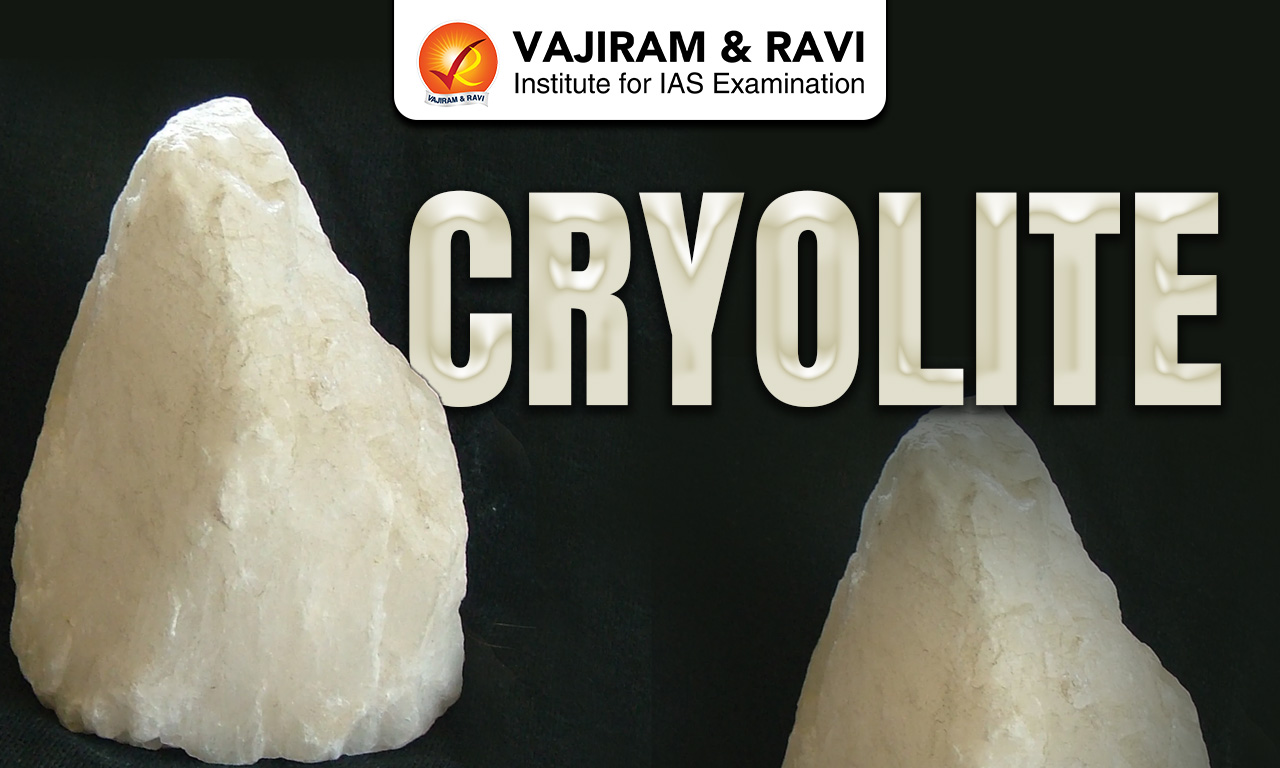
Cryolite is a rare mineral chemically known as Sodium Aluminium Fluoride (Na₃AlF₆) or Sodium Hexafluoroaluminate. Its name comes from Greek words “kryos” (cold) and “lithos” (stone) due to its ice like appearance. It was first discovered in 1799 and later found in large deposits in Greenland, which were exhausted by 1987. Today, it is almost entirely produced synthetically for industrial purposes. It plays a crucial role in aluminium production by reducing melting temperature and improving conductivity during electrolysis.
Cryolite Types
Cryolite occurs naturally but is now mainly produced artificially due to depletion of natural reserves.
- Natural Cryolite: Found mainly at Ivigtut (Greenland), it was once the only major commercial source globally, mined from the nineteenth century until exhaustion in 1987. Smaller deposits occur in Spain, Colorado, Russia and Canada.
- Synthetic Cryolite: Manufactured using Aluminium Fluoride and Sodium Compounds, or from Fluorite. It replaces natural Cryolite in industries. Examples include Sodium Cryolite (Na₃AlF₆) used in Aluminium Extraction and Potassium Cryolite (K₃AlF₆, KAlF₄) used in welding, abrasives and pyrotechnics.
Also Read: Conglomerate Rock
Cryolite Features
Cryolite shows unique physical, optical and chemical properties that make it industrially valuable.
- Physical Properties: It appears colourless or white, sometimes grey or black due to impurities, has monoclinic structure and specific gravity 2.95-3.0, making it relatively soft and lightweight.
- Optical Behaviour: Cryolite has a refractive index close to water (~1.34), making it nearly invisible when immersed in water, an unusual and distinctive mineral property useful in optics.
- Chemical Properties: It melts between 950-1012 °C, dissolves alumina efficiently and slightly reacts with acids releasing hydrogen fluoride gas under certain conditions.


Cryolite Distribution
Cryolite is one of the rarest minerals, with very limited natural occurrence worldwide.
- Major Deposit: The Ivigtut (Ivittuut) deposit in southwestern Greenland was the only large scale commercial source supplying industries globally for over a century before depletion.
- Minor Occurrences: Smaller deposits exist in Spain, Colorado (USA), Quebec (Canada), Russia and Norway, but none matched Greenland’s scale or purity.
- Present Scenario: Due to exhaustion of natural deposits, modern industries rely entirely on synthetic Cryolite produced using fluorite and chemical processes.
Also Read: Rock Systems of India
Aluminium Extraction through Cryolite
Cryolite plays a central role in the industrial production of Aluminium through electrolysis.
- Hall-Héroult Process: Alumina (Al₂O₃) is dissolved in molten Cryolite, which acts as both solvent and electrolyte, enabling electrolysis to extract aluminium efficiently at industrial scale.
- Melting Point Reduction: Cryolite reduces alumina’s melting point from about 2000-2500 °C to nearly 950-1000 °C, making the process energy efficient and economically feasible.
- Electrochemical Function: It improves electrical conductivity, allowing aluminium ions to deposit at the cathode while oxygen reacts with carbon anodes to form carbon dioxide gas.
Cryolite Applications
Cryolite has wide industrial importance beyond aluminium metallurgy due to its unique properties.
- Metallurgical Uses: It acts as a flux in aluminium production, welding, steel aluminization and metal remelting, improving conductivity and reducing melting temperatures.
- Industrial Applications: Used in glass and ceramics as an opacifier, in enamels for better coating and in abrasives to enhance grinding efficiency and reduce heat generation.
- Chemical and Other Uses: Applied in insecticides, pyrotechnics for colour effects, optical coatings for ultraviolet reflectivity and as a filler in various chemical and industrial products.

 Last updated on Sep, 2026
→ UPSC 2027 Notification will be released on 13 January 2027 at upsconline.nic.in.
→ Asian Games 2026 are being held in Aichi-Nagoya, Japan, from 19 September to 4 October.
→ Check out the latest UPSC Syllabus here.
→ Download UPSC Model Answers for Mains 2026
→ UPSC Mains Question Paper 2026 is out now for Essay & GS Paper 1, 2, 3 & 4.
→ UPSC Calendar 2027 has been released.
→ Enroll in Vajiram & Ravi’s UPSC Mains Test Series 2027 for structured answer writing practice, expert evaluation, and exam-oriented feedback.
→ Join Vajiram & Ravi’s UPSC Mentorship Program 2027 for personalized guidance, strategy planning, and one-to-one support from experienced mentors.
→ Go through the UPSC Mains Previous Year Papers to enhance your preparation.
→ UPSC has released UPSC Toppers List 2025 with the Civil Services final result on its official website.
→ Also check Best UPSC Coaching in India
Cryolite FAQs
Q1. What is Cryolite? +
Q2. Where is Cryolite mainly found? +
Q3. Why is Synthetic Cryolite used today? +
Q4. What is the role of Cryolite in Aluminium Extraction? +
Q5. What are the main uses of Cryolite? +