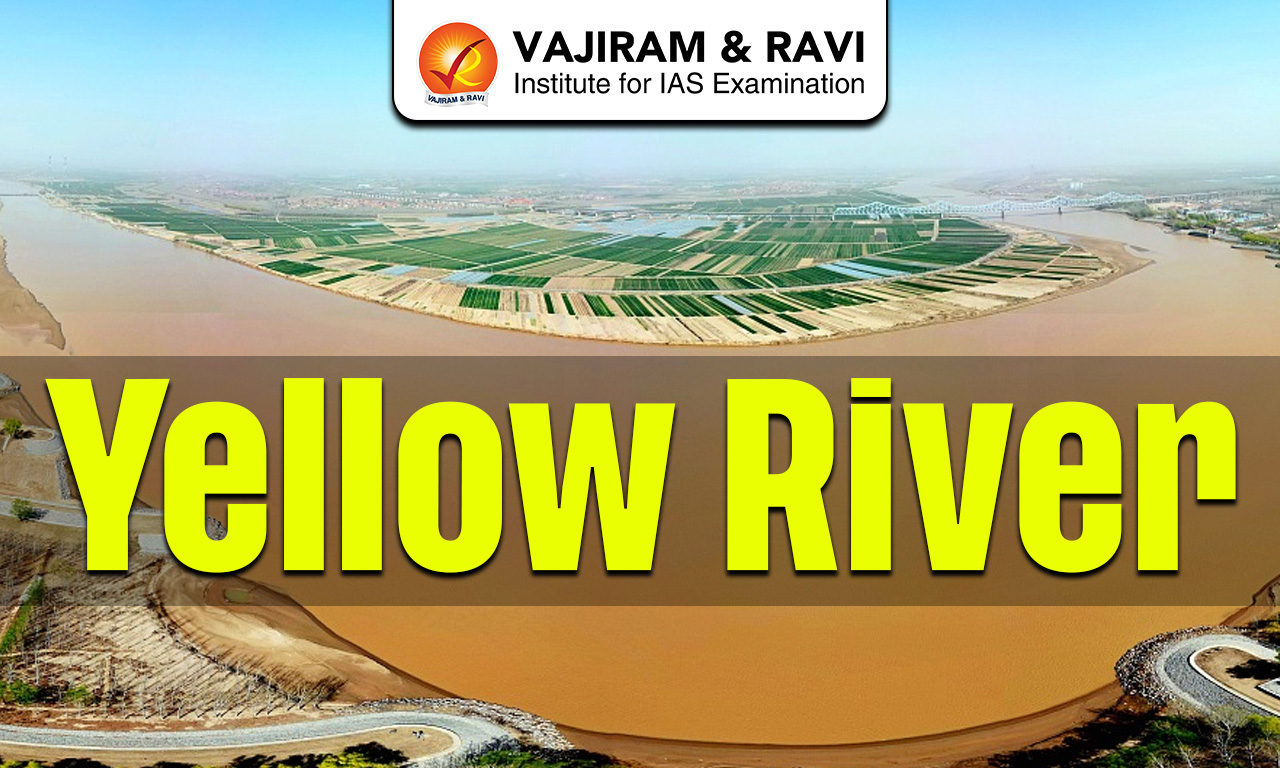
The Yellow River is also known as Huang He in China. It is the second longest river in China and the fifth longest river in the world. It originates from the Bayankala Mountains on the Tibetan Plateau and flows into the Bohai Sea. It is known as the “Mother River” and cradle of Chinese Civilization. It has supported agriculture, settlements and culture for thousands of years. However, its heavy sediment load and frequent floods have also made it historically destructive.
Yellow River Features
The Yellow River displays diverse geographical, cultural and economic features, making it one of the most significant river systems globally with immense historical and ecological importance. The major highlighting features of this river are:
- Origin: The river originates from the Bayankala Mountains in the Tibetan Plateau, where snowmelt and rainfall feed its upper course, ensuring a continuous water supply.
- Course: It flows eastward through nine provinces including Qinghai, Gansu and Henan, forming the Ordos Loop before crossing the North China Plain and draining into the Bohai Sea.
- History: The river basin is the birthplace of ancient Chinese civilization, with the Xia dynasty emerging around 2100 BC along its banks.
- Tributaries: Major tributaries include the Wei River, Fen River, Luo River, Tao River and Huangshui, contributing significantly to its flow and sediment load.
- Major Cities: Important cities along its course include Lanzhou, Yinchuan, Baotou, Zhengzhou, Kaifeng and Jinan, which depend heavily on its water resources.
- Drainage Basin: The basin covers about 795,000 square kilometers and supports nearly 120 million people, irrigating about 15% of China’s agricultural land.
- Sorrow of China: Frequent floods and course changes caused massive destruction, earning it the name “Sorrow of China” with over 1,593 floods recorded between 595 BC and 1946 AD.
- Dams: Major dams such as Sanmenxia, Xiaolangdi and Longyangxia help in flood control, irrigation and hydroelectric power, though sedimentation reduces their efficiency.
- Projects: The South-North Water Transfer Project aims to reduce water scarcity by diverting water from other rivers to the Yellow River basin.
- Tourism: Key attractions include Qinghai Lake (the largest Lake in China), Hukou Waterfall (the second largest waterfall in China) and the Yellow River Stone Forest which attracts visitors for scenic landscapes.
- Delta: It forms the Yellow River Delta that covers about 8,000 sq km of area. In recent times, it has shifted frequently due to sediment deposition and human intervention, forming new landforms over time.
Also Read: Mandakini River
Yellow River Biodiversity
The Yellow River basin supports diverse ecosystems ranging from alpine regions to wetlands, hosting a wide variety of plant and animal species adapted to different climatic conditions.
Flora
- Vegetation: Major vegetation includes alpine shrubs, grasslands, deserts and wetlands, with plants like seepweed, phragmites, foxtails and tamarisk dominating lower regions affected by human activity.
- Variation: Upper reaches have sparse tundra like vegetation, while lower areas support agriculture and wetland plants, showing strong regional variation in plant diversity.
Also Read: Bhadar River
Fauna
- Fish: The basin hosts over 160 native fish species, though many have declined due to habitat loss, pollution and dam construction affecting breeding patterns.
- Aquatic: Species include carp, catfish and loaches, with several endemic species found only in the upper reaches of the river system.
- Terrestrial: Animals such as Tibetan antelope, wild yak and musk deer inhabit upper regions, while wetlands support migratory birds like cranes and waterfowl.
- Aquaculture: Fish farming and turtle breeding are practiced in regions like Xingyang, with large scale aquaculture contributing to regional economies.


Yellow River Challenges
The Yellow River faces multiple environmental, hydrological and human induced challenges that threaten its sustainability, ecological balance and ability to support human populations.
- Sedimentation: The river carries the highest sediment load globally, with up to 1.6 billion tons annually, causing riverbed elevation and increasing flood risks.
- Flooding: Natural levee formation and heavy silt deposition make floods frequent and destructive, often changing the river’s course across the North China Plain.
- Water Scarcity: Overuse for irrigation and uneven rainfall have led to reduced flow, with the river failing to reach the sea for extended periods in the 1990s.
- Pollution: Industrial discharge and sewage have severely polluted the river, with about one-third of its water becoming unsuitable for agriculture or industry.
- Ecological Degradation: Soil erosion in the Loess Plateau and habitat loss have weakened ecosystems, making restoration slow and difficult across the basin.
- Climate Variability: Uneven rainfall distribution and dependence on monsoon patterns create fluctuations in water availability and increase vulnerability to droughts and floods.
- Human Intervention: Construction of levees, dams and embankments has altered natural flow, sometimes worsening flood intensity and ecological imbalance.

 Last updated on Oct, 2026
→ UPSC 2027 Notification will be released on 13 January 2027 at upsconline.nic.in.
→ Check Nobel Prize 2026 Winners List here.
→ Download PIB PRiSM Monthly Magazine 2026 here.
→ Check UPSC Monthly Current Affairs Magazine The Recitals here.
→ Check out the latest UPSC Syllabus here.
→ Download UPSC Model Answers for Mains 2026
→ UPSC Mains Question Paper 2026 is out now for Essay & GS Paper 1, 2, 3 & 4.
→ UPSC Calendar 2027 has been released.
→ Enroll in Vajiram & Ravi’s UPSC Mains Test Series 2027 for structured answer writing practice, expert evaluation, and exam-oriented feedback.
→ Join Vajiram & Ravi’s UPSC Mentorship Program 2027 for personalized guidance, strategy planning, and one-to-one support from experienced mentors.
→ Go through the UPSC Mains Previous Year Papers to enhance your preparation.
→ UPSC has released UPSC Toppers List 2025 with the Civil Services final result on its official website.
→ Also check Best UPSC Coaching in India
Yellow River FAQs
Q1. Why is the Yellow River called the “Mother River” of China? +
Q2. Why is the Yellow River known as “China’s Sorrow”? +
Q3. What makes the Yellow River the muddiest river in the world? +
Q4. Which sea does the Yellow River flow into? +
Q5. What are the major uses of the Yellow River? +
Tags: geography geography notes yellow river