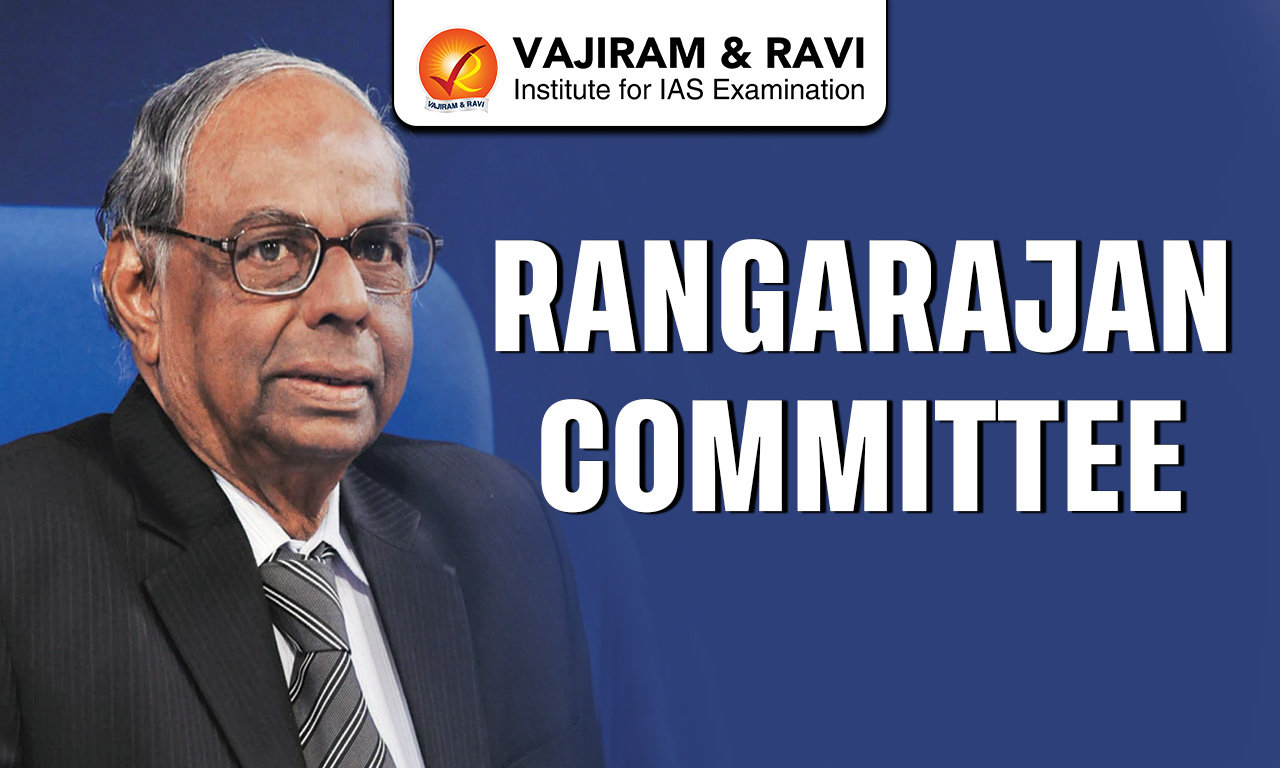
The Rangarajan Committee played an important role in shaping India’s economic and financial policies. It was formed to study key issues like poverty estimation, fiscal management, and the petroleum sector. The committee provided practical recommendations that helped the government improve policy decisions and economic planning.
The committee is named after C. Rangarajan, a well-known economist and former Governor of the Reserve Bank of India.
Rangarajan Committee Objectives
The main objective of the committee was to review existing systems and suggest better policies for economic growth.
- To create a broader poverty metric covering basic human needs.
- To include costs of food, health, education, clothing, and shelter.
- To move beyond the old calorie-based poverty estimation system.
- To reflect real living conditions and cost of living in India.
- To help the government design better welfare policies.
Key Highlights of the Rangarajan Committee Report
The Rangarajan Committee made several important observations and improvements over earlier poverty estimation methods:
- Earlier, the Tendulkar Committee used a single urban poverty basket to estimate poverty for both rural and urban areas. The Rangarajan Committee returned to the older approach of having separate poverty baskets for rural and urban areas, making the estimates more realistic.
- While the Tendulkar Committee moved away from calorie norms, the Rangarajan Committee reintroduced nutritional standards by considering calories, proteins, and fats together. It emphasized that nutrition should still be an important part of poverty estimation.
- The committee preferred National Sample Survey Office (NSSO) consumption data over National Accounts Statistics (NAS), as NSSO data better reflects household-level consumption patterns.
- It supported improved methods for adjusting price differences across states and over time, ensuring more accurate poverty estimates.
- The committee noted that government spending on services like education and health is not fully captured in consumption surveys, which may lead to underestimation of actual living standards.
- It rejected the use of non-consumption indicators (like assets or income) as the main basis for poverty measurement, stating that such methods are difficult to measure accurately. However, it also explored an alternative idea of identifying poverty based on a household’s ability to save.


Methodology Recommended by Rangarajan Committee
The committee proposed a detailed and scientific method to estimate poverty, based on both nutritional needs and essential non-food expenses.
- The committee suggested that the poverty line should be based on a comprehensive consumption basket, including both food and essential non-food items like clothing, housing, education, and transport.
- It adopted Monthly Per Capita Expenditure (MPCE) as the main basis for measuring poverty, focusing on how much a person spends to meet basic needs.
- Nutritional requirements were included using standards given by the Indian Council of Medical Research, covering calories, proteins, and fats rather than just calorie intake.
- It estimated average daily energy requirements as:
- 2,155 kcal per person in rural areas
- 2,090 kcal per person in urban areas
- The committee allowed a ±10% variation range in calorie intake to account for differences in lifestyle and health conditions.
- A food basket was designed that satisfies all nutritional norms (calories, protein, and fat), ensuring adequate nourishment.
- For non-food expenses, it used median expenditure levels for basic needs such as clothing, rent, education, and transport.
- Additional non-food expenses were included based on actual spending patterns of households that meet nutritional requirements.
- The committee used Modified Mixed Reference Period (MMRP) data from NSSO surveys for more accurate consumption estimates.
Also Check: Kelkar Committee
Poverty Line Defined by Rangarajan Committee
The Rangarajan Committee introduced a new poverty line based on Monthly Per Capita Expenditure (MPCE). This means the minimum amount a person needs to spend per month to meet basic needs.
Unlike earlier methods, this approach considered real expenses faced by individuals in daily life.
- Rural poverty line: ₹972 per person per month
- Urban poverty line: ₹1,407 per person per month
- Equivalent daily expenditure:
- ₹32 per day in rural areas
- ₹47 per day in urban areas
- Based on 2011-12 price levels
This method helped in better understanding the actual cost of living and identifying poor households more accurately.
Key Changes Over Tendulkar Committee
The Rangarajan Committee made several important improvements over the earlier Tendulkar Committee, which had already moved away from strict calorie norms but still had limitations.
- Expanded the consumption basket to include more essential services.
- Included expenses on education, healthcare, rent, and transport.
- Adopted a more detailed and realistic cost-of-living approach.
- Used improved data collection methods like MMRP.
- Provided separate and more accurate estimates for rural and urban areas.
- Addressed criticisms of underestimation of poverty in earlier methods.
Rangarajan Committee Criticism
Although the committee made improvements, it also faced criticism from experts and policymakers.
- The poverty line was still considered too low by many economists.
- It was argued that the estimates did not fully capture urban poverty challenges.
- Some believed that even higher standards should be used for a dignified life.
- Implementation of its recommendations in policymaking was limited.

 Last updated on Sep, 2026
→ UPSC 2027 Notification will be released on 13 January 2027 at upsconline.nic.in.
→ Asian Games 2026 are being held in Aichi-Nagoya, Japan, from 19 September to 4 October.
→ Check out the latest UPSC Syllabus here.
→ Download UPSC Model Answers for Mains 2026
→ UPSC Mains Question Paper 2026 is out now for Essay & GS Paper 1, 2, 3 & 4.
→ UPSC Calendar 2027 has been released.
→ Enroll in Vajiram & Ravi’s UPSC Mains Test Series 2027 for structured answer writing practice, expert evaluation, and exam-oriented feedback.
→ Join Vajiram & Ravi’s UPSC Mentorship Program 2027 for personalized guidance, strategy planning, and one-to-one support from experienced mentors.
→ Go through the UPSC Mains Previous Year Papers to enhance your preparation.
→ UPSC has released UPSC Toppers List 2025 with the Civil Services final result on its official website.
→ Also check Best UPSC Coaching in India
Rangarajan Committee FAQs
Q1. What is the Rangarajan Committee?+
Q2. Who chaired the Rangarajan Committee?+
Q3. Why was the Rangarajan Committee formed?+
Q4. What method did the Rangarajan Committee use to measure poverty?+
Tags: indian economy rangarajan committee