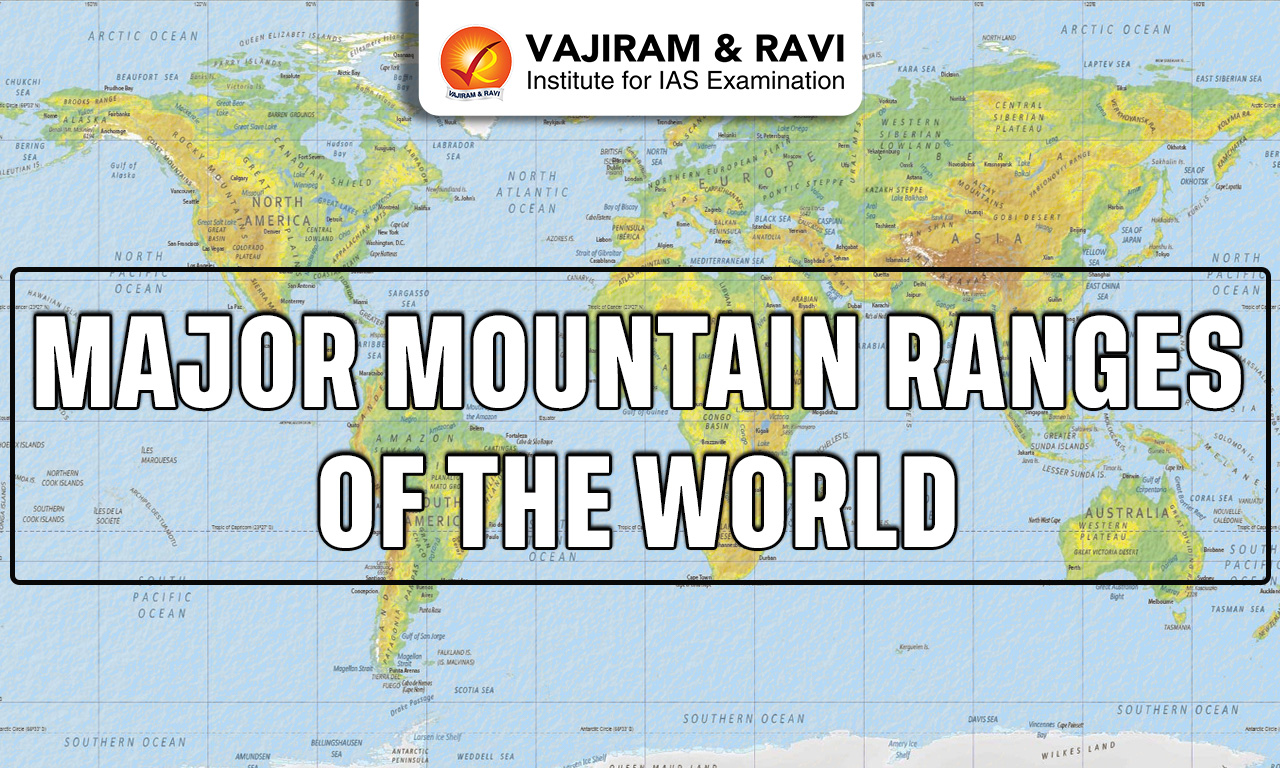
Mountain ranges are large groups of mountains that are connected by land. They are formed over millions of years due to movements in the Earth’s crust, volcanic activity, and erosion. These ranges play a crucial role in shaping climate, biodiversity, rivers, and human civilization. From the towering peaks of the Himalayas to the ancient hills of the Appalachian Mountains, mountain ranges are found on every continent. In this article, we have discussed all the Major Mountain Ranges of the World.
Formation of Mountain Ranges
Mountain ranges are formed over millions of years due to movements inside the Earth, especially the shifting of tectonic plates. These movements cause the land to rise, fold, or break, creating mountains. Different geological processes result in different types of mountain ranges across the world, such as the Himalayas and the Andes.
- Tectonic Plate Movement: Mountain ranges mainly form when Earth’s plates collide, move apart, or slide past each other, creating pressure and uplift.
- Fold Mountains Formation: When two plates collide, the crust folds and rises to form mountains like the Himalayas.
- Faulting (Block Mountains): Cracks in the Earth’s crust cause some land blocks to rise and others to sink, forming ranges like the Sierra Nevada.
- Volcanic Activity: Repeated volcanic eruptions build up mountains over time, seen in ranges like the Andes.
- Erosion and Weathering: Wind, water, and ice gradually shape and modify mountains, forming residual ranges like the Aravalli Range.
- Uplift and Subsidence: Parts of the Earth’s crust rise or sink due to internal forces, contributing to mountain formation.
Major Mountain Ranges of Asia
Asia is home to some of the highest and most extensive mountain ranges in the world. These ranges were mainly formed due to the collision of tectonic plates, especially the Indian and Eurasian plates. They play an important role in climate, rivers, biodiversity, and human life across the continent.
1. Himalayas
- Type: Young Fold Mountains formed due to collision of Indian and Eurasian plates (still rising)
- Length & Location: Extend about 2,400 km across India, Nepal, Bhutan, China, and Pakistan
- Major Peaks: Mount Everest, Kanchenjunga, Nanda Devi, Annapurna, Dhaulagiri
- Physiographic Divisions: Himadri (Greater Himalaya), Himachal (Lesser Himalaya), Shiwalik (Outer Himalaya)
- Climate Role: Act as a barrier preventing cold Central Asian winds and help in monsoon rainfall in India
- River Systems: Source of major perennial rivers like Ganga, Yamuna, Brahmaputra, and Indus
- Glaciers: Contain large glaciers such as Gangotri, Yamunotri, Siachen (nearby region), Zemu Glacier
- Flora: Tropical forests in foothills, temperate forests (oak, pine, deodar), alpine vegetation, medicinal plants
- Fauna: Snow leopard, red panda, Himalayan black bear, musk deer, yak, Himalayan monal
- Agriculture: Terrace farming is common; crops include rice, wheat, barley, and fruits
2. Karakoram Range
- Type: Fold Mountains (young and highly rugged)
- Location: Spread across India (Ladakh), Pakistan, and China
- Major Peaks: K2, Gasherbrum I & II, Broad Peak
- Glaciers: Home to some of the longest glaciers outside polar regions like Siachen Glacier and Baltoro Glacier
- Climate: Extremely cold desert climate with heavy snowfall, strong winds, and low oxygen levels
- Terrain: Very steep, rocky, and difficult terrain with deep valleys and sharp ridges
- Flora: Very sparse vegetation; mainly mosses, lichens, and alpine grasses due to harsh climate
- Fauna: Snow leopard, ibex, Himalayan brown bear, lynx, wild sheep
- Water Resources: Glaciers feed important rivers like the Indus River
- Human Settlement: Very low population due to extreme conditions; limited habitation
- Strategic Importance: Highly sensitive border region (India-Pakistan-China), important for defense
3. Hindu Kush
- Type: Fold Mountains
- Location: Extend across Afghanistan and north-western Pakistan
- Major Peaks: Tirich Mir (highest peak), Noshaq
- Length: About 800 km long mountain range
- Climate: Cold winters, dry conditions, and limited rainfall
- Terrain: Rugged mountains with deep valleys and narrow passes
- Flora: Dry forests, shrubs, juniper trees, and alpine grasses
- Fauna: Snow leopard, markhor, wolves, foxes, mountain goats
- Passes: Famous passes like Khyber Pass and Salang Pass (historically important)
- Historical Importance: Served as a major route for trade, migration, and invasions between Central and South Asia
4. Tian Shan
- Type: Fold Mountains
- Location: Spread across China, Kyrgyzstan, Kazakhstan, and Uzbekistan
- Length: Around 2,500 km long mountain system
- Major Peaks: Jengish Chokusu (Victory Peak), Khan Tengri
- Meaning: Known as “Heavenly Mountains” due to great height and scenic beauty
- Climate: Cold continental climate with heavy snowfall and glaciers
- Terrain: High rugged peaks, deep valleys, and extensive glaciated areas
- Flora: Coniferous forests (spruce), alpine meadows, grasslands, and wild fruit trees (origin of apples)
- Fauna: Snow leopard, ibex, lynx, wild sheep (argali), bears
- Water Resources: Source of major rivers like Syr Darya; glaciers provide water to dry regions
- Economic Importance: Supports agriculture through irrigation, pastoral activities, and mining
5. Altai Mountains
- Type: Fold Mountains
- Location: Spread across Russia, Mongolia, China, and Kazakhstan
- Major Peaks: Belukha Mountain (highest peak)
- Climate: Cold temperate climate with heavy snowfall and long winters
- Terrain: Mountainous region with glaciers, rivers, valleys, and forested slopes
- Flora: Dense forests of pine, fir, spruce, and birch; alpine grasslands and meadows
- Fauna: Brown bear, snow leopard, elk, sable, lynx, wild sheep
- Water Resources: Important watershed for rivers like Irtysh, Ob, and Yenisei
- Biodiversity: Recognized as a biodiversity hotspot with many rare and endemic species
- Cultural Importance: Home to nomadic tribes and ancient cultures; rich archaeological sites
- Economic Importance: Rich in minerals such as gold, copper, and zinc
- Human Activities: Animal grazing, forestry, mining, and traditional livelihoods
- UNESCO Status: Parts of Altai region are UNESCO World Heritage Sites
6. Zagros Mountains
- Type: Fold Mountains
- Location: Mainly in Iran, extending into Iraq
- Length: About 1,500 km long
- Major Peaks: Zard Kuh, Dena
- Formation: Formed due to collision of Arabian and Eurasian plates
- Climate: Semi-arid to Mediterranean type climate
- Terrain: Rugged mountains with folded structures and fertile valleys
- Flora: Oak forests, pistachio trees, shrubs, grasslands
- Fauna: Persian leopard, wild goat, hyena, fox, wolves
- Natural Resources: Very rich in oil and natural gas reserves
- Agriculture: Valleys suitable for farming (wheat, barley)
- Human Settlement: Moderately populated with tribal communities
- Economic Importance: Oil extraction, agriculture, and grazing
7. Ural Mountains
- Type: Very Old Fold Mountains (highly eroded)
- Location: Russia, extending from Arctic Ocean to Kazakhstan
- Length: Around 2,500 km
- Major Peaks: Mount Narodnaya
- Significance: Natural boundary between Europe and Asia
- Climate: Varies from tundra (north) to temperate (south)
- Terrain: Low to moderate height due to long-term erosion
- Flora: Taiga forests (pine, spruce, fir), tundra vegetation in north
- Fauna: Reindeer, brown bear, wolf, arctic fox, lynx
- Natural Resources: Rich in iron ore, coal, gold, platinum, and other minerals
- Industrial Importance: Major mining and industrial region of Russia
- Water Resources: Source of several rivers flowing to Europe and Asia
- Human Settlement: Well-developed settlements and industrial cities
8. Aravalli Ranges
- Type: Residual (Old Fold Mountains, highly eroded)
- Location: Extends from Gujarat to Delhi in India
- Length: Around 700-800 km
- Major Peaks: Guru Shikhar (highest peak in Mount Abu)
- Age: One of the oldest mountain ranges in the world
- Climate Influence: Acts as a barrier influencing desert expansion and local climate
- Terrain: Low hills, rocky ridges, and worn-down mountains
- Flora: Dry deciduous forests, thorny bushes, grasses
- Fauna: Leopard, hyena, jackal, nilgai, various birds
- Natural Resources: Rich in minerals like copper, zinc, marble, and granite
- Environmental Role: Helps prevent desertification of nearby regions like Rajasthan
- Human Activities: Mining, agriculture, and urban development


Major Mountain Ranges of Europe
The major mountain ranges of Europe include the Alps, Pyrenees, Carpathian Mountains, and Scandinavian Mountains. These ranges vary in age and height and play an important role in shaping Europe’s climate, rivers, and biodiversity.
1. Alps
- Type: Young Fold Mountains (formed during the Alpine orogeny due to collision of African and Eurasian plates)
- Location: Stretch across 8 countries: France, Switzerland, Italy, Austria, Germany, Slovenia, Liechtenstein, and Monaco
- Major Peaks: Mont Blanc, Matterhorn, Dufourspitze, Jungfrau
- Highest Peak: Mont Blanc (approx. 4,808 m) located on the France-Italy border
Physical Features:
- Consist of high rugged peaks, deep valleys, and extensive glaciated regions
- Presence of famous glaciers like Aletsch Glacier (largest in the Alps)
- Divided into Western Alps and Eastern Alps based on geography
- Numerous passes like Brenner Pass and St. Gotthard Pass for transportation
Climate:
- Alpine climate with long, cold winters and short, cool summers
- Heavy snowfall in higher altitudes supports glaciers and winter sports
- Strong influence on Europe’s weather patterns
Flora:
- Lower slopes: Deciduous forests (oak, beech)
- Middle slopes: Coniferous forests (pine, fir, spruce)
- Higher regions: Alpine meadows with grasses and flowers
- Snow line: Almost no vegetation
Fauna:
- Mountain animals like ibex, chamois, marmots
- Predators such as brown bear and lynx (in limited areas)
- Rich birdlife including golden eagle
Rivers & Water Resources:
- Source of major European rivers like Rhine, Rhone, Danube, and Po
- Glaciers act as freshwater reservoirs for Europe
- Important for hydroelectric power generation
2. Caucasus Mountains
- Type: Fold Mountains
- Location: Between the Black Sea and Caspian Sea
- Countries Covered: Russia, Georgia, Armenia, Azerbaijan
- Major Peaks: Mount Elbrus, Mount Kazbek
- Climate: Varies from humid to alpine conditions
- Terrain: High mountainous region with snow-covered peaks and deep valleys
- Flora: Mixed forests, coniferous forests, alpine meadows
- Fauna: Caucasian leopard, brown bear, mountain goats, lynx
- Biodiversity: One of the world’s biodiversity hotspots with many endemic species
- Cultural Diversity: Home to many ethnic groups, languages, and traditions
- Economic Importance: Tourism, agriculture in valleys, and hydroelectric power
3. Scandinavian Mountains
- Type: Old Fold Mountains (highly eroded)
- Location: Norway and Sweden
- Major Peaks: Glittertind
- Physical Features: Rounded peaks, fjords, glacial valleys
- Climate: Cold climate with heavy snowfall and tundra in north
- Flora & Fauna: Coniferous forests; reindeer, elk, arctic fox
- Importance: Hydroelectric power, tourism, mineral resources
4. Pyrenees
- Type: Fold Mountains formed during Alpine orogeny
- Location: Natural boundary between Spain and France (also includes Andorra)
- Major Peaks: Aneto (highest), Posets, Monte Perdido
- Physical Features: Rugged terrain, steep slopes, narrow valleys, limited passes
- Climate: Mix of Atlantic (west) and Mediterranean (east) influences
- Flora & Fauna: Oak, beech, pine forests; animals like brown bear, ibex, eagles
- Importance: Natural barrier, tourism (trekking, skiing), biodiversity conservation
5. Balkan Mountains
- Type: Fold Mountains
- Location: Mainly in Bulgaria, extending into Serbia
- Major Peaks: Botev Peak (highest)
- Physical Features: Moderate height with forested slopes and valleys
- Climate: Temperate with cold winters and warm summers
- Flora & Fauna: Oak, beech forests; bears, wolves, deer
- Importance: Influences climate, supports agriculture, tourism and biodiversity
Major Mountain Ranges of North America
North America has several important mountain ranges that extend across Canada, the United States, and Mexico. Most of these are fold mountains formed due to tectonic plate movements, while some are older and eroded. These ranges play a key role in climate, rivers, natural resources, and biodiversity.
1. Rocky Mountains
- Type & Formation: Fold Mountains formed during the Laramide orogeny due to compression of tectonic plates
- Location & Extent: Stretch from British Columbia (Canada) to New Mexico (USA), forming the western backbone of North America
- Major Peaks: Mount Elbert, Mount Robson, Pikes Peak
- Sub-Ranges: Includes Front Range, Wasatch Range, Bitterroot Range, and Canadian Rockies
- Physical Features: Sharp peaks, high plateaus, intermontane basins, deep river valleys
- Continental Divide: Forms a major watershed dividing rivers flowing to the Pacific and Atlantic Oceans
- Climate: Varies widely, cold alpine climate in north, semi-arid in southern regions
- Flora: Dense coniferous forests (pine, spruce, fir), alpine tundra at higher elevations
- Fauna: Grizzly bear, elk, moose, mountain lion, bighorn sheep, wolves
- Water Resources: Source of major rivers—Colorado, Columbia, Missouri, Rio Grande
- Natural Resources: Rich in minerals like gold, silver, copper, and coal
2. Appalachian Mountains
- Type & Age: Very old fold mountains formed over 300 million years ago; heavily eroded
- Location: Extend from Newfoundland (Canada) to Alabama (USA)
- Major Peaks: Mount Mitchell, Mount Washington
- Sub-Ranges: Blue Ridge Mountains, Great Smoky Mountains, Allegheny Mountains
- Physical Features: Rounded hills, broad valleys, low elevation compared to Rockies
- Climate: Humid climate with abundant rainfall and seasonal variation
- Flora: Rich deciduous forests (oak, maple, chestnut), mixed forests
- Fauna: Black bear, white-tailed deer, fox, raccoon, diverse bird species
- Natural Resources: Large reserves of coal, iron ore, natural gas
- Economic Importance: Early center of industrial development in USA (coal mining, steel)
- Agriculture: Suitable for farming in valleys (corn, wheat, fruits)
3. Sierra Nevada
- Type & Formation: Block Mountains formed by faulting and uplift of Earth’s crust
- Location: Eastern California and western Nevada (USA)
- Major Peaks: Mount Whitney (highest in mainland USA), Mount Williamson
- Physical Features: Steep eastern escarpment, gentle western slope, granite domes and cliffs
- Famous Landforms: Yosemite Valley, Lake Tahoe, Sequoia groves
- Climate: Mediterranean dry summers and wet winters with snowfall at higher altitudes
- Flora: Giant sequoia trees, pine forests, mixed conifer forests
- Fauna: Black bear, mule deer, mountain lion, bobcat, birds
- Water Resources: Major source of water for California; rivers like Sacramento and San Joaquin
- Economic Importance: Tourism, forestry, water supply, hydroelectric power
4. Cascade Range
- Type & Formation: Volcanic Mountains formed due to subduction of the Pacific Plate beneath the North American Plate
- Location: Extends from British Columbia (Canada) to northern California (USA)
- Major Peaks: Mount Rainier, Mount St. Helens, Mount Hood, Mount Shasta
- Volcanic Activity: Contains active and dormant volcanoes; Mount St. Helens erupted in 1980
- Physical Features: Snow-covered peaks, lava plateaus, volcanic cones, deep valleys
- Climate: Heavy rainfall on western slopes, creating dense forests; snowy winters
- Flora: Evergreen forests (fir, cedar, hemlock), mosses, ferns
- Fauna: Elk, black bear, cougar, deer, various bird species
- Water Resources: Source of rivers and hydroelectric power generation
- Economic Importance: Forestry, tourism, energy production
Major Mountain Ranges of South America
South America is dominated by one of the most impressive mountain systems in the world, along with a few smaller highland ranges. Most of these mountains are young fold mountains formed due to tectonic plate movements, especially the subduction of the Nazca Plate beneath the South American Plate.
1. Andes
- Type: Young Fold Mountains (formed by subduction of Nazca Plate)
- Location: Run along the western coast of South America across 7 countries: Venezuela, Colombia, Ecuador, Peru, Bolivia, Chile, Argentina
- Length & Width: About 7,000 km long (longest continental mountain range in the world)
- Major Peaks: Aconcagua, Ojos del Salado, Huascaran
- Physical Features: High mountain chains, plateaus (Altiplano), deep valleys, volcanic peaks
- Volcanic Activity: Contains many active and dormant volcanoes (part of the Pacific Ring of Fire)
- Climate: Varies from tropical (north) to cold desert (Atacama region) and alpine climate in high altitudes
- Flora: Tropical forests, grasslands, alpine vegetation depending on altitude
- Fauna: Llama, alpaca, vicuna, condor, puma
- Water Resources: Source of major rivers including Amazon tributaries
- Natural Resources: Rich in minerals like copper, silver, gold, tin
- Human Settlement: Dense population in valleys and plateaus (e.g., Andean civilizations)
- Economic Importance: Mining, agriculture (terrace farming), tourism
- Environmental Importance: Controls rainfall patterns and supports biodiversity
2. Brazilian Highlands
- Type: Old Fold Mountains / Highlands (highly eroded plateau region)
- Location: Eastern and central Brazil
- Major Peaks: Pico da Bandeira
- Physical Features: Rolling hills, plateaus, and escarpments
- Climate: Tropical and subtropical climate
- Flora: Tropical forests, savanna (Cerrado vegetation)
- Fauna: Jaguar, tapir, monkeys, birds
- Water Resources: Source of major rivers like Sao Francisco
- Economic Importance: Agriculture (coffee, sugarcane), mining
- Human Settlement: Densely populated region with major cities
- Environmental Issues: Deforestation and land degradation
3. Guiana Highlands
- Type: Old Plateau / Residual Mountains
- Location: Northern South America (Venezuela, Guyana, Suriname, Brazil)
- Major Peaks: Mount Roraima
- Physical Features: Flat-topped mountains (tepuis), waterfalls, plateaus
- Climate: Tropical climate with heavy rainfall
- Flora: Dense tropical rainforests
- Fauna: Jaguars, sloths, reptiles, diverse bird species
- Famous Feature: Angel Falls (world’s highest waterfall)
- Economic Importance: Mining (gold, bauxite), tourism
Major Mountain Ranges of Africa
Africa has several important mountain ranges and highlands, though it is not as mountainous as Asia or South America. These mountains are formed by a mix of folding, faulting, and volcanic activity. They play a key role in influencing climate, rivers, wildlife, and human settlements across the continent.
1. Atlas Mountains
- Type: Fold Mountains (formed during Alpine orogeny)
- Location: Stretch across Morocco, Algeria, and Tunisia
- Length & Divisions: About 2,500 km; divided into High Atlas, Middle Atlas, and Anti-Atlas
- Major Peaks: Mount Toubkal (highest in North Africa)
- Physical Features: Rugged mountains, plateaus, deep valleys, and passes
- Climate: Mediterranean climate in north; arid conditions towards Sahara Desert
- Flora: Cedar, oak, pine forests in higher regions; shrubs in dry areas
- Fauna: Barbary macaque, Atlas mountain goat, leopards (rare), birds
- Water Resources: Source of rivers and seasonal streams supporting agriculture
- Economic Importance: Farming (olives, fruits), mining (phosphates), tourism
- Human Settlement: Berber communities living in valleys and mountains
- Environmental Role: Acts as a barrier separating coastal climate from Sahara Desert
2. Drakensberg Mountains
- Type: Fold Mountains with volcanic origins (basalt formations)
- Location: South Africa and Lesotho
- Major Peaks: Thabana Ntlenyana (highest peak in Southern Africa)
- Physical Features: Steep escarpments, flat-topped plateaus, dramatic cliffs
- Climate: Cooler and wetter than surrounding areas; snowfall in winter
- Flora: Grasslands, alpine vegetation, shrubs
- Fauna: Antelope, baboons, jackals, eagles, vultures
- Water Resources: Source of important rivers like Orange and Tugela
- Cultural Importance: Rock art of San (Bushmen) people found in caves
- Economic Importance: Agriculture (grazing), tourism, water supply
3. Ethiopian Highlands
- Type: Volcanic Highlands (formed by volcanic activity and uplift)
- Location: Ethiopia (also extends into Eritrea)
- Major Peaks: Ras Dashen (highest peak)
- Physical Features: Large plateaus, deep gorges, volcanic mountains, Rift Valley edges
- Climate: Cooler than surrounding lowlands; moderate rainfall
- Flora: Grasslands, forests, crops like teff and barley
- Fauna: Ethiopian wolf, gelada baboon, ibex, endemic bird species
- Water Resources: Source of Blue Nile River (Lake Tana region)
- Agriculture: Highly fertile volcanic soil supports farming
- Human Settlement: Densely populated due to favorable climate and fertile land
- Economic Importance: Agriculture, hydropower, and livestock
4. Tibesti Mountains
- Type: Volcanic Mountains
- Location: Northern Chad and southern Libya (Sahara Desert)
- Major Peaks: Emi Koussi (highest peak in Sahara Desert)
- Physical Features: Volcanic cones, lava plateaus, craters, rugged desert terrain
- Climate: Extremely hot desert climate with very low rainfall
- Flora: Sparse vegetation, mainly desert shrubs and grasses
- Fauna: Camels, desert foxes, antelope, reptiles
- Water Resources: Limited; some oases and seasonal streams
- Human Settlement: Very sparse; inhabited by nomadic tribes (Toubou people)
- Economic Importance: Limited due to harsh environment; some mineral resources
- Environmental Role: Important highland region within the Sahara Desert
Major Mountain Ranges of Antarctica
Antarctica, the coldest and most remote continent, has several important mountain ranges hidden beneath thick ice sheets. Most of these are block and fold mountains, and many peaks are covered with glaciers.
1. Transantarctic Mountains
- Type: Block Mountains (formed due to faulting and uplift)
- Location: Divide East Antarctica and West Antarctica
- Length: About 3,500 km (one of the longest ranges on Earth)
- Major Peaks: Mount Kirkpatrick, Mount Markham
- Physical Features: Long chain of rugged peaks, valleys, glaciers, and ice-covered slopes
- Climate: Extremely cold, dry, and windy (polar desert conditions)
- Flora: Very limited mainly mosses, lichens, and algae
- Fauna: Penguins, seals, and seabirds near coastal regions
- Importance: Acts as a natural barrier influencing movement of ice sheets
2. Ellsworth Mountains
- Type: Fold Mountains formed due to tectonic compression
- Location: Western Antarctica near the Ronne Ice Shelf
- Extent: Around 360 km long mountain system
- Major Peaks: Mount Vinson, Mount Tyree, Mount Shinn
- Divisions: Consist of Sentinel Range (north) and Heritage Range (south)
- Physical Features: High, rugged peaks with sharp ridges, deep glacial valleys, and nunataks rising above ice sheets
- Climate: Extremely cold polar climate with temperatures often below -40°C, strong winds, and low precipitation
- Flora: Almost no vegetation; only mosses, algae, and lichens in limited ice-free areas
- Fauna: Very limited land fauna; nearby coastal areas have penguins, seals, and seabirds

 Last updated on Sep, 2026
→ UPSC 2027 Notification will be released on 13 January 2027 at upsconline.nic.in.
→ Asian Games 2026 are being held in Aichi-Nagoya, Japan, from 19 September to 4 October.
→ Check out the latest UPSC Syllabus here.
→ Download UPSC Model Answers for Mains 2026
→ UPSC Mains Question Paper 2026 is out now for Essay & GS Paper 1, 2, 3 & 4.
→ UPSC Calendar 2027 has been released.
→ Enroll in Vajiram & Ravi’s UPSC Mains Test Series 2027 for structured answer writing practice, expert evaluation, and exam-oriented feedback.
→ Join Vajiram & Ravi’s UPSC Mentorship Program 2027 for personalized guidance, strategy planning, and one-to-one support from experienced mentors.
→ Go through the UPSC Mains Previous Year Papers to enhance your preparation.
→ UPSC has released UPSC Toppers List 2025 with the Civil Services final result on its official website.
→ Also check Best UPSC Coaching in India
Major Mountain Ranges of the World FAQs
Q1. What are mountain ranges?+
Q2. Which is the highest mountain range in the world?+
Q3. Which is the longest mountain range in the world?+
Q4. Which is the oldest mountain range in the world?+
Q5. Which mountain range separates Europe and Asia?+
Tags: geography major mountain ranges of the world