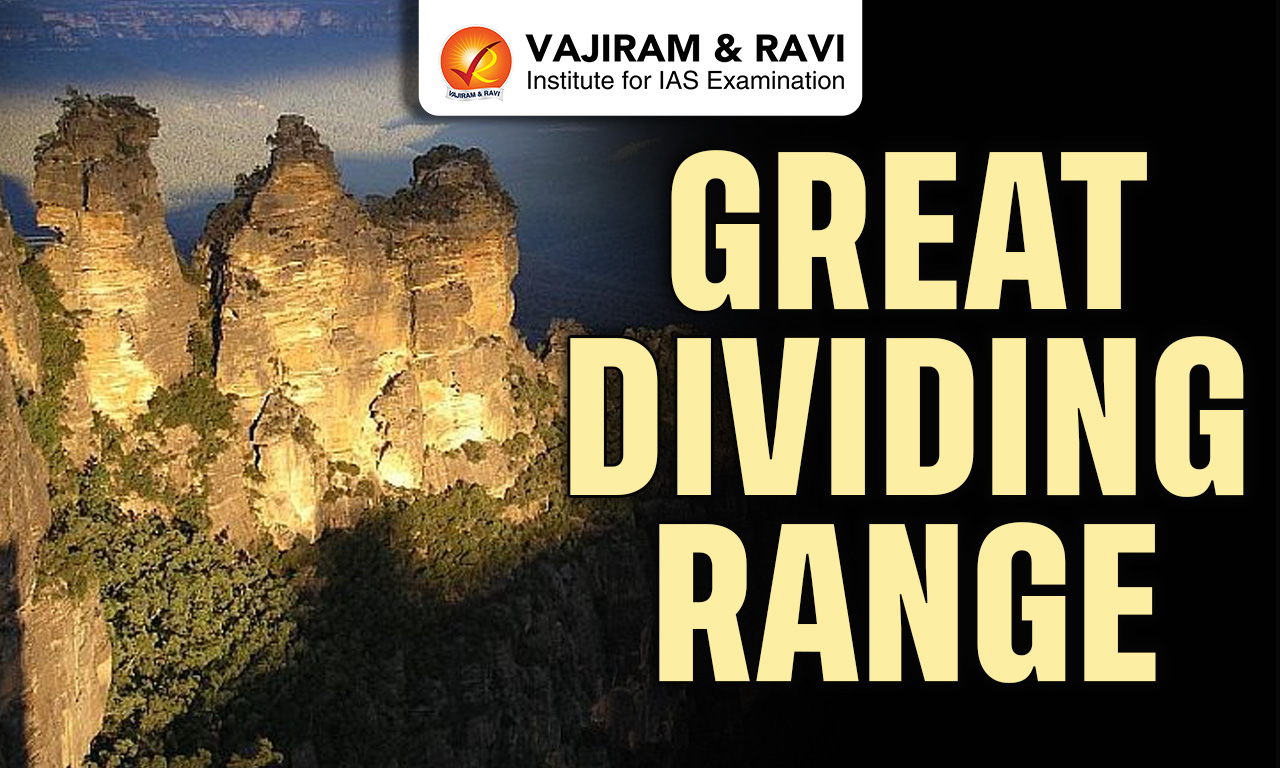
The Great Dividing Range is the principal watershed of eastern Australia and one of the world’s longest mountain chains extending over 3,500 kilometres. It runs parallel to the eastern coast through Queensland, New South Wales and Victoria and it consists of plateaus, hills and low mountains. It separates river systems flowing eastward to the Pacific Ocean from those draining inland, making it a defining physiographic and hydrological feature of the continent.
Great Dividing Range Features
The Great Dividing Range forms a vast and complex upland system with varied elevations, geology and hydrology across eastern Australia. The major features include:
- Extent and Location: The range stretches about 3,500 to 3,700 km from Cape York Peninsula in Queensland to the Grampians in Victoria, with widths ranging from 160 to 300 km along the eastern coastline.
- Physiography: It is not a single continuous range but a cordillera system comprising plateaus, escarpments, rolling hills and low mountain ranges formed through folding, faulting and long term erosion processes.
- Elevation Pattern: Average elevations range from 600 to 900 metres in Queensland to around 900 metres further south, while peaks exceed 2,000 metres in the Australian Alps region.
- Highest Peak: Mount Kosciuszko at 2,228 metres in the Snowy Mountains represents the highest point of the entire range and of mainland Australia.
- Major Subregions: Important sections include the Australian Alps, Blue Mountains, McPherson Range and Lamington Plateau, each with distinct topography and climatic conditions.
- Geological Composition: Rocks include sandstone, limestone, dolomite, quartzite and schist, reflecting a complex geological history involving tectonic uplift and erosion over millions of years.
- Watershed: The range forms the main drainage divide, with eastern rivers flowing into the Pacific Ocean and western rivers joining inland systems like the Murray-Darling Basin.
- River Systems: Major rivers originating here include Snowy, Murrumbidgee, Lachlan, Darling and Goulburn on the west and Burdekin, Hunter and Clarence flowing eastward.
- Water Resource Role: It supplies water to over 10 million people and feeds major irrigation and hydroelectric projects such as the Snowy Mountains Scheme and Upper Nepean Scheme.
- Landforms: The region includes tablelands like Atherton Tableland, valleys, canyons, waterfalls and fertile plains such as Darling Downs and Southern Highlands supporting agriculture.
Great Dividing Range Biodiversity
The Great Dividing Range supports diverse ecosystems ranging from tropical rainforests to alpine environments with rich flora and fauna.
- Vegetation Diversity: The range includes tropical rainforests in Queensland, eucalypt forests in central regions and alpine grasslands in the south, reflecting climatic and altitudinal variation.
- Faunal Diversity: The region hosts marsupials such as kangaroos, wallabies and koalas, along with birds like lyrebirds and reptiles adapted to varied climatic zones.
- Ecological Corridors: The range acts as a biological corridor enabling species migration between northern tropical and southern temperate ecosystems.
- Endemism: Many species are endemic due to geographical isolation and varied habitats, particularly in rainforest and alpine zones.
- Fire Adaptation: Vegetation such as eucalyptus forests is adapted to periodic bushfires, playing a key role in ecological regeneration.
- Biodiversity Hotspots: Areas like the Greater Blue Mountains and Lamington Plateau are recognized for high species richness and conservation value.


Great Dividing Range Significance
The Great Dividing Range plays a critical role in Australia’s economy, environment, culture and infrastructure systems.
- Agriculture: Fertile regions like Darling Downs and tablelands support grazing, mixed farming and fruit cultivation, making the range vital for agricultural productivity.
- Water Supply: It is the primary source of freshwater for eastern Australia, supporting irrigation, urban water supply and major river systems like the Murray-Darling Basin.
- Hydroelectric Projects: Rivers originating from the range power hydroelectric schemes such as the Snowy Mountains project, contributing significantly to energy generation.
- Mining Resources: The region supports mining of minerals and coal, contributing to regional economies and industrial development across New South Wales and Queensland.
- Tourism: National parks like Blue Mountains National Park attract tourists for scenic landscapes, waterfalls and recreational activities.
Great Dividing Range Conservation
Conservation efforts focus on protecting ecosystems, biodiversity and water resources through protected areas and environmental management.
- National Parks Network: Over 90 protected areas exist, including Kosciuszko National Park and Alpine National Park, safeguarding large sections of the range.
- World Heritage Areas: Sites such as Greater Blue Mountains and Gondwana Rainforests are recognized globally for ecological and evolutionary significance.
- Water Resource Management: Policies regulate river systems and groundwater recharge, particularly for the Great Artesian Basin and major irrigation schemes.
- Indigenous Participation: Indigenous communities are increasingly involved in land management and conservation using traditional ecological knowledge.
- Tourism Management: Sustainable tourism practices are promoted in national parks to minimize ecological damage while supporting local economies.

 Last updated on Sep, 2026
→ UPSC 2027 Notification will be released on 13 January 2027 at upsconline.nic.in.
→ Asian Games 2026 are being held in Aichi-Nagoya, Japan, from 19 September to 4 October.
→ Check out the latest UPSC Syllabus here.
→ Download UPSC Model Answers for Mains 2026
→ UPSC Mains Question Paper 2026 is out now for Essay & GS Paper 1, 2, 3 & 4.
→ UPSC Calendar 2027 has been released.
→ Enroll in Vajiram & Ravi’s UPSC Mains Test Series 2027 for structured answer writing practice, expert evaluation, and exam-oriented feedback.
→ Join Vajiram & Ravi’s UPSC Mentorship Program 2027 for personalized guidance, strategy planning, and one-to-one support from experienced mentors.
→ Go through the UPSC Mains Previous Year Papers to enhance your preparation.
→ UPSC has released UPSC Toppers List 2025 with the Civil Services final result on its official website.
→ Also check Best UPSC Coaching in India
Great Dividing Range FAQs
Q1. Where is the Great Dividing Range located?+
Q2. What is the length of the Great Dividing Range?+
Q3. Which is the highest peak in the Great Dividing Range?+
Q4. Why is the Great Dividing Range important for Australia?+
Q5. Which rivers originate from the Great Dividing Range?+
Tags: geography geography notes great dividing range