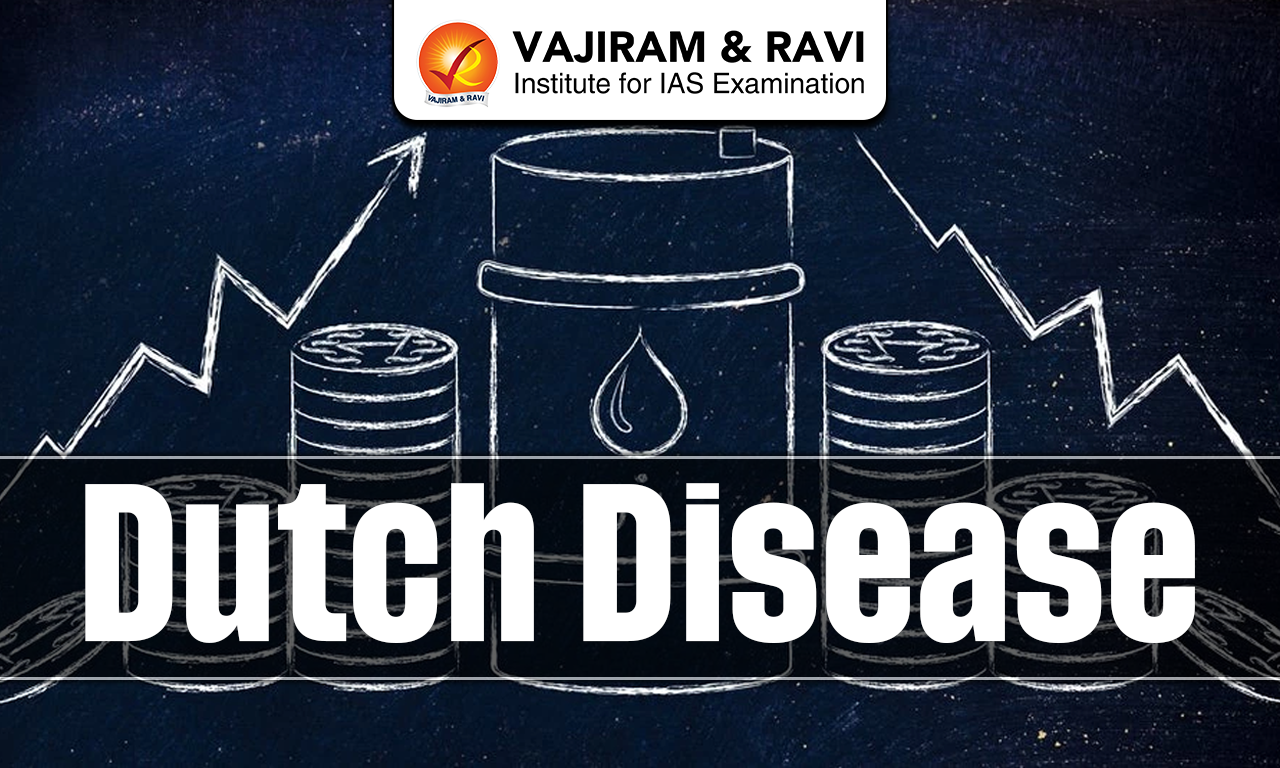
Dutch Disease is a situation where a country’s economy becomes unbalanced due to a sudden rise in income, often from natural resources. While this increase may seem beneficial, it can weaken other sectors of the economy. A rise in income can make a country’s goods more expensive for others, reducing exports from sectors like agriculture and manufacturing. Over time, this leads to overdependence on one source of income and reduces overall economic balance.
About Dutch Disease
- Meaning
- Dutch Disease is an economic problem that happens when a country discovers valuable natural resources like oil, gas, or minerals.
- As the country starts earning a lot of money from exporting these resources, one part of the economy grows very fast, while other sectors grow slowly or even decline.
- The large inflow of money makes the country’s currency stronger, which makes its other exports (like manufactured goods and agricultural products) more expensive in the global market.
- At the same time, imports become cheaper, so people and businesses prefer buying foreign goods instead of domestic ones.
- Main Economic Effects
- Reduced export competitiveness: Goods produced by industries like manufacturing become expensive for other countries. As a result, exports from these sectors decrease.
- Increase in imports: A stronger currency makes foreign goods cheaper. This leads to higher imports and lower demand for domestic products.
- Long-Term Effects
- Decline in manufacturing and agriculture: These sectors may shrink because they cannot compete globally.
- Unemployment: Jobs in industries like manufacturing may reduce as production shifts to cheaper countries.
- Overdependence on natural resources: The economy becomes too dependent on one sector, making it risky if resource prices fall.
- Regional inequality: Areas rich in resources may develop faster than others, creating imbalance within the country.
- Origin of the Term
- The concept was formally explained by economists Peter Neary and Max Corden in 1982.
- The term “Dutch Disease” was first used by The Economist in 1977.
- Impact of Gas Discovery on the Dutch Economy
- During the 1960s, the Netherlands discovered large natural gas reserves in the North Sea.
- Exporting this gas brought a significant increase in national income and caused the currency to strengthen.
- This led to challenges for other sectors:
- Non-gas products became more expensive in global markets.
- Exports from manufacturing lost competitiveness.
- The manufacturing sector declined, causing job losses and reduced investments.
- Over time, the economy became heavily reliant on gas, weakening other industrial areas.
- How to Control Dutch Disease
- Fiscal Policy (Government Spending): Governments should spend resource income carefully instead of overspending. Funds should be invested in education, infrastructure, and long-term development. Creating sovereign wealth funds (saving money for future use) can help reduce risks.
- Smart Spending Policies: Public spending should focus on improving productive sectors like manufacturing and agriculture. Encouraging private investment in industries can increase productivity and competitiveness. Supporting exports through subsidies or incentives can also help.
- Monetary Policy (Central Bank Actions): Central banks can control excess money supply to prevent currency from becoming too strong. Increasing reserve requirements or controlling credit can reduce inflation and currency appreciation.
- Economic Diversification: The country should develop multiple sectors instead of depending only on natural resources. Promoting industries like technology, services, and manufacturing can balance growth.


 Last updated on Oct, 2026
→ UPSC 2027 Notification will be released on 13 January 2027 at upsconline.nic.in.
→ Check Nobel Prize 2026 Winners List here.
→ Download PIB PRiSM Monthly Magazine 2026 here.
→ Check UPSC Monthly Current Affairs Magazine The Recitals here.
→ Check out the latest UPSC Syllabus here.
→ Download UPSC Model Answers for Mains 2026
→ UPSC Mains Question Paper 2026 is out now for Essay & GS Paper 1, 2, 3 & 4.
→ UPSC Calendar 2027 has been released.
→ Enroll in Vajiram & Ravi’s UPSC Mains Test Series 2027 for structured answer writing practice, expert evaluation, and exam-oriented feedback.
→ Join Vajiram & Ravi’s UPSC Mentorship Program 2027 for personalized guidance, strategy planning, and one-to-one support from experienced mentors.
→ Go through the UPSC Mains Previous Year Papers to enhance your preparation.
→ UPSC has released UPSC Toppers List 2025 with the Civil Services final result on its official website.
→ Also check Best UPSC Coaching in India
Dutch Disease FAQs
Q1. What is Dutch Disease?+
Q2. How does Dutch Disease affect exports and imports?+
Q3. What are the long-term effects of Dutch Disease?+
Q4. Where did the term “Dutch Disease” originate?+
Q5. What happened in the Netherlands due to gas discovery?+
Tags: dutch disease economy