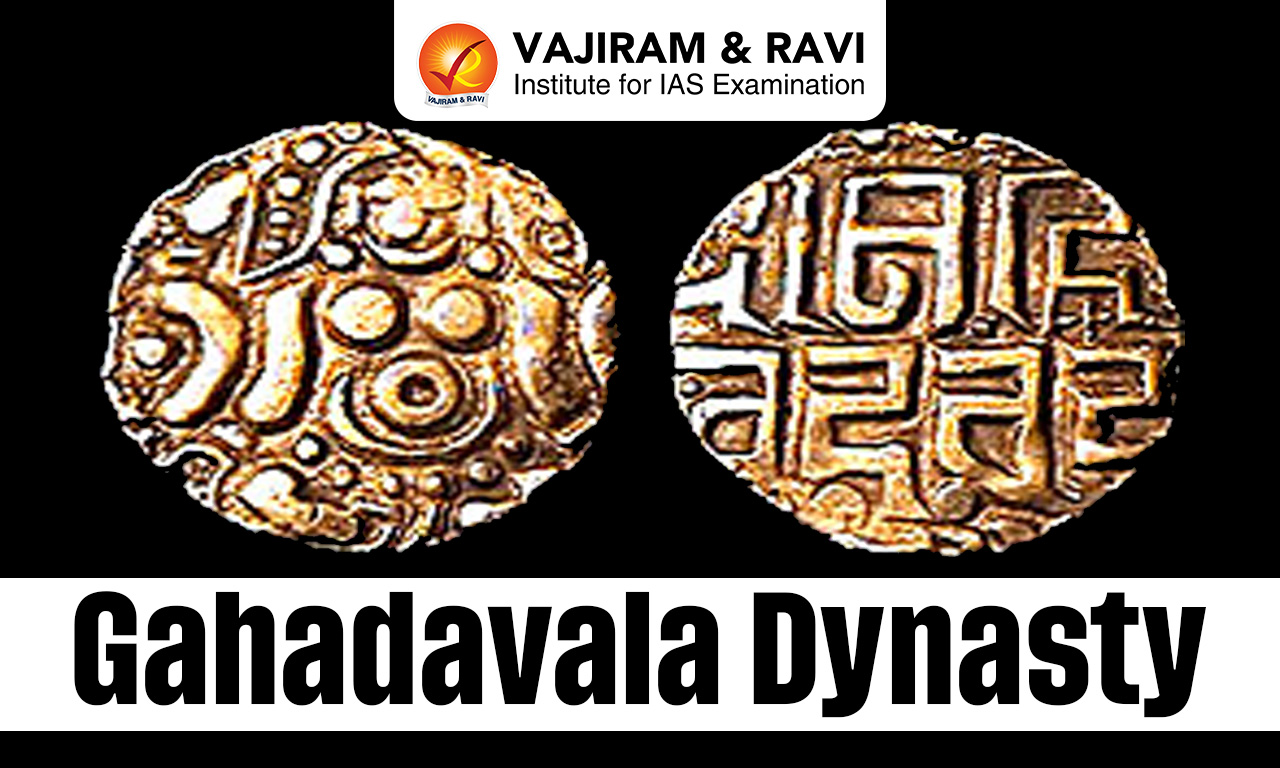
The Gahadavala Dynasty was an important ruling power of northern India between the late 11th century and mid 13th century. It emerged after the decline of major imperial powers and controlled regions like Varanasi, Ayodhya and Kannauj. The dynasty reflected features of early medieval polity such as feudal structure, Brahmanical influence and constant warfare. It played a crucial role in resisting external invasions but eventually declined due to internal weaknesses and foreign attacks.
Gahadavala Dynasty Historical Background
The Gahadavala Dynasty emerged in a politically unstable north India after the decline of Gurjara-Pratiharas and Kalachuris, gradually consolidating power in the Gangetic plains.
- Origin: The dynasty likely originated in Varanasi and Oudh region of present day Uttar Pradesh. Early records suggest their strong association with Varanasi, where most inscriptions were issued.
- Rise: Power was consolidated under Yashovigraha, Mahichandra and Chandradeva. Chandradeva (c. 1089-1103) established independence and expanded control over Varanasi, Ayodhya, Kannauj and nearby regions.
- Territorial expansion: The kingdom expanded across Uttar Pradesh and extended towards Delhi and eastern Bihar, including Patna and Munger, often at the expense of Kalachuris and other regional powers.
- Political environment: The dynasty operated in a fragmented polity marked by dynastic rivalries, alliances and feudal arrangements, lacking a strong central imperial authority.
- External threats: Continuous Muslim incursions, especially from the Ghaznavids and later Ghurids, shaped their military and diplomatic strategies, including alliances and tribute payments.
Gahadavala Dynasty Rulers
The Gahadavala Dynasty rulers played a key role in establishing, expanding and defending the kingdom, with some rulers achieving significant political and military success.
- Yashovigraha: Founder of the dynasty, he laid the foundation of power with strategic alliances and policies. He held titles like Maharaja Dhiraj and Parambhattark, focusing on stabilizing the kingdom.
- Mahichandra: Son of Yashovigraha, also known as Mahipala or Mahitala, he was comparatively weak and lacked strong administrative capabilities, ruling largely as a subordinate figure.
- Chandradeva: First independent ruler titled Parmeshwar, he expanded the kingdom by conquering Ayodhya, Varanasi and Kannauj and protected sacred regions like Kashi and Kosala from invasions.
- Madanpala: Ruled with assistance of a council and faced Ghaznavid attacks. He suppressed invasions and defeated Rampala of the Pala dynasty, though his health limited active governance.
- Govindachandra: Most powerful ruler who expanded the empire to Bihar and strengthened administration. He repelled Muslim attacks, promoted religion and maintained diplomatic relations with various powers.
- Vijayachandra: Faced increasing pressure from Muslim invasions and struggled to maintain control. His reign marked the beginning of decline due to weakened military and political authority.
- Jayachandra (Jaichand): Last major ruler who ruled Uttar Pradesh and Bihar but failed to unite with other Rajput powers. He was defeated and killed in the Battle of Chandawar (1194) by Muhammad of Ghori.
- Harishchandra: Successor of Jayachandra, ruled briefly with limited power as a vassal. The dynasty survived temporarily but eventually lost control due to continuous external invasions.


Gahadavala Dynasty Administration and Governance
The Gahadavala Dynasty administration reflected a feudal system with strong central authority supported by subordinate chiefs and officials managing different regions.
- Feudal structure: The kingdom was governed through semi independent feudatory chiefs holding titles like Raja and Maharaja, who maintained local control while acknowledging the king’s authority.
- Administrative officials: Key officials called Amatyas handled governance duties, including ministers, priests, commanders and treasurers, ensuring smooth functioning of administration.
- Territorial divisions: The kingdom was divided into units such as visaya (province), pathaka (sub province) and villages, facilitating efficient local administration and revenue collection.
- Role of royalty: Princes and heirs issued grants independently, while queens’ grants were announced by the king, indicating centralized control over royal decisions and limited autonomy of women.
- Legal and policy framework: Administrative functions and duties were described in texts like Kṛtya-Kalpataru by Lakshmidhara, reflecting structured governance and legal traditions.
Gahadavala Dynasty Economy
The economy under the Gahadavala Dynasty was primarily agrarian, supported by land grants, taxation and control over important trade and religious centers like Varanasi.
- Agrarian base: Agriculture formed the backbone of the economy, with fertile Gangetic plains supporting crop production and sustaining population and state revenue.
- Land grants system: Kings issued land grants to Brahmins and religious institutions, reinforcing Brahmanical ideology while also supporting education and religious activities.
- Taxation system: Taxes such as Turushka-danda were imposed, possibly to meet military expenses or deal with external threats, showing the financial burden of constant warfare.
- Trade and urban centers: Cities like Varanasi and Kannauj acted as important commercial hubs, facilitating trade in goods and contributing to economic prosperity.
- Tribute and diplomacy: Payment of tribute to invading forces like Ghaznavids was sometimes used as a strategy to maintain stability and avoid destruction.
Gahadavala Dynasty Art and Culture
The Gahadavala Dynasty contributed significantly to cultural development through temple building, literary works and patronage of scholars and intellectuals.
- Temple architecture: The rulers promoted construction and protection of temples in sacred cities like Varanasi and Sarnath, strengthening religious and cultural identity.
- Literary patronage: Govindachandra encouraged scholarly works, including Kṛtya-Kalpataru by Lakshmidhara, which became an important text on law and administration.
- Court poets: Vijayachandra patronized poets like Shriharsha, who composed Naishadha Charita, reflecting the literary excellence of the period.
- Eulogies and inscriptions: Works like Jaichand Prakash by Bhatta Kedar and inscriptions provided valuable historical and cultural information about rulers and society.
- Cultural synthesis: The dynasty supported both Hindu and Buddhist traditions, promoting intellectual growth and diverse cultural expressions across the kingdom.
Gahadavala Dynasty Society
The society under the Gahadavala Dynasty was deeply influenced by Brahmanical traditions, while also showing tolerance towards other religions like Buddhism.
- Brahmanical dominance: The rulers depended heavily on Brahmanical ideology, granting land and privileges to Brahmins, which reinforced social hierarchy and religious authority.
- Hindu religious practices: Kings worshipped Vishnu, Shiva and Surya and were often titled Parama-Maheshvara, indicating strong devotion to Hindu deities.
- Religious tolerance: Despite Hindu dominance, Buddhism was also supported. Queens like Kumaradevi and Vasantadevi were Buddhists and monasteries were constructed.
- Social structure: Society followed a hierarchical system based on caste, with Brahmins enjoying high status due to royal patronage and religious importance.
- Cultural life: Religious rituals, temple activities and scholarly pursuits shaped daily life, making religion a central element of social organization.
Gahadavala Dynasty Decline
The decline of the Gahadavala Dynasty resulted from internal weaknesses, feudal fragmentation and continuous external invasions, especially by the Ghurids.
- Internal weaknesses: The feudal structure weakened central authority, making the kingdom vulnerable to rebellion and reducing its ability to respond effectively to invasions.
- Military challenges: Repeated invasions by Ghaznavids and Ghurids strained resources and exposed the limitations of their defensive strategies.
- Battle of Chandawar (1194): Jayachandra was defeated and killed by Muhammad of Ghor, marking a decisive blow to the dynasty’s power in northern India.
- Loss of territories: After Jayachandra’s death, key regions like Varanasi and Kannauj were gradually captured and local chiefs shifted allegiance to new rulers.
- Final phase: The dynasty lingered under Harishchandra and later Adakkamalla, but eventually disappeared by the mid 13th century after retreating to central India.

 Last updated on Oct, 2026
→ UPSC 2027 Notification will be released on 13 January 2027 at upsconline.nic.in.
→ Check Nobel Prize 2026 Winners List here.
→ Download PIB PRiSM Monthly Magazine 2026 here.
→ Check UPSC Monthly Current Affairs Magazine The Recitals here.
→ Check out the latest UPSC Syllabus here.
→ Download UPSC Model Answers for Mains 2026
→ UPSC Mains Question Paper 2026 is out now for Essay & GS Paper 1, 2, 3 & 4.
→ UPSC Calendar 2027 has been released.
→ Enroll in Vajiram & Ravi’s UPSC Mains Test Series 2027 for structured answer writing practice, expert evaluation, and exam-oriented feedback.
→ Join Vajiram & Ravi’s UPSC Mentorship Program 2027 for personalized guidance, strategy planning, and one-to-one support from experienced mentors.
→ Go through the UPSC Mains Previous Year Papers to enhance your preparation.
→ UPSC has released UPSC Toppers List 2025 with the Civil Services final result on its official website.
→ Also check Best UPSC Coaching in India
Gahadavala Dynasty FAQs
Q1. Who founded the Gahadavala Dynasty?+
Q2. Which ruler brought the Gahadavala Dynasty to its peak?+
Q3. What were the main regions ruled by the Gahadavala Dynasty?+
Q4. Why did the Gahadavala Dynasty decline?+
Q5. What was the religious policy of the Gahadavala Dynasty?+
Tags: gahadavala dynasty geography geography notes